This blog, combined with The Cottonwood Post, my other blog more focused on birds, climate change, and other environmental issues, will be slowly moving to my new Substack. It offers more options for the reader and is easier to manage from my end. Everything will be free, always.
If you are subscribed here, I’ve transferred your subscription over to the Substack. This means you’ll get an email every time I post (about once a week).
At the Substack, I will be re-posting some of the posts from here, updated with new information as warranted.
I will maintain this blog for the time being, though new material will probably be at the Substack. We’ll see how this works out.
Below is a collection of quotes, mostly from politicians and newspapers, calling for or describing the genocide of Native Americans, from 1832 to 1891. That word didn’t evolve until the Holocaust. In the 1800s, the word was simply “extermination.”
The ghost village memorial at Big Hole National Battlefield, Montana.
On a timeline of US history, this collection of quotes follows an era that was dominated by calls for mass deportation and ethnic cleansing, most notably from Thomas Jefferson as early as the 1700s. This policy was codified in the Indian Removal Act of 1830. Just two years later, beginning with William Clark (of the Lewis & Clark Expedition), white policy began sliding down the slippery slope, with calls for “extermination.”
White Americans sometimes hesitate to use the word genocide with regard to Native Americans. Natives don’t hesitate. But our memories are better. We know our history well. No, we didn’t die mostly from diseases. When plagues did spread, it was nearly always during times of war and ethnic cleansing. These things were entwined.
In chronological order:
“… we are now involved with blood thirsty and ferocious savages. The faithless and treacherous character of those at the head of our Indian enemies appears now to be so well known… a War of Extermination should be waged against them.” – William Clark, Superintendent of Indian Affairs, 1832, letter to Secretary of War Lewis Cass
“[They] deserve to be exterminated as savage and pernicious beasts.” – Chief Justice John Catron, Tennessee Supreme Court, 1835, ruling in State v. Foreman
“The country can be rid of them only by exterminating them.” – General Thomas S. Jesup, Florida, 1836
“If the wild cannibals of the woods will not desist from their massacres, if they will continue to war upon us with the ferocity of tigers and hyenas, it is time that we should retaliate their warfare. Not in the murder of their women and children, but in the prosecution of an exterminating war upon their warriors; which will admit of no compromise and have no termination except in their total extinction or total expulsion.” – President Mirabeau Lamar, Republic of Texas, 1838
“They will continue to rob and murder our citizens until they are exterminated.” – Colonel George McGill, New Mexico, 1849
“The shrieks of the slaughtered victims died away, the roar of muskets that ceased, and stretched lifeless upon the sod of their native valley were the bleeding bodies of these Indians — nor sex, nor age was spared; it was the order of extermination fearfully obeyed.” – Daily Alta California, 1850
“The savage Indians… must be exterminated.” – Governor James Calhoun, Santa Fe, New Mexico, 1851
“That a war of extermination will continue to be waged between the two races until the Indian race becomes extinct, must be expected.” – Governor Peter Burnett, Annual Message to the Legislature, California, 1851
“[The Indians] will be exterminated before the onward march of the white man. The interest of the white man demands their extinction.” – US Senator John Weller, California, 1852
“[The fight against the Indians should] go on towards extermination, as there is no safety in trusting such treacherous devils anywhere.” – Yreka Herald, 1854
“[The white settlers] assembled in armed bodies with the avowed purpose of ‘exterminating’ this miserable and inoffending people.” – Assistant Surgeon F. Sorrel, acting commander of Fort Jones, California, 1855
“A war of extermination has been declared against the Cascouse Creek, Bear River, Eel River and other neighboring Indians. Some twenty to thirty armed men are said to have been busily occupied during several months past in killing Indians South and East of the Mattole.” – J. Ross Browne, Treasury Department, San Francisco, California, 1858
“The initial steps have been taken, and it is safe to assert that the extinction of the tribes who have been to settlers such a cause of dread and loss, will be the result.” – Shasta Herald, 1861
“[The white settlers] are determined to drive off or exterminate the Indians.” – Marysville Appeal, 1862
“Exterminate or banish!” – white settlers, regarding the Santee Dakota, Minnesota, 1863
“It is becoming evident that extermination of the red devils will have to be resorted to before the people… will be safe.” – Red Bluff Independent, 1863
“We feel convinced that there is but one course to be pursued towards these treacherous red skins. We have long since thought they should be collected together and removed to some remote district of country, away from settlements, or to an island in the sea…” – Mendocino Herald, 1864
“Self preservation demands decisive action, and the only way to secure it is through a few months of active extermination against the red devils.” – Rocky Mountain News, 1864
“Exterminate them! Exterminate them! Exterminate them!” – crowd at the Denver Opera House, 1865
“Let the Navajos know that large parties of citizens are in pursuit of the Navajos who would not come in from their old country. Many of the latter have already been killed. Their crops will be destroyed and they will be exterminated unless they come in.” – General James H. Carleton, New Mexico, 1865
“They ought to be all killed off. There is no better way to get rid of them.” – Texas settler, 1866
“It is a mercy to the red devils to exterminate them, and a saving of many white lives. Treaties are played out—there is only one kind of treaty that is effective—cold lead.” – Chico Courant, 1866
“We must act with vindictive earnestness against the Sioux, even to their extermination, men, women, and children.” – letter from General William Sherman to President Ulysses Grant, 1866
“The Pioneer has before declared that our only safety depends upon the total extermination of the Indians. Having wronged them for centuries, we had better, in order to protect our civilization, follow it up by one more wrong and wipe these untamed and untamable creatures from the face of the earth.” – L. Frank Baum in the Aberdeen Saturday Pioneer, 1891
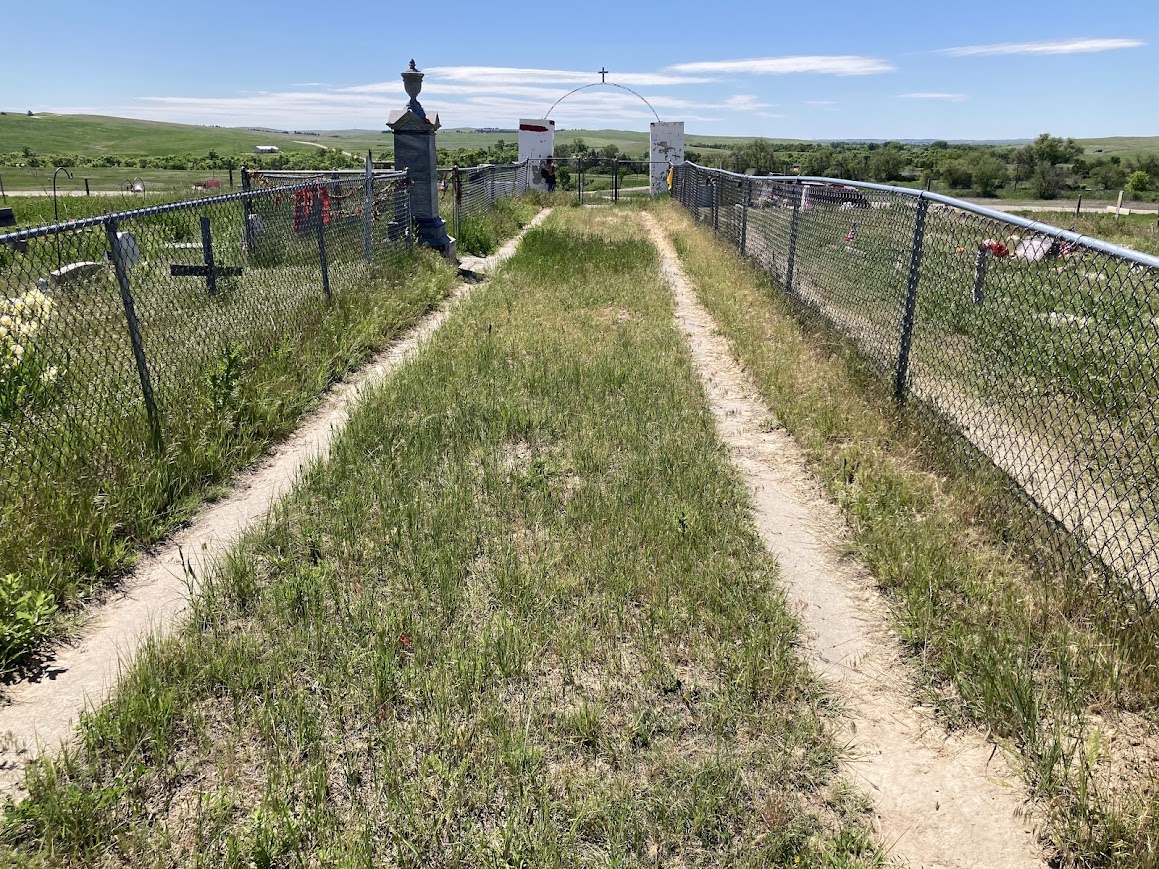
The outlines of the mass grave trench at Wounded Knee.
Nicolas Mirzoeff’s essay, The Whiteness of Birds, brought my attention to this painting.
There are layers here that probably tell us more about people than the about the ecology of the bird – about white history, white nature, white autonomy, even white ornithology – an invisible thread of slavery and ethnic cleansing.
The painting, of course, is by John James Audubon.
The bird is now known as the Snowy Egret. Its scientific name is still Egretta thula. “Thula” comes from the Araucano word for Black-necked Swan. It was applied to the egret in error, as happened with several Indigenous words for birds. It won’t be corrected – those are the rules.
In the background of Audubon’s painting is Rice Hope Plantation, near Moncks Corner, South Carolina. Audubon painted this in 1832, when enslaved people would have been working on 371 acres of rice and indigo under cultivation. They are not pictured. Not one.
Audubon is pictured, the small figure in the lower right, a white man with a gun.
The Rice Hope Plantation House.
Audubon would have been intimately familiar with slavery. He was born on a slave plantation in Haiti. As the owner’s son. By all accounts, he was surrounded by mixed-race siblings. His own mother was a French chambermaid, though she died shortly after his birth.
With a slave revolt brewing, his father took him and fled to France when he was just three. By the time Audubon was 19, in 1804, the Haitian Revolution was complete. For the only time in modern history – perhaps all history – a nation was created by a slave revolt. Audubon was then in the US. At that time there were only two independent nations in all of the Americas, and Audubon had lived in both. But the US did not recognize Haiti’s independence until after the Civil War.
Again, any mention of slavery remains elusive.
Twelve years before Audubon was born on a slave plantation, John Houstoun McIntosh was born at the Rice Hope Plantation. He grew up to serve as a general in the ethnic cleansing of the Seminole from Florida. The Seminole were not the first Natives to live in Florida. Originally, there were dozens of other tribes, mostly wiped out by English slavers in the early 1700s. There were sent up to Charleston and then off to plantations in the Caribbean. Enslaved Natives went out; enslaved Africans came in. When the Seminoles came in the early 1800s, they were refugees filling a vacuum. They were Red Stick Creeks (aka Mvskoke or Muscogee), allied with escaped Black slaves, fleeing Andrew Jackson.
In 1832, when Audubon painted the egret, the Indian Removal Act had just been passed. The US was allocating enormous resources to ethnically cleanse everything from Georgia to the Mississippi River. Lumber was being purchased, stockades were being built, wagons were being lined up. At the same time, other plans were under way. Money was invested, land was cleared, and slave quarters were constructed. By 1840, the Black Belt was opened to cotton farming and thousands of enslaved people were sold south from Virginia.
Today, Rice Hope Plantation is called Rice Hope Plantation Bed & Breakfast. According to a 5-star Yelp review, it has “tons of history.” Like the painting and the historical markers, there is no direct mention of slavery.
This photo features the plantation grave yard – of marked graves. If there is a graveyard of unmarked graves on the property, it is not mentioned.
The existence of slavery has been so thoroughly erased that the name, Rice Hope Plantation, can now be used freely.
The Facebook page for the Rice Hope Plantation housing development.
A few hours south, near Savannah, Georgia, there is a housing development called Rice Hope Plantation. According to their website, it is “a community jam-packed with resort style amenities such as a swimming pools, a lazy river, slide, splash pad, clubhouse with fitness center, lake for kayaking, playground and so much more.” It practically goes without saying, there is no mention of slavery.
Community services at the Rice Hope Plantation housing development near Savannah, Georgia.
Today, you can go online and buy prints of the painting for $500. The websites will tell you it is an Audubon print, it is a Snowy Egret, and Rice Hope Plantation is in the background. They may tell you that the print pairs nicely with his paintings of other herons. They will not mention the enslaved.
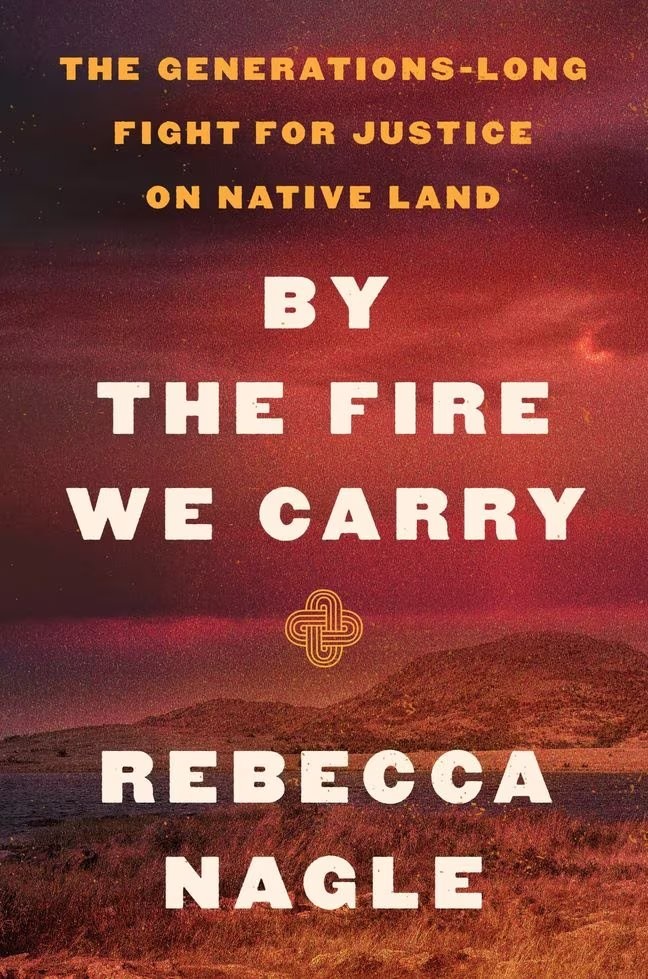
Like Rebecca Nagle, I remember that Monday morning in July, 2020, glued to my laptop, waiting for news from SCOTUSblog. My first indication of the McGirt decision was a tweet from Nagle exclaiming that Gorsuch authored the decision. That was enough to tell us we won. His opening line remains etched in our minds, “On the far end of the Trail of Tears was a promise.” Against all expectation, the Supreme Court had affirmed the Creek (Mvskoke) reservation and, by extension, the reservations of the Cherokee and many others.
But Nagle’s book, By the Fire We Carry: The Generations-long Fight for Justice on Native Land, is about much more than the McGirt decision. It’s a tour de force, weaving together personal and family memoir, a murder case, and Native history that demonstrates that the present is a loud echo of the past, diminished only by Native resistance and occasional victories such as the McGirt ruling. She casts McGirt not so much as a victory, however, but as a rare instance when existing law supporting tribes was actually honored and upheld by the US government.
Her deep dives into history may seem like rabbit-holes to those who have been denied such history, but are a comprehensive analysis of stories we know well in Indian Country. Her book is an opportunity to un-erase the past in order to understand the present. This is history about Natives by a Native. She tells our stories, and she tells them well and boldly.
Her review of the Indian Removal Act includes not only the saga of the Trail of Tears, but the far-reaching political significance at the time. It was the central issue in the 1832 presidential election, pitting Northern liberals against Southern conservatives. The project involved the commitment of a third of the federal budget. Once implemented, it generated immense wealth for Southern planters, who paved the ethnically-cleansed lands with large slave plantations. As a result of Indian removal, an estimated one-third of Black slave children in Virginia were separated from their mothers and shipped further south to new plantations.
A direct descendant of Major Ridge of the Treaty Party, Nagle describes their betrayal of the Cherokee leadership and their personal sacrifice in no uncertain terms, bringing as much resolution to this long-standing schism as anything I’ve ever seen. She also does well to embrace the tribal claims of Freedmen. (Thank you, Rebecca. My family comes from the other side of Honey Creek, just six miles away from your family cemetery. Like so many Cherokees, they include scores from both sides of the Cherokee Civil War).
Nagle doesn’t stop in the 1800s. She spends considerable time detailing the plunder of Indian Country after the Allotment Act. She casts Oklahoma as a state primarily founded to steal wealth and land – and oil – from Natives. The criminal graft depicted in Killers of the Flower Moon was not unique to the Osage. Through the lens of Millie Narharkey – a Mvskoke child abducted, swindled, raped, cheated, and swindled again – Nagle describes the plunder of Natives by a network of cowboys, oil men, fiduciary trustees, lawyers, policemen, judges, and politicians, all finding ways to exonerate white criminals. Just like what Georgia did in the 1830s, which led Major Ridge to embrace removal in the first place.
Nagle also details Supreme Court decisions in recent decades, which have served to strip Native nations of their sovereignty. In contrast to the hyperbole of Oklahoma lawyers after McGirt, these other decisions really did lead to increased crime, only the victims were Native. SCOTUS thus appears as just another enabler of robber barons, like the other white men who’ve sought to exempt Natives from legal protections and create the paperwork required for exploitation. If SCOTUS is concerned about “lawless reservations,” they need look no further than a mirror.
McGirt was a 5-4 decision. The other side argued that, because the US and Oklahoma had broken the treaty so many times, it was null and void. Using the example of Ruth Bader Ginsburg, Nagle illustrates something most Native activists have experienced: the unreliability of white liberal allies. In the mixed-up world of white colonizers, Gorsuch is a Native ally, while RBG was an uncertain swing vote. The only thing sure is that they don’t really understand us or know our history. In that context, she paints a picture of a world in which 5-4 decisions by strangers affect our lives in profound ways they will never know. She describes the loss of language and culture associated with boarding schools. In the face of such challenges, the only thing that sustains us is the desire to sustain ourselves.
Rebecca Nagle with her fact-checker Wudan Yan. Seattle. Nov 13, 2024.
In reviewing the backlash to McGirt and the following Castro-Huerta decision of 2022, she excoriates Governor Stitt and the Oklahoma lawyers for conjuring up false data about freed criminals. They spread that misinformation to TheWashington Post and Wall Street Journal, who regurgitated the racist trope of “complete, dysfunctional chaos” and “criminal anarchy in tribal areas.” The Oklahoma team than stood before SCOTUS, pointing to the so-called journalism as evidence. Nagle makes the case that Oklahoma committed willful perjury before the high court, and, as so often in history, it was exactly what SCOTUS was looking for. She also highlights her own small role in the case – her article in The Atlantic countering the falsified numbers. Her article was cited by the Mvskoke attorneys during the trial. Regarding Stitt, she goes further than current Cherokee Nation Principal Chief Chuck Hoskin Jr., sharing the stories of Stitt’s family – that they faked their Cherokee ancestry to gain thousands of acres of allotments.
Of all the stories Nagle tells that connect the past to the present, none are more evocative than the fire for which the book is named. As is so common in Indian law, the issue at hand – tribal jurisdiction and the mere existence of a reservation – came to the courts via a completely unrelated route. In this case, a murder. The critical question was: Did the crime occur in Indian Country, as defined by law? One of the legal criteria for Native land included the continued presence of Natives and Native customs. Just a few miles from the crime scene is a traditional Mvskoke ceremonial ground – a stomping ground. It is marked by a perpetual fire, carried to that location on the Trail of Tears. That fire has never gone out.
My essay, published Oct 9, 2024 by Native News Online, dives into the long tradition of women in social and political leadership roles in Indigenous societies, from time immemorial to the present.
It can be found at the hyperlink above.
Performance art mimicking the matriarchal oversight of male leaders. From the INDECLINE art collective, feat. Court Axe.
Last week I saw one of the largest mass burial sites in the United States. It is unmarked.
Dry Valley Rd between Charleston, Tennessee (Tenasi), and Rattlesnake Spring. This is where nearly two-thousand Cherokees, most of them children, died in the summer of 1838, under the care of the US Army.
The location is the fields among the rolling hills and gentle pastures just south of Charleston, Tennessee. This is where 9,032 Cherokees were forced to encamp in preparation for “Indian Removal” – the official name for the US government’s policy of ethnic cleansing in the 1830s.
Replica of a typical middle-class Cherokee home during the time of Removal. These were highly coveted by Georgia pioneers.
Backstory
For the Cherokees, the Trail of Tears began suddenly, on May 26, 1838, when General Winfield Scott ordered his soldiers to begin going door to door, house to house, farm to farm, cabin to cabin, rounding up 16,000 people at gunpoint and marching them to stockades hastily built across portions of Alabama, Georgia, Tennessee, and North Carolina. The majority of Scott’s men, 5,180 out of 7,380 (70%) were from local militias with a vested interest in pillaging Cherokee property. As such, they gave people little time to gather possessions or even a spare change of clothes.
Among white Americans, the Indian Removal Act had been extremely controversial when it passed Congress by a few votes in 1830. During the presidential election of 1828, mass deportation was one of the top issues. Ironically, the margin of victory came from the extra votes that southern states had in the House of Representatives because their Black slaves counted as 3/5ths of a person. The ethnic cleansing of Native Americans then paved the way for a massive increase in slave plantations across the Black Belt of the South. The US Constitution thus created a system in which Black representation was used against them.
Sign at the 2024 Republican National Convention. In nearly 200 years, the doctrine of white supremacy – that the US is a country by whites for whites – has hardly changed. In 1838, most of the Cherokees at the concentration camps were marched there from their homes in northern Georgia, from a place that is now Marjorie Taylor Greene’s district.
Eight years into the project, Indian removal was still controversial. Scott, one of the top generals in the US Army, was only in charge of the Cherokee removal because his underling, General John Ellis Wool, asked to be relieved of the duty. Wool even threatened to resign his commission. Likewise, Brigadier General R. Dunlap threatened to resign. Like many in the area, he was personally acquainted with many Cherokees.
The Concentration Camp
From the start, plans went awry. The first three detachments of Cherokees, each with about a thousand people, departed from Ross’s Landing (Chattanooga) on flatboats down the Tennessee River. But the summer was hot and dry and the river was low. The boats floundered and people began to die.
At this point, the Cherokee government intervened and asked General Scott if the operation could be delayed, and if the Cherokees could supervise their own ethnic cleansing, waiting until fall when the weather was cooler and rains enabled ferries to cross the rivers.
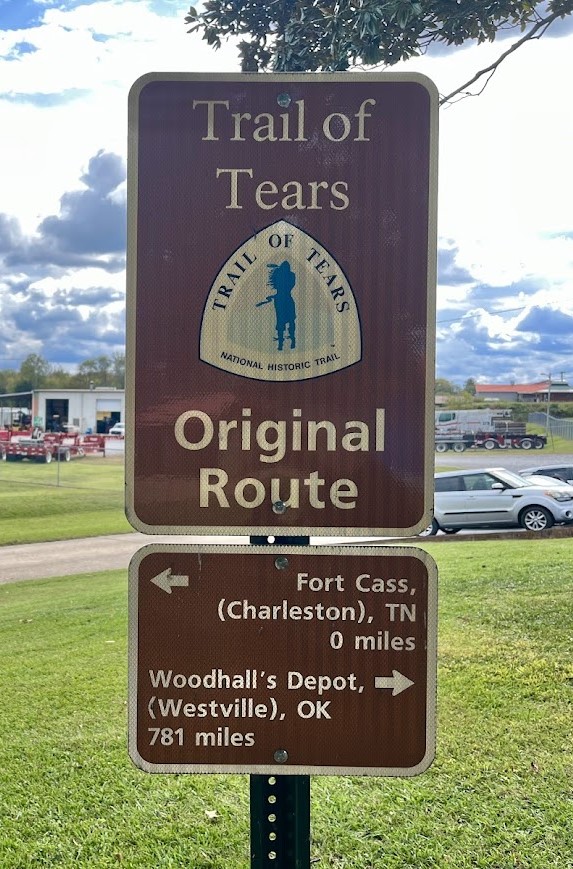
Scott consented and moved most of the rest of the Cherokees to Fort Cass at the Cherokee Agency (now Charleston, TN) along the Hiwassee River, the border between Cherokee Nation and the United States. From here, they could cross the Tennessee River at Blythe’s Ferry and take an overland route to Indian Territory (Oklahoma). The expenses were tracked and reimbursed, making it one of the most well-documented genocides in history. We have the invoices and receipts.
With a long, hot summer of waiting ahead of him, Scott wanted to “parole” the Cherokees, to send them back to their homes with a promise to return. But this was no longer an option. Across Cherokee Nation, white settlers had already moved into their homes and cabins, taking over barns and livestock, furniture, household goods, and even bedding and clothing left behind. Furthermore, the state of Georgia promised to hang any Cherokees found within their borders.
And so the majority of the Cherokees – 9,000 out of 16,000 – ended up at Fort Cass, stuck in the encampments on the south side of the Hiwassee River. This included many mixed families with white fathers. Measles, dysentery, and whooping cough began to spread through the camps “to a great and deplorably fatal extent,” to quote Captain John Page of the US Army.
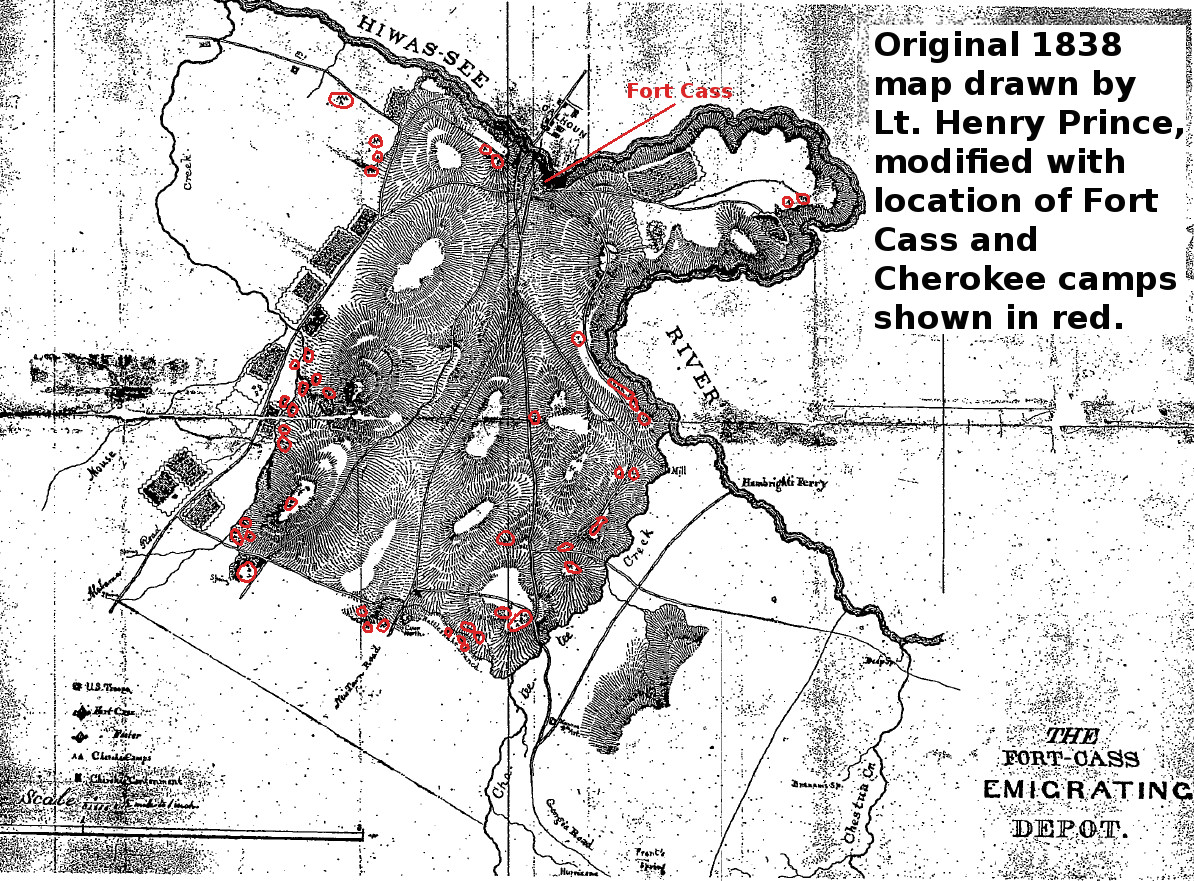
Fort Cass and the Cherokee concentration camps. Charleston, TN now occupies the northern section along the river. The fort property spanned 12 square miles. Archeological research shows the locations of likely encampments (in red). The exact sites of the burials are unknown.
Missionary Elizur Butler estimated 2,000 people died in the camps that summer. Subtracting the number that was counted in the camps (14,870) from the number that eventually departed on the various detachments that fall (13,111), 1,759 are missing. Those are the presumed dead.
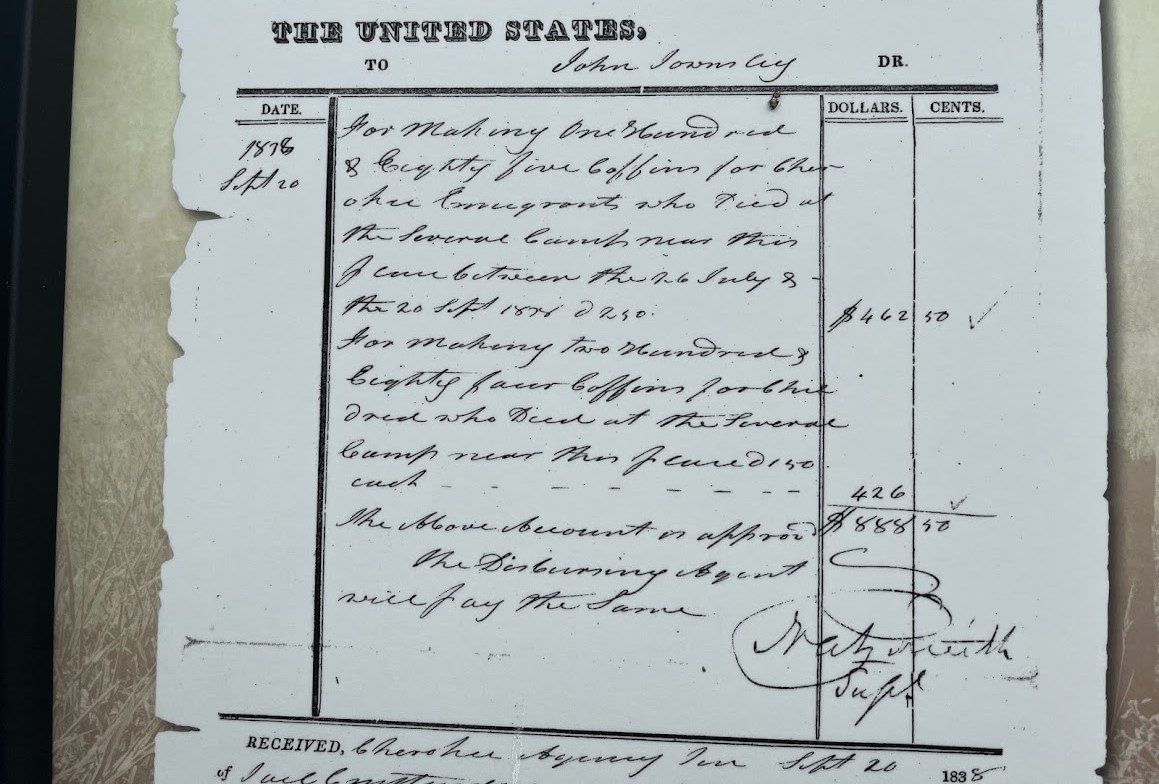
We know a disproportionate share of the dead were children. This US Army invoice, covering a 57-day period, was for lumber “for making 185 coffins for Cherokee emigrants who died near this fort between 26 July and 20 Sept 1838… and 284 coffins for children…” Others were probably buried before the coffins were available.
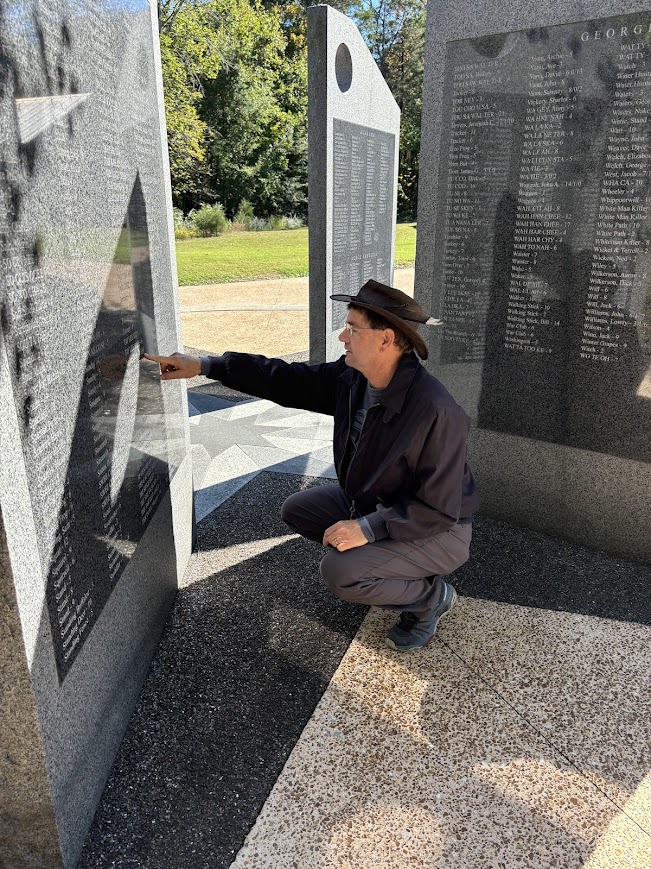
Me at the Cherokee Removal Memorial at Blythe’s Ferry. I was reminded of my visit to the Gate of No Return at Cape Coast Castle in Ghana, and a similar site in Ouidah, Benin, only this one had my ancestors’ names on the monument. I’m pointing to Dick Taylor (Richard Fox Taylor), my 3x great uncle. He led the 11th detachment across the Tennessee River not far from this point.
For me, this was a home-going trip. I was in this area for the annual Trail of Tears Association conference. Over 200 of us attended, half of us Cherokees, seeking to connect with each other and learn details of our ancestors. It was my first time to visit the Cherokee homeland. In fact, I think I may have been the first to return since the Trail of Tears. I’m pretty sure that neither my father nor my grandparents, all born in Oklahoma/Indian Territory, ever made the journey.
The other half of us seemed to be allies, mostly academic researchers and dedicated government agency staff, seeking to tell our story to the public. We saw some new memorials, monuments, signs, and displays educating the public. They were generally well done.
As we drove toward the Hiwassee River Heritage Center in Charleston, the locations of the camps were pointed out. We couldn’t stop – it was a narrow county road with no shoulder. And there were no signs telling us what was there. All we saw were open pastures and rolling hills. I asked Jack Baker, Cherokee historian and the guide for our trip, about those hundreds of coffins on the invoice and the thousands of deaths in the camps. “Where were they all buried?” “Out there,” he said, with a wave of his arm, “they couldn’t take them with them.”
Honestly, I never expected to be standing at a mass burial site. I never realized that approximately half the deaths associated with the Cherokee Trail of Tears happened at one place – in these fields – before the main journey had even begun.
Mass graves in the US
Nearly all of the graves are likely on private land, mostly pasture or corn fields with scattered homes. Some of the landowners have been there seven generations, dating back to 1850. There are communications with some of them, who have voiced a desire to leave the graves undisturbed, but there are no laws to ensure that. The Native American Graves and Repatriation Act (NAGPRA) only applies to federal land. Though it would surely qualify, National Historic Landmark designation requires the landowners’ consent. Legally, there is nothing to stop them from plowing up the remains. Talking with Cherokees involved with protecting such sites, they said the path of least resistance is often to talk with the landowners and arrange for a land trust organization to acquire the land or purchase an easement protecting the sites.
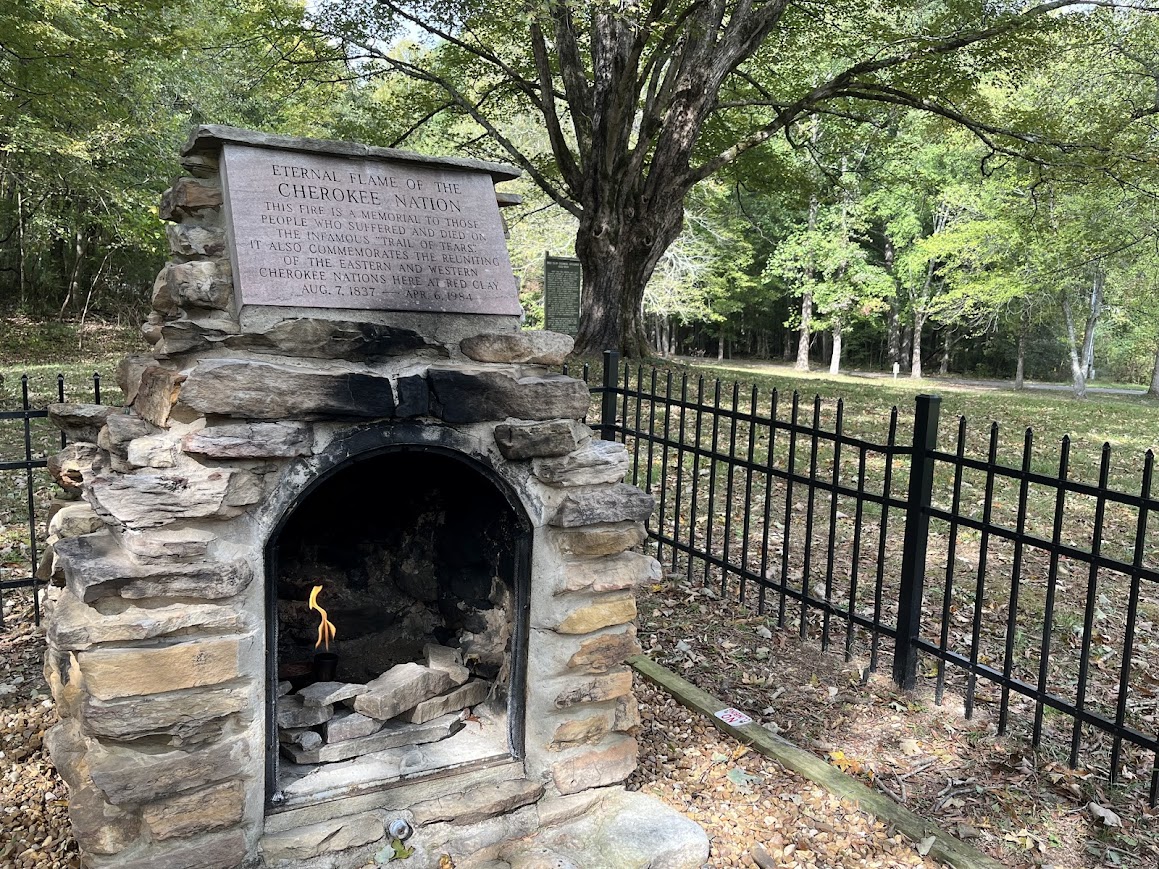
The Cherokee eternal flame at Red Clay. This fire was carried on the Trail of Tears in 1838, and then brought back to this spot on the Tennessee/Georgia border, in the original Cherokee Nation, years later, re-united with the fire of the Eastern Cherokees still living in North Carolina.
This issue is not unique to this site. Across Indian Country, from Sand Creek to Camp Grant to Whitestone Hill, only portions of the resting places of our ancestors are protected. Others, such as Wounded Knee, Bear River, and Mystic, have been acquired by the affected tribes.
At Fort Cass, we don’t even know the exact locations of the burial sites. This is not unusual. Finding them requires ground-penetrating radar surveys. That’s a slow process. Just surveying an area the size of a basketball court takes hours. Such work also requires funding. And it also requires permission of the landowners.
This all contrasts strongly with white gravesites. At St. Clair’s Defeat in 1791, when hundreds of US soldiers were killed by a pan-tribal alliance, the dead were found and re-interred within a few years. A huge monument in the town of Fort Recovery, Ohio, honors them. Likewise, at the Battle of Little Bighorn, aka Custer’s Last Stand and Greasy Grass, white bodies are considered sacred. A federal site protected by the National Park Service, the battlefield has been subject to an immense amount of research and study to identify the precise locations where each and every US solider fell.
But Black and brown bodies lie scattered and often without any legal protection. During our site visits, local white hosts often referred to “the tragic events of 1838.” But all these land acknowledgements and vague ethnic cleansing acknowledgements only go so far. They have a clear stopping point. We found that stopping point. Landback is not included. Legal protection for one of the largest mass graves in the nation is not included. And even the ability to look for the graves is not included. They remain out there, somewhere beyond that arm wave, vulnerable to backhoes and excavators, at risk of being erased by a parking lot or a housing development.
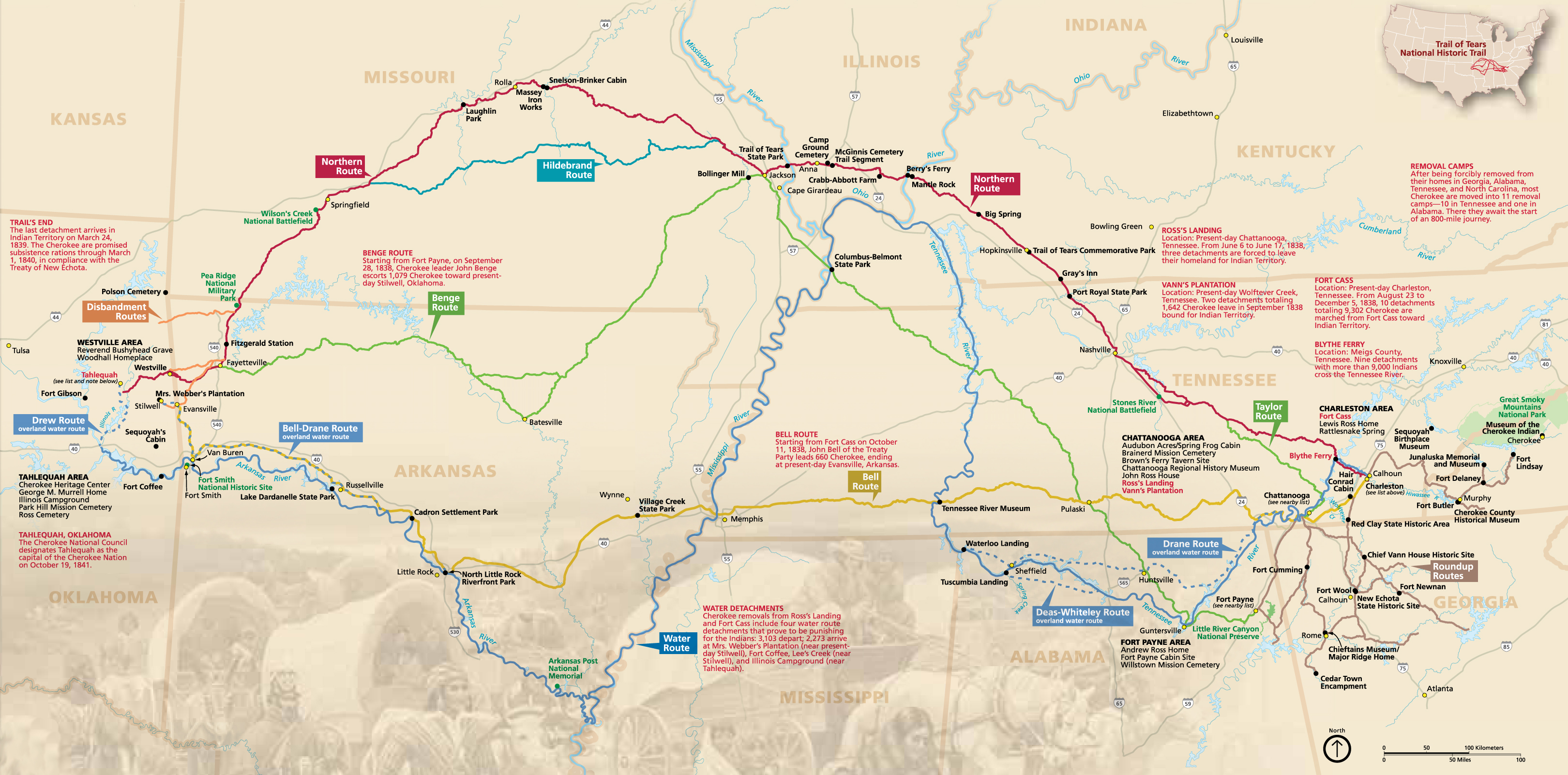
For each family, the Trail of Tears started at their home. From there, they were marched to stockades, dozens of which were constructed by the US Army across Cherokee Nation. After that, the majority were concentrated at Fort Cass, between today’s Charleston and Cleveland, TN, just northeast of Chattanooga. About half the deaths on the Trail of Tears occurred in the concentration camp at Fort Cass. Map courtesy of the National Park Service.
The 100-million-year story of the Black Belt, a crescent-shaped swath from Virginia to Louisiana, has been told many times – how a geological formation from the Cretaceous, visible today in the dark soils it created, can be seen in the patterns of human history, where Southern slave plantations were concentrated and where cotton was produced.
Today, that same crescent marks concentrations of Black people, voting patterns, and even where insurance companies rip people off. The term “Black Belt” reflects its diverse implications. It was first meant to describe the soil. As early as 1901, Booker T. Washington explained how it became used for a geopolitical region in which Blacks, first slave and now free, outnumber whites.
Slave population by county, based on the US Census, 1860.
Missing from this story is the Native American piece. In her well-crafted and comprehensive book, By the Fire We Carry, Rebecca Nagle describes how the Indian Removal Act of 1830 – and the resulting ethnic cleansing called the Trail of Tears – cleared the path for all those rows of cotton and slave plantations.
Here are some poignant excerpts from her book:
“The Indian Removal Act passed the House of Representatives by a margin of only five votes. Most often the histories of Indigenous dispossession and enslavement in the United States are taught separately. But these two systems of oppression needed each other. What we think of as the Antebellum, or Deep South, was built on land Southern lawmakers fought for and won in the Indian Removal Act. And in 1830, the South had an additional 21 votes in the House, because enslaved people, who of course could not vote, were counted towards Southern states’ representation.”
“Expelling our tribes from our homeland was one of the largest and most expensive projects the young federal government had ever attempted. As historian Claudio Saunt has tabulated, the federal government spent, in today’s currency, $1 trillion – or $12.5 million per deportee – on removal. Some years, it was nearly half the entire federal budget…. Because land speculators acquired the land for almost nothing, the profits they reaped were unimaginable. The final wave of profiteers were the men who sat atop the slave economy. In the decade following the Indian Removal Act, over 300,000 enslaved people were moved from the Eastern Seaboard to the Deep South. For enslaved families, the Second Middle Passage broke apart an estimated one in five marriages and separated a third of children from their parents. With cheap land and free labor, the cotton economy boomed. By the close of the decade, cotton production in Mississippi increased ten-fold. And by the time of the Civil War, the Mississippi River Valley had more millionaires per capita than any other place in the US.”
Though I was taught some about slavery and a little about Indians in school, and though I learned later, as an adult, that the US was largely built with slave labor on stolen land, I never linked those two sins as tightly as Nagle weaves them. Of course, it makes sense — most of the Black Belt was Indian Country through 1830.
The Native story began, of course, tens of the thousands of years earlier, as Native peoples farmed the rich soils. The remarkable archeological site, Poverty Point, which dates from 2000 to 1000 BCE, lies at the intersection of the Black Belt and Mississippi River corridor. In the 1500s, DeSoto’s path of rape and pillage followed the Black Belt extensively. The historic walled city of Mabila, site of the epic battle between Tuscaloosa’s and DeSoto’s men, later became an area with the greatest density of slaves.
Here are some Black Belt maps that tell many stories.
North America during the Cretaceous Period. A shallow coastline across the Black Belt led to the deposition of billions of plankton, ultimately creating rich soil.Modern soil maps illustrate the very distinct crescent of unique soil. The path of DeSoto, with Native towns listed. Traditional Mvskoke (aka Creek, Muscogee) lands. (Map from By the Fire We Carry.) Lands lost after the passage of the Indian Removal Act. The Creek (Mvskoke), Choctaw, and Chickasaw lands all straddle the Black Belt.Cotton production (by slaves) in 1859.To this day, most of the nation’s majority-Black counties are in the Black Belt or along the Mississippi River. Since the passing of the Voting Rights Act in 1965, the Black Belt can be seen on county-level election maps. It is not visible prior to that.This map, from a recent New York Times article, suggests that Black homeowners in the Black Belt are paying more for insurance than most others. The article did not point this out and made no mention of race. The Black Belt from space.
The contradictions of JD Vance are well-known. He once called Trump “a bad man, a morally reprehensible human being.” Now he’s allied with Trump. He claims to come from a poor region, yet embraces policies that will further exploit and impoverish them.
From the lands Vance claims to know so well, there is an alternative political ethos – a Native one.
The false elegy
Vance calls his book an elegy, but it’s not really a mournful lament. The New Republic described it as “a list of myths about welfare queens repackaged as a primer on the white working class.” Following white conservative tropes, it blames the poor for laziness – for their failure to pull themselves up by their bootstraps, as he did. Everything white people say about Blacks or Natives, Vance says about poor whites. But just because he’s white, it doesn’t make it legitimate.
In retrospect, the book was a self-serving, politically-contrived memoir designed to position him for future campaigns. Using no actual data or economic analysis, he presents himself as proof of hard work, while blaming government services for making people lazy, while acknowledging that both he and the grandparents that raised him benefited from some of these services, while now planning on cutting those services. He says he supports unions, but was scored a 0% by the AFL-CIO’s Legislative Scorecard.
In his climb to the top, he set up a charitable organization to fight opioid abuse, but the funds were largely diverted to his campaign advisor. The same charity also worked with Purdue Pharma, whose predatory dispersal of OxyContin so decimated Appalachia that the life expectancy of the entire US declined. In its communication, the charity watered down connections between Purdue Pharma and opioid abuse.
What Vance is to Appalachia is what a fox is to a henhouse. And that’s just with regard to white people. Black people hardly exist in his book. There is no discussion of white retractions of public services when faced with sharing them thru integration, no mention of the conjoining of racism and accusations of so-called socialism.
Vance’s erasure of Blacks is the point, because, according to his book, Trump’s 2016 nomination and election had nothing to do with race. Apparently, that’s the explanation that white liberals wanted. Even though the polls, surveys, and research – as well as Trump’s own rhetoric, both then and now – pointed to white supremacy to explain Trump’s cult-like support, Vance gave white liberals an opportunity to reach across the aisle, avoid race, and feel the pain of the poor white working class. Blacks didn’t buy this premise. Neither did whites from Appalachia.
In fact, his book was most critiqued by Appalachians themselves. In a 2017 review for the Ohio Valley Environmental Coalition, Janet Keating wrote, “The lack of ambition and control Vance refers to is not the fault of Appalachians. The years of systemic exploitation and heavy-handed control by the extractive industries, and the political establishment that kowtows to these industries, underlies the generational poverty, domestic violence, and current drug/alcohol addiction.” The coal industry literally removed Appalachian mountaintops, devastated their forests and streams, made billions, and left their workers impoverished. John Prine’s 1971 song “Paradise”, about the Peabody coal mine, remains as relevant as ever.
Another reviewer noted that the once thing “Vance expresses continually throughout his book, is how absolutely brilliant he is compared to almost everyone else.”
One can see how this would endear him to Trump. Together, their main policies – discouraging and deporting immigrants, jacking up tariffs on foreign goods, and creating a weak dollar – would fuel inflation. And that’s according to the conservative American Enterprise Institute.
Perhaps Vance’s greatest contradiction is that he never lived in Appalachia. He was born and raised in Middletown, Ohio, a suburb just north of Cincinnati. When his grandparents raised him, they came to Middletown and left Appalachia behind.
The Indigenous critique
My family, if you go back far enough, is also from Appalachia. In fact, we claimed much of it until the Trail of Tears. I’m an eighth-generation descendant of Nanyehi, aka Nancy Ward, one of the great leaders of Cherokee Nation. It’s hard for me not to superimpose Vance onto the Appalachia of a traditional Native society. I imagine him seeking leadership. He would not fare well.
Though cultures and societies varied across Turtle Island, political structures often employed a gender-based balance of powers. In simplified terms, most leaders were men, but only women could vote. Clan matriarchs selected chiefs and leaders and could remove them from office at any time.
Performance art mimicking the matriarchal oversight of male leaders. From the INDECLINE art collective, feat. Court Axe.
In 1765, when Cherokee leader Attakullakulla met an English negotiating party, his first question was, “Where are your women?” He likely had Nancy Ward at his side. Because the English had arrived at the treaty table without women, he assumed they were not serious about the negotiations.
Not only did the Cherokees and other tribes have women leaders before the US even existed, the power of women was integral to Native societies across much of the Americas. Many had matrilineal societies; some still do. Rights and possessions were passed down thru the mother’s line. Traditionally, upon marriage the groom moved into the family compound of the bride. One British fur trader warned his friends about marrying in, because “the women Rules the Rostt and weres the brichess.” European women, meanwhile, lived in near servitude.
Vance, who has embraced traditional families (as defined by white culture) and abortion without exception, and dismissed the gravity of violent relationships, would face a chilly welcome among traditional Native in-laws.
The social power of Indigenous women was – and still is – a reflection of their prominence in Native cosmology. Female goddesses and spiritual beings abound, often with the greatest significance. The concept of “Mother Earth,” a distant echo in European cultures, remains foundational in Native circles, where it has political significance. Among the Haudenosaunee (Iroquois), Sky Woman helped create the terra firma we stand on.
Fascism, and indeed any orders from tribal leaders, were not acceptable. Tolerance and respect for individual rights were so paramount in traditional Native America that anyone could decline an order without fear of force of law. In 1695, the Ojibwe leader Chingouabe explained to the French governor, “It is not the same with us as with you. When you command, all the French obey you and go to war. But I shall not be heeded and obeyed by my nation in like manner.”
Native governing authority was by persuasion. As noted by Benjamin Franklin, “Their government is by counsel of the ages; there is no force, there are no prisons, no officers to compel obedience, or inflict punishment.” It’s no coincidence that many historical Native leaders – Tecumseh, Quanah Parker, Canassatego – were described as powerful orators.
These Native political and social customs were communicated to Europe via diaries from Jesuit priests (the Jesuit Relations). They went viral. In TheDawn of Everything, David Graeber and David Wengrow describe this as the “Indigenous Critique” of oppressive European societies. It inspired the French Revolution. Liberté, égalité, fraternité.
This is not to say Native societies were primitive anarchies or utopian communes. Surely they had problems, but they were held together by a complex web of kinship relationships. Villages, clans, tribes, and matriarchal lines wove through each community, interlocking them.
In Native America, the measure of a leader was how much they cared for their people. The historic footprints of the great Shawnee chief Tecumseh undoubtedly crossed some of the same paths as Vance in the Ohio Country. Anthony Shane, a French/Odawa relative of Tecumseh, said that he “was remarkable for hospitality and generosity. His house was always supplied with the best provisions, and all persons were welcome and received with attention. He was particularly attentive to the aged and infirm, attending personally to the comfort of their houses when winter approached, presenting them with skins for moccasins and clothing…. He made it his particular business to search out objects of charity and extend the hand of relief.”
In the eighteenth century, when Native American dignitaries visited London and Paris, they were shocked at beggars in the streets, puzzled how these obviously wealthy societies ignored their own people.
This community ethic continues to this day. My own Cherokee Nation pours its revenues into education and healthcare, some of which are available to non-tribal citizens living within the reservation.
In 2016, Vance criticized Trump, saying he was “leading the white working class to a very dark place.” But now he has joined that black road. His Venmo transactions show close connections to The Heritage Foundation’s Project 2025, which threatens to weaponize federal enforcement agencies into tools of personal and political retribution. Trump promises that, should he win this election, there will be no more elections. Vance has ridiculed Indigenous Peoples’ Day, calling it “a fake holiday to sow division.”
This is my lament, my elegy – that the Cherokee homeland, the Appalachians, and all of America, have come a long way from the world of Sky Woman. Rather than the authoritarianism of a white male ethnostate, the land and the people need leaders that reflect traditional Indigenous values. A version of the Haudenosaunee criteria for leaders reads: “The Lords of the Confederacy of the Five Nations shall be mentors of the people for all time. The thickness of their skin shall be seven spans — which is to say that they shall be proof against anger, offensive actions and criticism. Their hearts shall be full of peace and good will and their minds filled with a yearning for the welfare of the people of the Confederacy. With endless patience they shall carry out their duty and their firmness shall be tempered with a tenderness for their people. Neither anger nor fury shall find lodgment in their minds and all their words and actions shall be marked by calm deliberation.”
If leaders do not live up to this, the women will remove them from office. Or prevent them from getting there in the first place.
My essay, published this morning (July 4, 2024) by Native News Online and Yahoo News, explores a central thesis in Ned Blackhawk’s award-winning book, The Rediscovery of American – that the American Revolution was primarily motivated by the desire to ethnically cleanse the land of “merciless Indian savages.”
You may have heard that the US government will now allow the Makah Tribe to hunt whales again.
Not quite.
The US will now allow the Tribe to “enter into a cooperative agreement under the Whaling Convention Act.” After that, they still must “apply for and receive a hunt permit.” This comes after an excruciating 29-year process in which the Tribe has been seeking permission to hunt whales.
The 1855 Treaty of Neah Bay is clear. The Makah Tribe has “the right of taking fish and of whaling and sealing at usual and accustomed grounds and stations…” It was whale oil from Neah Bay that lubricated the early lumber mills built by British and European pioneers. You can read about this in Indians of the Pacific Northwest by Vine Deloria Jr., one of the best books on the topic – and it takes you right up to the Fish Wars in the 1970s, when tribes fought – both via violent confrontations with law enforcement and in the courts – for their fishing rights, also granted by treaty, denied to them for over a century.
Neah Bay, the home of the Makah Indian Nation
Located along the rocky beaches and wave-crashed sea stacks of the northwest corner of the Northwest, a five-hour drive northwest of Seattle, the Makah may seem as remote as their Alaska Native relatives, yet they are well within the web of the white man, both with respect to natural resource exploitation and bureaucracy.
The Eastern North Pacific Gray Whales – their target species – was hunted to near extinction, mostly by American whalers, beginning in 1845. By 1874, they were getting so hard to find that hunting them was scarcely worth it. That’s 29 years – the same length of time during which the Makah have been allowed to kill exactly one whale.
Most of the historic whaling took place off Baja California, where they breed. Additional gray whaling occurred from California to Alaska. The Makah took a few whales up into the 1920s. Then they stopped. In 1936, with only a tiny fraction of the original population left, the US protected them. Like so many Indigenous treaty rights regarding hunting and fishing, the Makah’s rights were near worthless because the white man had decimated the stock.
Over the ensuing decades, the whales were further protected by international treaties and federal laws, such as the Marine Mammal Protection Act (MMPA). In 1994, the Eastern North Pacific Gray Whale was removed from the Endangered Species List because it had “recovered to near its estimated original population size.” The next year, the Makah sought permission to resume hunting, asking to take five per year.
The thunderbird and the whale is a common symbol at Makah Nation.
This initial request went relatively smoothly, though it took time, passing through both international and federal processes. Permission was granted in 1998. On May 17, 1999, the Makah took their first whale in generations. Though no living Makah could remember the last time they landed a whale, they knew that whaling was integral to their culture and tribal identity – and they celebrated as such. For more on their perspective, here is their website about Makah whaling. I also recommend the book Whale Snow by Chie Sakakibara (not the same as the children’s book by the same title), which explores how the entire social calendar of the Inupiat in Utqiaġvik revolves around whaling.
Natives are used to their destinies being decided by white peoples’ culture wars. This time there was a twist. Likely influenced by the overwhelming whiteness of the environmental movement, even more evident in the animal rights movement, “save the whales” trumped liberal sympathies for Native treaty rights. The 1999 whale hunt was accompanied by protests, racist taunts, and death threats against the Makah. The Humane Society and other animal rights groups sued the US government, arguing that the environmental review for Makah whaling was insufficient. Twice, judges supported the Makah, only to have their opinions reversed on appeal.
The legal challenges raised the bar in terms of permitting. In the world of environmental law, as defined by the federal National Environmental Protection Act (NEPA), there are several levels of possible review for projects using federal funds or subject to federal laws. They are:
Categorical Exclusion – Known as a “Cat Ex,” this is for projects that “do not have a significant effect” on the environment. This might apply to things like education programs, routine maintenance of small equipment, or small habitat restoration projects. A Cat Ex is basically a stamp of approval – nothing to see here; go ahead with your project.
Environmental Assessment (EA) – This is for larger projects that might have an environmental impact. An EA can result in: 1) A Finding of No Significant Impact, known as a FONSI, or 2) a recommendation to do an EIS.
Environmental Impact Statement (EIS) – This is the granddaddy of them all. Typically requiring outside consultants and several years, it requires extensive analysis, a review of multiple alternatives, and two public comment periods. In my decades working in habitat restoration, we had to do this a couple times – when we were using rodenticide to eradicate non-native mice or rats from an island (because the rodents were wiping seabirds to extinction).
Over the course of 29 years, the Makah and NOAA Fisheries ended up doing two EAs and nearly three EISs to get to where we are today. There was also the issue of receiving quota from the International Whaling Commission (IWC). One of the Makah’s’ main concerns was the loss of cultural knowledge and traditions with each passing generation without a whale hunt. In the past 29 years, just asking permission from settler colonists cost them another generation.
Here’s a graphic of the bureaucratic path they have followed to date:
The current waiver and associated regulations include several limitations on Makah whale hunting:
They are limited to no more than five whales per year. Their quota is shared with the Chukotkan Natives of Russia. This level of take is anticipated to have “no effect on the overall population of ENP gray whales,” according to the regulations issued on June 18, 2024.
The permit is only for ten years, after which the population status of the whales will be reviewed.
They may only hunt in offshore waters, not within the Strait of Juan de Fuca. The Makah argued against this, pointing out how much more difficult and dangerous it can be.
There are a number of other details concerning strike limits, monitoring, etc. For a full list of the regulations, see NOAA’s FAQ here.
Let’s compare the Makah’s permitting journey to that of the Deepwater Horizon oil rig in the Gulf of Mexico – the one that exploded in 2010, spilling 210 million gallons of oil, oiling beaches from Texas to Florida, killing thousands of birds and hundreds of dolphins. The initial explosion killed 11 workers, whose bodies were never found.
The Deepwater Horizon oil rig was drilling 18,000 feet below the surface in 5,100 feet of water. What kind of permitting and environmental compliance goes along with this?
It was approved with a Cat Ex.
In fact, thousands of oil rigs in the Gulf were approved with a Cat Ex, thanks to their political influence. Their permitting process hardly needs a diagram, but here it is:
Nothing to see here; you’re good to go.
~~~
For more examples of bureaucratic double standards affecting Natives, see my blogpost:











 Memories of the People