
The bloodiest battle between Europeans and Native Americans took place on this date in 1540 in Alabama. De Soto’s army had been rampaging through the southeast, stripping villages of their entire winter stores of food, kidnapping political leaders, chopping off limbs, and taking young women for sex (but not before baptizing them).
Then De Soto ran into Tuskaloosa. According to one of De Soto’s men, “Full of dignity, he was tall of person, muscular, lean, and symmetrical. He was the suzerain of many territories, and of numerous people, being equally feared by his vassals and the neighboring nations. He wore a mantle of feathers down to his feet, very imposing.” 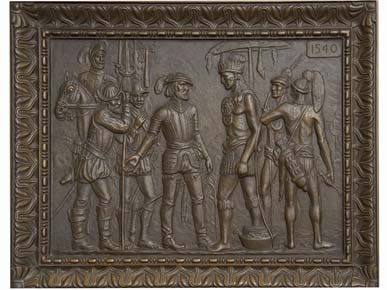
De Soto meets Tuskaloosa, as depicted on the bronze panel doors at the Alabama Department of Archives and History.
A servant was always next to him, shading him with a parasol. He was seated on cushions on a balcony above a town square when De Soto entered. As De Soto’s man recalled, “And although the Governor entered the plaza and alighted from his horse and went up to him, he did not rise, but remained passive in perfect composure and as if he had been a king.”
On October 18 Tuskaloosa led De Soto’s army to his town of Mabila, where he had promised the Spaniards slaves and women. Upon arrival, the Spaniards were greeted with a celebration of dancers– all men. The town was walled, with fresh fortifications and guard towers. All trees and bushes within bowshot of the walls had been recently cleared. In the shadows were weapons, lots of them.
What began with a shout and the slash of a knife ended with the burning of the town. The Battle of Mabila raged for hours. The Indian death toll was estimated at several hundreds to perhaps thousands. The fate of Tuskaloosa is unknown.

The Spaniards won the battle but lost the war. They lost dozens of men and horses and most of their gear. It was the beginning of the end for them, and it would be nearly 150 years before Europeans ventured this way again.

 Memories of the People