
Here is the original account of the first Thanksgiving. It’s only three short paragraphs.
But first, a little context. It’s 1621. The Pilgrims arrived the previous December, finally settling in the abandoned Native village of Patuxet. A year or two earlier, the village – and many like it along the New England coast – had been wiped out by an unknown contagion undoubtedly acquired from other European traders. The disease hit so hard that the people of Patuxet could not even bury their dead. After clearing out the skeletons, the Pilgrims moved into their homes and replanted their corn fields. They had the help of Tisquantum (Squanto), a native of Patuxet, who had recently returned home after years in Europe, having been kidnapped, sold into slavery in Spain, and lived in London.
Despite Tisquantum’s assistance, life in a new North American settlement typically meant starvation for half the colonists in their first year. That’s what happened in Jamestown in 1607. The Pilgrims were no exception. At the same time, they were desperate to establish trade relationships with local people.
This is where Massasoit, the Great Sachem of the Wampanoag comes in. Massasoit, his own people also decimated by disease, was keen on establishing a monopoly with European traders as well as a mutual defense pact to protect his people from the Narragansett, who remained powerful and untouched by the plague.
Thru deft negotiations, the alliance between the Wampanoag and the Pilgrims was sealed on March 22. The pact held thru spring, summer, and fall, but the settlers still lived in fear of the natives’ superior numbers. Thus, the harvest feast that fall was a diplomatic affair, involving shows of force on both sides. The Pilgrims demonstrated the firepower of their weapons; the Wampanoag highlighted their strength in numbers. Here is the account of William Bradford. It’s not clear the Indians were initially invited, but it is clear they provided much of the meat.
“We set the last spring some twenty acres of Indian corn, and sowed some six acres of barley and peas, and according to the manner of the Indians, we manured our ground with herrings or rather shads, which we have in great abundance, and take with great ease at our doors. Our corn did prove well, and God be praised, we had a good increase of Indian corn.
“Our harvest being gotten in, our governor sent four men on fowling, that so we might after have a special manner rejoice together after we had gathered the fruit of our labors; they four in one day killed as much fowl, as with a little help beside, served the company almost a week, at which time amongst other recreations, we exercised our arms, many of the Indians coming amongst us, and among the rest their greatest King Massasoit, with some ninety men, whom for three days we entertained and feasted, and they went out and killed five deer, which they brought to the plantation and bestowed on our governor, and upon the captain, and others. And although it be not always so plentiful as it was at this time with us, yet by the goodness of God, we are so far from want that we often wish you partakers of our plenty.
“We have found the Indians very faithful in their covenant of peace with us; very loving and ready to pleasure us; we often go to them, and they come to us; some of us have been fifty miles by land in the country with them.”
The pact held for five decades. If Thanksgiving should be remembered for anything, it’s the diplomatic skills of Massasoit.
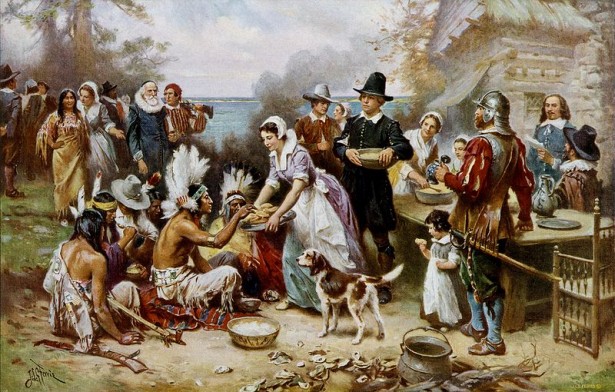
This stylized painting undoubtedly includes numerous historical inaccuracies, most notably the overall symbolism that the Pilgrims were providing the Wampanoag with a meal as if they were children at snack time. I’m not quite sure where the guy on the right (presumably Miles Standish) picked up that conquistador helmet.
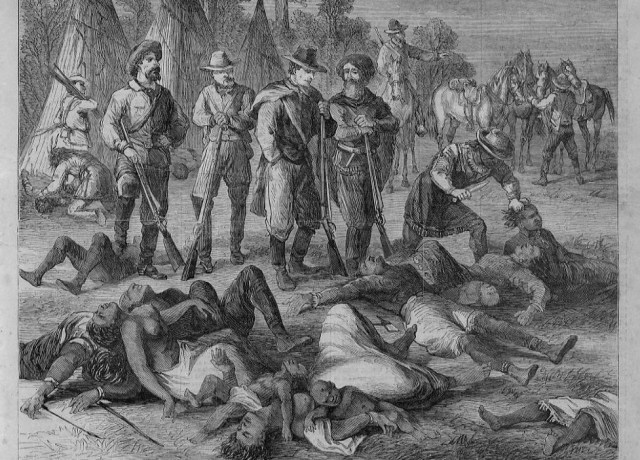
The term “Thanksgiving” was not used until after the brutal massacre of Pequot men, women, and children at Mystic River in 1637. Thus, Thanksgiving is also associated with this act of genocide. The Puritans sold the survivors into slavery and sought to forever ban the name “Pequot”.
In 1970, a Frank James, Wampanoag, was invited to speak at a Thanksgiving ceremony. After seeing a copy of his speech beforehand, they would not let him read it. Here is the speech he did not give.

 Memories of the People
Reblogged this on Memories of the People and commented:
Here is the account of the “first Thanksgiving”.
The 1970s speech link is broken, is there another site?
wow thank you for this article the speech was everything i needed to hear right now as also my shared lineage with native american.
thank you for writing this