
The release of new textbooks in Texas, which diminish the African slave trade by describing the slaves in the US as “workers” or “immigrants”, has sparked outcry. Many have commented that this is a classic attempt at erasure, to erase the memory and history of slavery in the US.
It’s a fair concern because another slave trade has already been erased. It is ignored by high school textbooks. Most Americans are completely unaware of it: the widespread capture and enslavement of Native Americans, primarily in Florida in the late 1600s and early 1700s.
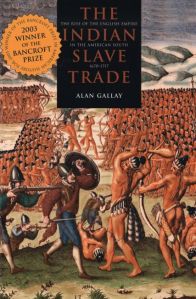 By 1705, the villages and towns of the Apalachee, Timucua, Ais, Jeaga, Calusa, Tocobaga, and Matecumbe had all been devastated by the Yamasee, who worked as slavers for the British. All the way down to Key West, Florida was depopulated so that, today, many of the original tribes no longer exist. A few remaining Indian villages sought protection around the Spanish settlement at St. Augustine; they were “IDP’s”, internally displaced persons. Most of the captives were taken to Charleston, South Carolina and shipped as slaves to British plantations in the Caribbean. Between 1670 and 1715, as many as 50,000 Indians were exported from Charleston, more than double the number of African slaves brought in.
An Englishman recounted, “They have drove the Floridians to the Islands of the Cape, have brought them in and sold many Hundreds of them, and Dayly now Continue that Trade so that in some few years they’le Reduce these Barbarians to a farr less number. There is not one Indian Town betwixt Charles Town and Mowila Bay [Mobile, Alabama]…”
It was one of the most complete genocides of Native Americans (the other being California in the 1850s and 60s). Yet you’d be hard-pressed to find this in a high school textbook.


 Memories of the People