
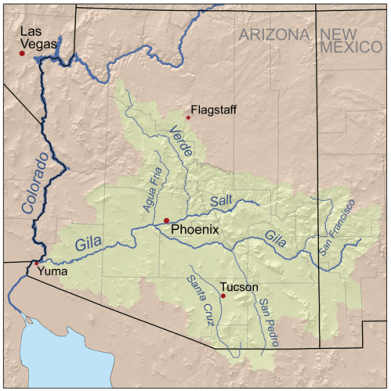
The Gila River begins in the mountains of New Mexico. Today, it doesn’t make it past Phoenix.
With the waters of the Gila River under threat again, most articles about the river talk about the reminiscences of Aldo Leopold or the Coolidge Dam, which impounds most of the water at San Carlos on the storied San Carlos Indian Reservation.
But going back a little farther, to the mid-1800s, the truth is shocking. That barren sandy land between Phoenix and Tucson, where dust devils swirl on the slightest breeze and old airplanes are parked on the desert floor, was once a carpet of green agriculture and thriving communities.
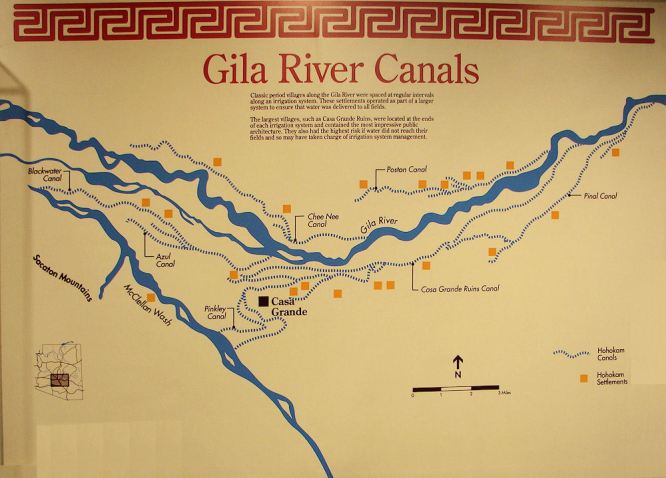 Using a thousand-year-old network of levees, weirs, canals, and irrigation channels (above), the the O’odom and Pee Posh (or Pima and Maricopa) re-engineered the Gila River, cultivating over two hundred square miles of rectangular fields. Hardly a drop of water was left unused. Soldiers, trappers, explorers, outcasts all stopped; many stayed. Among the thatched homes, Mexicans, French, Dutch, English, and Americans mixed with chickens and children. They rested and ate well, enjoying a bounty of wheat, corn, beans, pumpkins, watermelon, squash, peas, tobacco, and cotton.
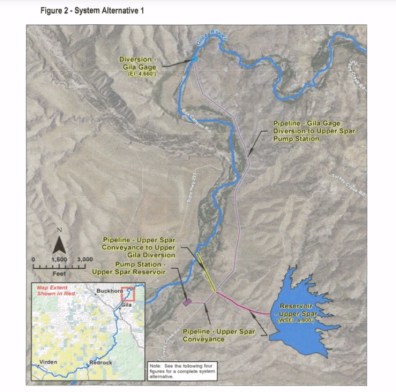
A recent proposal is to divert water near the headwaters of the Gila, in the mountains of New Mexico, and pipe it to a reservoir created to hold water for irrigation.
In 1846, Lieutenant William Emory, surveyor and civil engineer, was impressed by their ingenuity and generosity. “To us it was a rare sight to be thrown in the midst of a large nation of what is termed wild Indians, surpassing many of the Christian nations in agriculture, little behind them in the useful arts, and immeasurably before them in honesty and virtue. During the whole of yesterday, our camp was full of men, women, and children, who sauntered amongst our packs, unwatched, and not a single instance of theft was reported.”
This all disappeared when white settlers began diverting water upstream. Now the Gila barely reaches these dry sands.


 Memories of the People