
Many of the stories associated with the development of the atom and nuclear bombs in the US are well within their half-lives, enduring in the dirt and dust we walk on, and in the stories we tell ourselves and our children. The uranium contamination at Navajo Nation, the plan to use a bomb to create a harbor in Alaska on the coast of the Chukchi Sea, and the fallout from tests in the American West and at Bikini Atoll come to mind. For anyone involved with toxic waste cleanup — which I was for twenty-five years — the Hanford cleanup site in eastern Washington is legendary. Not far from there, a school continues to honor the actions that ended a war, contaminated their region, and killed 80,000 people: the Richland High School Bombers.
Richland is located on the dry steppes of eastern Washington at the confluence of the Columbia and Yakima Rivers, and just a few miles from the confluence with the Snake River. Historically, this was salmon-harvesting country, where the Yakama, Nez Perce, Umatilla, and others would converge.
Richland was a small farm town from 1906 until 1943, when the US Army purchased the whole town, two other nearby farming communities, and the surrounding land, totaling 640 square miles, half the size of Rhode Island. This land included many of the villages of the Wanapum, a Native group that had never signed a treaty, never been moved to a reservation, and still lived in traditional tule houses along the Columbia River upstream of Richland. Here the US Army built the Hanford Engineering Works. Seeking to construct the world’s first nuclear weapon, they were looking for some place remote, in case of an accident, with as few white people as possible, and lots of water to cool the reactors used to make plutonium.
 Richland became the “company town” for Hanford, growing from 300 to 25,000 residents in two years. The entire town was fenced and access was restricted, like a military base. Black employees, 15,000 of them, lived in the “colored barracks” outside of town. At Hanford, the whites and Blacks came together and built Fat Man, the bomb dropped on Nagasaki on August 9, 1945. It took the creation of an entire town to build a weapon to destroy another town half a world away.
While not exactly a hang fire, the people of Richland, indeed people all around, have also been victims of the bomb. For decades, the US Army deliberately released radioactive water into the Columbia River from operations at Hanford, affecting salmon. This disproportionately affects the Yakama and other Natives who eat fish at levels much greater than the white population. These releases were kept secret until 1986. Today, pollution accidents from the site continue to plague the region, with releases of radiation filling the news annually. Of the original 640 square miles purchased by the Army, 586 remain closed to the public due to contamination. As “the most toxic place in the nation,” Hanford is now ground zero for environmental cleanup. It is the largest cleanup site in North America, costing taxpayers over $2 billion/year to keep the radiation under control. Ironically, the Hanford Site cleanup is now the largest source of jobs for the people of Richland today. The Toxicologists would be a more accurate contemporary mascot.
All of this sordid history makes Hanford and Richland a kind of poster child for the concept that wars have no winners, only losers.
 Nevertheless, in what looks like a desperate attempt to justify the past, just a few months after the bombing they changed the high school mascot from the Beavers to the Bombers. They made the mushroom cloud logo official in the 1980s. It now serves as a kind of civic religious symbol, the town’s focal point for celebrating and defending its role in the bombing of Nagasaki. Other high schools in the area are the Falcons, Bears, Bulldogs, Lions, Riverhawks, Suns, and Panthers. There is also the Kamiakin High School Braves, complete with a spear and feather logo, a Native warrior logo, school functions called Tomatalk, TRIBE, and Trading Post, and, on their website, a short respectful but white-washed history of Chief Kamiakin, as if all is resolved and in the past. The usual Native mascot stuff.
Much has been written about the use and social purposes of Native mascots. I summarize most of the peer-reviewed literature, 18 papers, at this blog post. Several of those papers describe how the choice of mascot asserts the power and privilege of one group over another, defining history and the morality of history in the process, while denying “cultural citizenship” to others.
At Richland High, here is what you can find:
- The mushroom cloud logo adorns everything from their website to athletic socks. The distinctive atom bomb cloud is, writ large, all around campus, including the center of the gym floor.

- Letterman’s jackets include mottos such as the offensive “Nuke ‘em” and defensive “Proud of the Cloud.”
- At sports events, the students chant, “Nuke’em ‘till they glow!”
- At the Bombers Drive Thru, a popular hamburger joint with the high school crowd, you can buy a mushroom burger called “The Meltdown.”
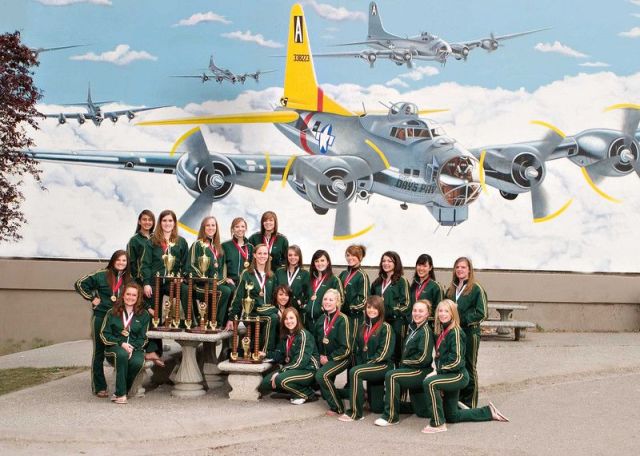
The other prominent symbol on campus is a large mural of Day’s Pay, a B-17 Flying Fortress. The nickname comes from a fundraiser during the war in which 51,000 workers at Hanford each contributed a day’s pay to financing the plane (back in the day when they held fundraisers for the US military). This aircraft was not used in the bombing of Nagasaki; it was actually used primarily in bombing Germany. Attempts to change the meaning of the “Bombers” mascot to this plane have not been fully successful, especially with the school maintaining the distinctive mushroom cloud logo.
Equally shocking is the minimal controversy and media coverage about this mascot. An online search yields just these:
- Al-Jazeera wrote a comprehensive story (July 21, 2015) covering the history of the name, a visit to the school by Tom Brokaw with a Japanese delegation in 1988, a track coach that refused to have the logo on his team’s uniforms, and efforts to shift the mascot’s focus to a different “bomber”, a B-17 that flew over Germany.
- The Washington Post gave the mascot a brief mention last year (May 10, 2017) when it covered an incident at the Hanford Site; this article was written by the same author as above.
- A story in the local Tri-City Herald (May 27, 2017) repeated much of the information from the Al-Jazeera piece, adding more on various attempts to change the name.
- A recent story in the Seattle Times (Mar 11, 2018) described the visit of a Nagasaki survivor to the school and Hanford Site. That visit is also covered in greater detail by Crosscut.
That was Mitsugi Moriguchi, who was eight-years-old when his town was destroyed. Five of his siblings died of cancer.

Moriguchi (in center with beige jacket and black pants) at Richland High.
Last year, a Hiroshima survivor came to Davis, California, and spoke to students at a school assembly, promoting peace thru forgiveness. There was no such healing in Richland, however. There was no assembly for Moriguchi. Most students never knew he was there, and school officials were openly nervous about his visit, at first denying media access. A seven-minute video of his visit is here.
His stated goal, after seeing the apparent celebration of the bomb at both Hanford and the high school, was to get Americans to “look under the cloud.” In the video, at least one student does, telling Moriguchi that his visit reminds her that the Japanese were real people, that they existed.
The public comments to the news stories and at an online debate at Buzzfeed illustrate just how easy it is to convince a new generation of a viewpoint that is morally shocking to most others. The overwhelming majority of the comments, often made by former students of Richland High, defend the mascot using painfully immature and illogical arguments. In defense of the mascot, supporters generally make these points:
- The bombing was justified because it was in response to Pearl Harbor and other offenses.
- The bombing ended the war, thus saving American lives (and some add Japanese lives to this argument).
- It’s part of our history.
All of these statements, regardless of how true or false they may be, are mere deflections and irrelevant to the central issue. It is entirely possible to affirm all three of these points and still reject the notion that a high school celebrate and honor a specific violent act that killed 80,000 people (nearly all of them civilians). It is entirely possible to agree with all three of the points above and still mourn the cloud.
Absent in the online discussion is the affect this mascot has on others in the community and our nation. When I mentioned the mushroom cloud logo to a Japanese-American friend of mine, she was momentarily breathless with shock. It is a bold in-your-face display of white American power and privilege. It is difficult to imagine a Japanese-American or even Asian-American student feeling included at Richland High. In the  words of Strong (2004), Asian-Americans in this context are denied any “cultural citizenship;” they do not belong. To quote Farnell (2004) from the Native American mascot literature, the use of a mascot like this asserts the school as white American “public space” where the Nagasaki bombing is justified and celebrated and alternative views are rejected, sometimes by majority vote. The displacement of Natives, segregation of Blacks, and contamination of the environment all associated with the building of the bomb is ignored. It’s a town where Japanese and Asian-Americans do not count at all.
The nature of the comments, and even the mere existence of the mascot and mushroom cloud logo, suggests the people of Richland are uncomfortable with their history and have a desperate need, even seventy-five years and four generations later, to defend their participation in the bombing. Deep down, they know that celebrating a mass killing is warped at best, appalling and alienating at worst.

Because they deliberately targeted a civilian population, many (mostly outside the US) consider the Hiroshima and Nagasaki bombings as examples of state terrorism, as well as the world’s largest terrorist attacks. Pearl Harbor and the aerial bombardments of Tokyo, London, and Dresden are also described as examples of state terrorism.

 Memories of the People
August 6 is my birthday, so I have a long relationship with this situation. The Richland high school mascot is by far the most surreal and disturbing example I have ever heard of.
This article fails to mention many other things about the war and after. While America closed many war factories, Russia was building more war factories. The only thing that stopped Russia from invading west Germany ect was the bomb.
Now about the dropping of the bombs on the Japanese. The MAIN factor for doing this was the Japanese themselves and how they fought like fanatics on Okinawa ect. Now you tell me, if you found out your father, son,uncle ect lives could have been spared by dropping a bomb on cities that produced war products but invaded instead causing at least a million casualties, how would you have felt?? Lastly the Japanese people nowadays are so great, we have so much to learn from each other. I personally admire them verymuch, but back during the 30s and 40s it was very different. Japanese newspapers would list the count on the front of there newspapers. Baseball, nope. How many Chinese heads could be chopped off in Nanking ect and they had a running Talley. Things were different then. The people you should ask if we should have dropped the bombs are POWs in Japanese prison camps not bias writers like the one writing the stated article. Thank You
In 1944 my dad was an ensign stationed at Tacloban, waiting to pilot a landing craft for the invasion of Japan. If Truman hadn’t dropped the bomb, I wouldn’t be here.
This narrative is TOTAL nonsense. The US was not planning to invade Japan until November 1945, but the Soviet Union was planning to invade as soon as it could after marching across Manchuria. The bomb was dropped to stop the Soviet invasion, not to save American lives! Dropping the bomb was the start of the Cold War, not the end of WWII. (RHS graduate 1971)
I graduated from Richland High School in 1981. While I attended school there, I honestly never gave much thought to the mushroom cloud or the Bomber name. Then I went to Seattle to college, and I found out quickly how shocking many of my fellow students found all of it. Absurd, really, And unbelievable. A few years ago, I was visiting my parents (who still live there) with my then 16-year-old son. I decided to take him to walk around the grounds of my old high school. It was summer, and the smoke from far-off fires had moved down the Columbia River to blanket the town with a yellow brown haze. I knew the high school had been remodeled; what I didn’t know until I got there was how they’d apparently doubled down on the mushroom cloud. It was everywhere we turned. Our walk around the grounds was surreal–practically choking on the acrid smoke while being confronted everywhere with images of the mushroom cloud. It left me feeling sad and altogether discouraged. What is there to be proud of? Many schools have changed their names and mascots–it can be done. That Richland High School and its supporters have persisted so long in retaining what is to many a deeply offensive and hurtful symbol of destruction and suffering seems incomprehensible to me now. Know better, do better (my apologies to Maya Angelou). And surely by now, they should know better.
Alison, Thank you very much for sharing.
The state legislature is quick enough to ban Native American mascots. Why do they permit a weapon of mass destruction to endure as a mascot?
I completely agree. I didn’t think much of it while I was in school either. But now I realize how shocking it is, and how much having The Bombers as out mascot desensitized us and perpetuated a toxic culture.
The “nuclear burst” was adopted along with the schools coat of arms in 1968. This “Nuclear Burst” is not a symbol of bombing Nagasaki. It’s unfortunate that those who are doing the research on this, take only the surface and delve no further. It is clearly explained in the coat of arms what that Nuclear Burst symbolizes and it is exactly what we shouldn’t sweep under the rug. Taken from the coat of arms: “The nuclear burst symbolizes the attainments by educated men and reminds us of responsibilities shared by all men in all of life’s endeavors and that man alone does not control the forces of this world.” It’s important to remember the historical significance and the student body was actively trying to keep this horrific act in the present, not as a celebration, but as a remembrance. Those who do not remember their history are doomed to repeat it. Are we to say that the Miami hurricanes are glorifying the lives lost in Florida from the many horrific disasters that took many lives? A schools mascot is to represent the strength and resilience of the people who live in the area. So in many ways, the RHS mascot of the Nuclear Burst or Nuclear Cloud, actually represents the school’s commitment to peace and non-violence. The burst represents the idea that just because we can do something as human beings, doesn’t mean we should.
Recently read Ann Southard’s fabulous book on Nagasaki, using the latest in unclassified documents along with the eyewitness accounts of some of the children who were survivors of this blast. She does discuss that while the emperor was wanting to surrender to the US, many on his fanatical cabinet of military-industrialists and generals refused to do so. She points out that even after the Nagasaki bomb, the generals were not going to surrender, mainly because they had very poor communications to the city (as well as the communications facilities being destroyed) and could not grasp the magnitude of the bomb. Some would have fought to the death and expected the rest of the country to do so (as would we if we were being invaded!) Luckily, the Emperor decided enough was enough. And yes, the Russian threat was very compelling. Get Ann’s award winning book “Nagasaki”