
Migration across the Bering Land Bridge is a controversial subject among Native Americans, kind of like creation and evolution with Christians. It’s also a hot topic among archaeologists and anthropologists. The science behind the peopling of the Americas in still evolving, no pun intended. With each new archaeological discovery, linguistic analysis, and DNA study, the timeline of human migration is pushed further back, the story gets more complicated, and the controversy continues. Here’s the latest.
The Bering Land Bridge
It is now clear that humans arrived from Asia thru Alaska in multiple waves, some much earlier than previously thought. Originally, most scientific theories focused on the Bering Land Bridge. Because sea levels were lower, this bridge existed from approximately 30,000 BP (years before present) to 11,000 BP. However, during that time there was another obstacle that limited the usefulness of this land bridge: glaciers. While much of Alaska was clear, these formidable walls of ice blocked access to the rest of North America from 21,000 to 13,000 BP. This left just two windows for land migration: one before 21,000 BP and one after 13,000 BP.

New discoveries
The most recent window, around 13,000 BP, was long regarded as the time when humans first came to the Americas. This was based on artifacts found near Clovis, New Mexico, and dated to around 13,000 BP. Even that was older than originally thought.

Pre-Clovis sites
It is now clear that migration occurred earlier. The prevailing view, at the moment, is that Homo sapiens arrived in North America by at least 20,000 BP, but were temporarily blocked by glaciers. For context, Homo sapiens first spread to Europe and East Asia between 45,000 and 35,000 BP. Because much of Alaska was glacier-free, they stayed there, eventually venturing south along the Pacific Northwest coast by boat, finding ice-free “refugia” on islands and peninsulas. There is a growing list of archaeological sites, some as far south as Chile, that date as far back as 15,000 BP. This implies that Native American ancestors were clearly pre-Clovis.

Early boat travel makes sense. Even now, you really can see Russia from Alaska—or at least from islands off Alaska. I took this photo from the Nome-Teller Road this May (with caribou in the foreground). As hunters of whale and walrus, our ancestors would have been adept at open ocean travel.
The growing list of pre-Clovis sites, as well as the tremendous diversity of languages in Native America, suggest that very early migration was not a trickle; it was a flood. What’s more, there is DNA evidence that there was reverse migration on at least two occasions; later generations moved back into Asia. Note that today’s residents of St. Lawrence Island, Alaska (aka Sivuqaq) speak Siberian Yupik, not Alaskan Yupik.
There are also a variety of archaeological sites that suggest very early human presence, as early as 130,000 BP, but these remain unaccepted by most, as they lack supporting evidence.
There is also incontrovertible evidence of contact between Oceana and South America, which led to the spread of sweet potatoes from America across the South Pacific. This was much more recent, however, occurring around 700 AD. Some DNA signals in South America, however, suggest earlier contact.
Red earth and white lies: Deloria’s hypotheses
It is impossible to discuss this without mentioning the theories of Vine Deloria Jr. Because he was a key Native American leader from the 1960s until his passing in 2005, his views on the peopling of the Americas still carry weight today. In 1995, he published Red Earth, White Lies, attacking the prevailing view that Native Americans arrived around 10,000 BP and descended from the Clovis culture. At the time of his writing, the Monte Verde site in Chile had already been dated to 15,000 BP, yet it was not accepted by mainstream US scientists until 1998. Thus, Deloria was ahead of his time, right to challenge American scientists, and was ultimately proven correct—migration did occur much earlier. Furthermore, new discoveries and studies have only strengthened his position. That said, some of his ideas were outlandish. He posited a young earth, similar to a literal interpretation of the Bible, and asserted that dinosaurs lived into the 1800s. He also considered the notion that some Native Americans emanated from the Americas, as described in their stories of origin—more on this below.
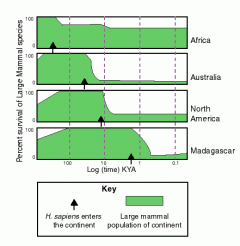
Deloria also criticized the notion that the first Native Americans over-hunted, causing the extinction of a long list of large mammals (e.g. mammoth, mastodon, giant ground sloth, saber-toothed cat, etc.). Extinctions and ecological cascades (leading to the disappearance of Homo neanderthalis and other human species) happened in Europe, Asia, Africa, and Australia as well, all shortly after the arrival of Homo sapiens.
It is important to remember that Deloria was trained as a lawyer and theologian, taught political science and helped establish Native studies as an academic field; he was not a biologist or a geologist. He fought against biases in science and he was right, in part. Nevertheless, it is well-established that dinosaurs (not including birds) disappeared 66 million BP; Homo sapiens only evolved into present form about 200,000 BP, and only began migrating in earnest out of Africa around 70,000 BP. That’s fairly recent, about 1/1000ths of the time span since dinosaurs last walked on the earth.
Science and Native oral history
While it may seem that current migration theory, with all its emphasis on modern science, conflicts with Native creation stories, it does so no more than the theory of evolution conflicts with the Book of Genesis. The two can live side by side. In reality, there are not just two Native creation stories; there are hundreds. Each culture has their own, some in conflict with one another. Wind Cave is the origin of life on earth for the Lakota, but not for the Cherokee or Chumash. Such stories should be taken symbolically and valued for their rich meaning; they describe the relationship of the people to the land, and of the people to their creator. For example, ancient Israelites said God walked in the garden with Adam and Eve, and yet they did not trust him. The story is about the relationship, not the age of the earth. These stories are not intended to be scientific analyses. North America is not really a giant turtle, nor does it hang from four cords. That said, there are some elements of history in many stories. Consistent with their origin stories, the Diné (Navajo) did migrate from the far north. Today, their Athabaskan ancestors in northern Canada speak a language, Na-Dené, so similar the two groups can understand each other. Origin stories tell us that the earth is a gift from the creator to the people, to be respected and protected.

This map illustrates the general scientific consensus at the moment.
Racist theories
There are other theories, more pernicious, that the Americas were originally populated by Phoenicians, Indians from India, or even white Europeans (including the Solutreans). These so-called “Mound Builders” built great civilizations that were later wiped out by “Indian savages”. This myth was the prevailing theory in the US in the 1800s and has been revived today by neo-Nazi and white supremacist groups, claiming they are “taking back America” for the white race.
Fighting this “alt-history” is one reason why it is important for Natives to understand the science behind the peopling of the Americas and to defend it. The ancient mounds of Cahokia and other sites were indeed built by Native ancestors who came here from Asia over 20,000 years ago, not long after Homo sapiens spread to Europe and East Asia.
Summary
The continuing discoveries of new archaeological sites, as well as DNA and linguistic analyses, make one thing clear: Homo sapiens spread thru the Americas earlier than white American scientists first thought. We then spread rapidly and thoroughly through both continents. This allowed Native Americans to develop the wide array of unique languages and cultures that survive today. After that, we were relatively isolated for millennia, as evidenced by unique DNA haplotypes. There was not a continuing influx of peoples from Europe or the South Pacific, either by land or sea—at least not in any significant way that left its mark on American societies or DNA.
It is possible to simultaneously believe in this science, to reject white supremacist revisions of it, and to respect Native traditional stories of our relationship to the land.

 Memories of the People
New oldest site: Ancient Nez Perce village site yields oldest date of human habitation in North America, 16,560 years ago. https://www.wallowa.com/news/ancient-nez-perce-village-site-yields-oldest-date-of-human/article_c65b59a8-ccd3-11e9-8e90-bf84f5db49e6.html?fbclid=IwAR0Wp5CAdfWhrk4kKKJ1M6eo3QYSUL6O4_a9ZgjPCamSEKUR51moaKL-hxE
Potential older site 26,500 years ago, but it will take some time to confirm this. https://www.smithsonianmag.com/science-nature/when-did-humans-reach-america-mexican-mountain-cave-artifacts-raise-new-questions-180975385/?fbclid=IwAR245yNjvWaP3rajyH1MH0F148h531Ujr18d5EN16SgG8MBWza2a23cCmn8
The footprints at White Sands push the timeline back a little further. We already knew humans came to the Americas pre-Clovis and pre-glacial, so about 20,000 BP. This new discovery puts humans in New Mexico 21,000 BP, implying not only early migration from Asia, but also early spread south thru the Americas. They were not stopped by glaciers. Most likely, they used boats to come down the coast if glaciers posed an obstacle. https://www.npr.org/2021/09/24/1040381802/ancient-footprints-new-mexico-white-sands-humans