
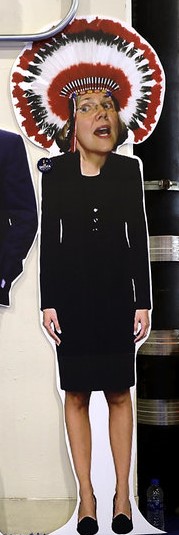
A conservative politician makes fun of Elizabeth Warren.
It’s complicated.
Two white politicians are in conflict. One, virulently racist and anti-Native in thought, word, and deed, verbally ridicules the other, who is an ally of Natives on most policy issues.
Let’s start with the ally, Elizabeth Warren. To quote Opechan from IndianCountry Reddit, she has been active in promoting and sponsoring “pro-Indian legislation concerning safety, health, and food-on-the-table issues.” She has also allied herself “with Representatives Haaland and Davids, the first Native American women elevated to Congress.” On issue after issue, Warren is united with Native Americans and she is anti-Trump.
That said, she doesn’t really understand Native Americans. She stumbled awfully and publicly into the complex topic of Native identity and sovereignty when she claimed, based on an old family story, that she had some Native ancestry. That, in and of itself, is not surprising, especially for someone from Oklahoma. But what she didn’t have was a long-standing family or personal connection to the Cherokee Nation.
At this point, she should have acknowledged as much and dropped the subject. But she didn’t. She took Trump’s bait and proceeded to stumble more, taking a DNA test to prove that old family story.
That’s when Native reaction really split, resulting in fierce debate.
The most public Native condemnation of Warren, at least as reported by the white media, came from Chuck Hoskin, the Cherokee Nation Secretary of State, who said, “Using a DNA test to lay claim to any connection to the Cherokee Nation or any tribal nation, even vaguely, is inappropriate and wrong.” Within Indian Country, there was plenty of additional condemnation of Warren, the basic point being that she did not understand the difference between a DNA test and an actual relationship with a Native community, nor the distinction between tribes as ethnic groups and sovereign nations. It looked like she was trying to purchase Native identity, appropriate it for political gain, and circumvent Cherokee sovereignty regarding citizenship. Natives called her a “pretendindian”. Academics fit her behavior into a paradigm of white people “playing Indian”.
Then a second conflict erupted, between anti-Warren Natives and the Huffington Post. Jennifer Bendery wrote an op-ed asserting that Native criticism of Warren was overblown. Her subtitle was “Tribal leaders and Native people say the senator is an ally — and they support her look at her ancestry. But hardly anyone asked them.” Bendery, like Warren, did not have a full understanding of Native American cultural complexity and, like Warren, also stumbled. She claimed she had spoken to many Native “leaders”, and that none of them had spoken out against Warren. Bendery then went on to quote Doug George-Kanentiio, co-founder of the Native American Journalists Association (NAJA), who explained that tribes were busy addressing “serious problems with domestic abuse, youth suicide, environmental contamination, loss of territory and horrifying levels of missing and murdered Native women.”
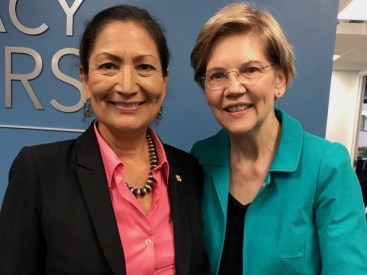
Elizabeth Warren with Debra Haaland
This struck a raw nerve with many Natives. It sounded like: We’ve spoken to your chief, he’s on our side, don’t be offended by this, just go home and focus on your poverty. Natives have been dismissed like this for centuries. First, Native leaders, even elected ones, don’t speak for everyone. In the age of Trump, you would think the mainstream media would understand this concept. In the 18th and 19th centuries, the United States routinely targeted weak corruptible village chiefs, bribed them or threatened them, and then got them to sign over thousands of acres of Indiana or Illinois or Georgia. In return, the tribes got annuities, like $5 per person per year (“forever” but usually curtailed after one or two years). The annual payments addressed the hunger and poverty they were experiencing because their harvests had been lost to white settlers and the game was disappearing due to market hunting, which was the only way they could earn cash income. So the Natives were hungry. Often they were in debt, having borrowed money for guns and bullets for hunting. They were in a debt-poverty spiral, and the only way to get out was signing over their land, which just further exacerbated the spiral. But not all Natives agreed with this approach; they wanted to keep their land. We know their names: Tecumseh, Crazy Horse, Captain Jack, Chief Joseph, Geronimo. At times, younger Natives killed old village chiefs for signing away their land. So when Bendery focused her argument on “elected leaders”, a whole lot of Natives cried foul. Also, it was clear she didn’t look very hard for other Native voices. She didn’t even go to the Cherokee Phoenix, the oldest bastion of Native journalism, a newspaper founded in 1828.
Second, Bendery’s implication that Natives should not be offended by Warren’s DNA test but instead worry about more material issues is also a tired old line. That’s what Natives are told when they object to offensive Native mascots. As if Natives can only think about one issue at a time.
In response, NAJA wrote to the Huffington Post, decrying the article as “negligent and irresponsible”, and demanded an apology as well as suggesting cultural sensitivity training for all HuffPost staff. The HuffPost rejected these demands, but they did allow an opposing op-ed by Rebecca Nagle (Cherokee), who describes herself as a “writer, organizer and all-around agitator”. In that piece, Nagle provided a list of Native essays voicing concern over Warren’s DNA test, and argued that “Instead of listening to marginalized voices, Warren listened to Trump.”
But again, Nagle doesn’t speak for all Natives. That gets us to our third controversy, Natives versus Natives, because, as NAJA explained to Bendery, “Indigenous communities often hold conflicting viewpoints on important issues.” I’ll refer again to Opechan, who countered Nagle on IndianCountry Reddit. He counseled Natives to put the battle in perspective. He reminded us of Trump, who:
- “Steamrolled Standing Rock and the Water Protectors by expediting the Dakota Access Pipeline in his first act of Federal Indian Policy;
- Ended the celebrated Self-Determination Era inaugurated by President Nixon by insisting Tribal Nations be treated as “Ethnic Groups” by the Executive Branch;
- Commenced a New Termination Era with the additional step of unrestrained implementation of the hated > Carcieridecision from the Roberts Court, beginning with preliminary steps towards seizure of Reservations;
- Kicked the Indians out of DC through mandatory divisional transfers of divisions at the Bureau of Indian Affairs;
- Promoted an “American Energy Dominance” Policy that prioritizes highway robbery resource extraction on trust lands above all else;
- Eliminated Climate Change and land preservation initiatives intended to preserve the land we have;
- Violated paid and bargained-for Treaty benefits by shuttering Indian Health Seevice with the Trump Shutdown;
- Elevated President Andrew Jackson, architect of the Trail of Tears that disproportionately killed those in Nagle’s own Cherokee Nation, to a place of honor in the Oval Office and administration;
- Appointed incompetent Indian tokens who don’t give a shit about Indian Country to high posts affecting Federal Indian Policy;
- Appointed anti-Indian federal judges and Supreme Court Justices;
- Fomented a frenzy of racial violence that puts brown folk like us in the crosshairs;
- Mainstreamed and broadcasted Pocahontas as an in-context racial slur from high office…
…and this is just the abridged version since inauguration.”
Nagle and Opechan represent just two of many voices in Indian Country when it comes to Warren and Trump. Nagle acknowledged both sides of the issue, tweeting, “As cont Native Americans, we live in the space btwn Trump and Warren, btwn the stereotypes created to excuse the wholesale slaughter of our ppl and the stereotypes created to excuse the wholesale appropriation of our identity and cultures.”
So what does this Native American think of the whole controversy? Personally, in the war of words between Nagle and Opechan, they both make some good points. I can’t say the same for Warren or Trump, but I’ll take Warren over Trump any day if that’s my choice.

 Memories of the People