
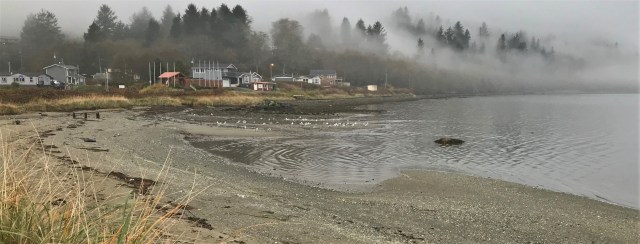
 One doesn’t really need to do a land acknowledgement for Neah Bay because it is still in Makah hands. But I’ll do it anyway: This is Makah Nation land.
It’s my first time here, in the northwest corner of the Pacific Northwest, out on a point of land that divides the Pacific Ocean and the Straight of Juan de Fuca. In the Lower 48, you can’t get more northwest than here. Bathed in sea air, protected by clouds, bald eagles perch above the main street scanning the beach, loons and grebes dive in the harbor, and fishing is everything.
This is the home of the Thunderbird and the Whale, who fought so famously on January 26, 1700, causing a 9.0 earthquake and a tsunami that transformed the Pacific Northwest.  The Makah logo, an eagle holding a whale, is everywhere; it appears on police vehicles, government buildings, boat houses, etc.
The Makah are one of the fortunate tribes to have their reservation on their ancestral land. And the four-hour drive from Seattle keeps this nation set apart, a world unto its own. I’m grateful they welcome visitors, who each must pay $10 for an annual visitor’s pass. No problem; I’m happy to do that. Many come to fish or to hike to the tip of Cape Flattery.
It is beautiful.

Tsoo-Yess Beach on the Pacific side of the point.
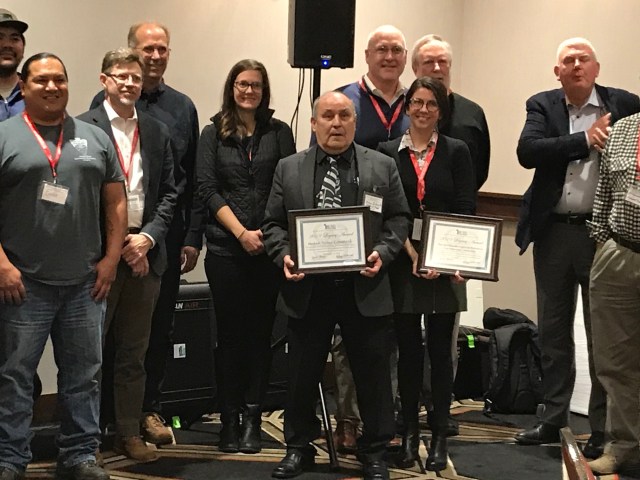
I got to see the Makah again, a few days later, at the Pacific States Oil Spill Task Force annual meeting in Bellingham, where they received a Legacy Award for their work in prevention and preparedness of oil spills (below). A large US Coast Guard rescue tug is stationed in Neah Bay.
As I write this, other tribal officials are in Seattle for a hearing on their continued attempts to get a permit to resume whaling. More on that later. Here’s a past blogpost where I covered white liberals debating that issue on Facebook.

 Memories of the People