
Militias, rag tag groups of armed white men, farmers, and pioneers, often supported by local law enforcement, have a long history of enforcing the idea that the United States is first and foremost for white people (i.e. white supremacy). These militias violently seek to keep “uppity” Native Americans, Blacks, and others in their place.

All Americans are familiar with the KKK, essentially a vigilante militia enforcing their own rule of law. And many Americans may be familiar with the 1921 Black Wall Street massacre in Tulsa, as well as dozens of “race riots” in the early 20th century in which angry whites took to the streets in opposition to Black attempts at integration (e.g. using public swimming pools).
Many may have also heard of foreign militias that played key roles in their own civil wars and genocides, often with the support of their governments. Examples include the Janjaweed of the Darfur region in Sudan and the Interahamwe of the Rwandan genocide.
When it comes to Native Americans, unofficial militias, largely pioneers on the “frontier”, played a significant role in the ethnic cleansing and genocide that is called “manifest destiny”.
A few examples:
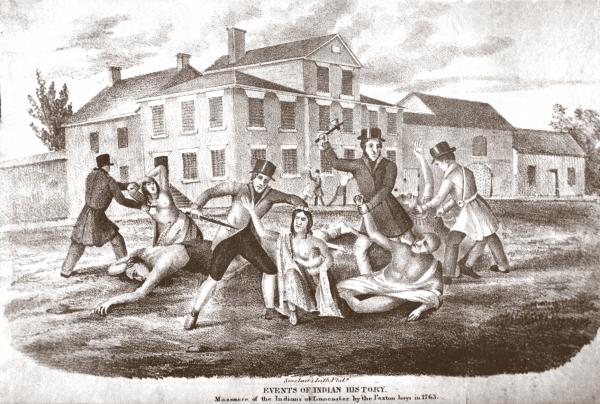
- Conestoga Massacre, 1763. Inflamed by the on-going French-Indian War and Pontiac’s Rebellion, the Paxton Boys of Lancaster County, Pennsylvania, murdered six local Susquehannock and burned their homes, even though the peaceful Natives were widely known and kindly regarded in the community. The militia claimed the Natives had provided support for distant hostiles. Authorities moved the surviving Susquehannock into the local jail for their own protection. Two weeks later, while the local sheriff stood aside, the militia broke into the jail to complete their massacre, tomahawking and scalping women and children, cutting off body parts and shooting their brains out. Benjamin Franklin later described the militia as “white savages”. The local reverend, the “Fighting Parson” John Elder, defended the militia, saying “the men in private life are virtuous and respectable; not cruel, but mild and merciful. The time will arrive when each palliating circumstance will be weighed.” He blamed the local government for not doing enough about the Indians in the first place.
- Sand Creek, 1864. Colonel John Chivington, a Methodist pastor, led a group of Colorado volunteers against the Cheyenne and Arapaho camps of Black Kettle, White Antelope, and Left Hand. Under orders of the US government, those Native bands had just reported to Fort Lyon and set up camp. Chivington found them to be much easier targets than the combatant Natives he was supposed to be looking for. More than killing combatants, Chivington wanted to make a statement for himself, so he attacked the peaceful village. He also wanted to target children because, in his words, “nits make lice.” He and his men killed hundreds of women and children and then paraded their scalps, testicles, vaginas, breasts, and fetuses on the streets of Denver to cheering crowds. One man, Captain Silas Soule, refused to participate. He later gave testimony against Chivington. For that, Soule was gunned down on those same Denver streets.
- Camp Grant Massacre, 1871. The self-styled Tucson Committee for Public Safety, a local white militia with support from Mexican Americans and a rival tribe, attacked a peaceful band of Pinal and Aravaipa Apache who were living near a US Army fort. One hundred forty-four Apache were killed and mutilated, of which only eight were men. Twenty-nine children were sold into slavery. In response, President Grant condemned the attacks and brought the perpetrators to trial. The jury found them not guilty after nineteen minutes of deliberation.
A couple common threads here: 1) The target was always innocents, not combatants (the definition of terrorism); 2) The militias always had either the tacit or actual support of local officials or law enforcement; 3) With most massacres of Native Americans by pioneer militias, the federal government condemned it, launched an investigation, held hearings, and issued a report—but justice was rare in coming.

 Memories of the People