
September, 1493, barely six months after Columbus returned to Castile (Spain) from his first voyage, the harbor at Cádiz was abuzz with activity. An armada was assembling. Colombo’s second voyage was no reconnaissance expedition, no “exploration”. It was an invasion.
He set out with seventeen ships, over a thousand men (no women), and America’s first horses, pigs, sugarcane, oranges, and lemons. They also packed weapons, armor, and trained dogs of war.
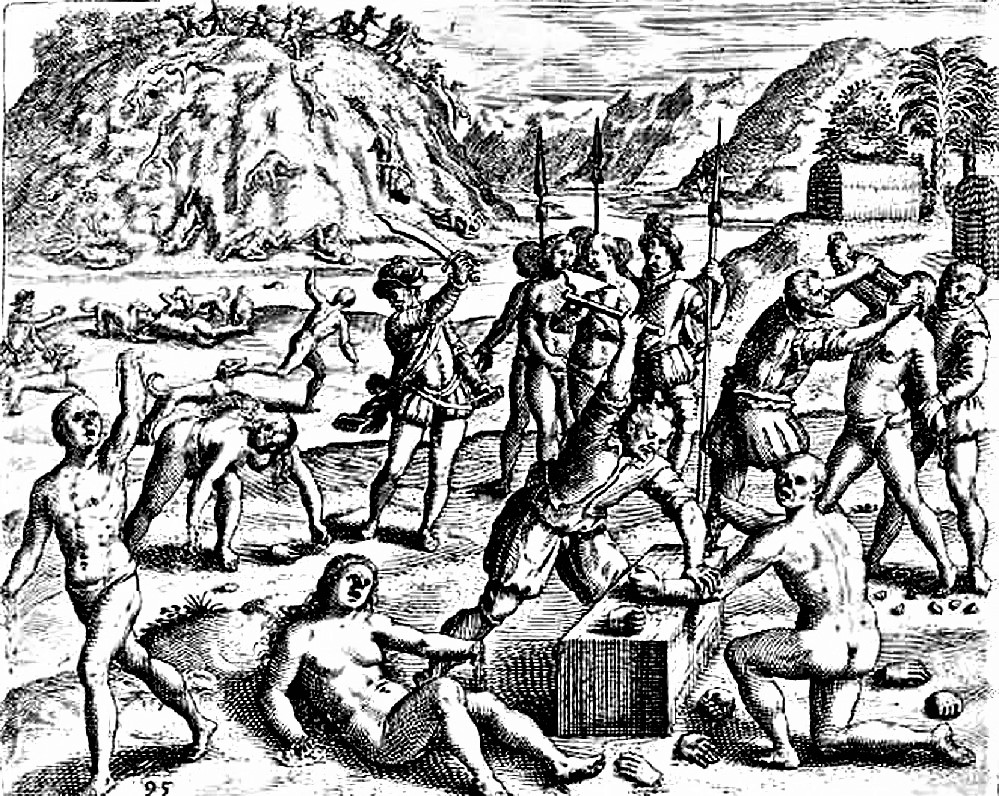
Columbus tried to rendezvous with the thirty-nine men he had left at La Navidad, present-day Haiti, but found the fort abandoned and some of the men dead. He had taken some captives during his first voyage and apparently the locals had risen up after the left.
The second voyage – the invasion – was a total bloodbath in comparison. Within months, the Spaniards documented themselves committing widespread murder, capture, rape (including by Columbus himself), and dismemberment of Native peoples. On Hispaniola (the island that makes up Haiti and the Dominican Republic), the Spaniards imposed the feudal encomienda system, which quickly dissolved into slave plantations where people were bought and sold. Native uprisings occurred regularly. Columbus and his men put down one of them and sent 500 captives, including women and children, back to Spain as slaves; 40% died on the voyage.
In less than ten years, disease and slavers had so decimated the civilization of the Taínos on Hispaniola and the Bahamas that replacements were required. In 1502, the first slaves from Africa – five shiploads – were brought for labor on Caribbean plantations.

 Memories of the People
Please publish the sources cited for this article. It all seems entirely plausible, but it’s polemical, and so before I can comfortably share it (with the intention of edifying people in my social media circle and elsewhere), I need to see the data on which you base your comments. Am I alone here?
Most of this information is widely available. My main source was Robert Fuson’s book, Juan Ponce de Leon: And the Spanish Discovery of Puerto Rico and Florida. Despite the title, the first third of the book covers the period from 1492 up to Ponce de Leon.
The sketch, I believe, is from Bartelome de Las Casas’s work.
that was supposed to be the Amazon book link. I’m not sure what happened to it, but you can look it up easily enough.