
While I’m tremendously relieved that Biden won the election, I remain terrified. Why did 71 million people vote for Donald Trump in 2020, even more than in 2016?
By now, we all knew that the draft-dodging, pussy-grabbing, bankrupt, tax cheating, misogynist, racist narcissist was an exhausting national nightmare and international embarrassment. His White House was filled with nepotism and corruption on an unprecedented scale, a seamless blending of his personal businesses and official policies. His appointed administration sycophants followed a familiar pattern of flaming out and writing damning kiss-and-tell books afterwards, many of them only to support him again in the recent election.

I get that wealthy people and business owners vote Republican; they want the tax breaks and de-regulation. And they don’t care about the loss of public services; they can afford private schools and don’t have to worry as much about health insurance. But the question has always been, why do poor people – read poor white people – vote Republican?
Jonathan Metzl, in his book Dying of Whiteness: How the Politics of Racial Resentment is Killing America’s Heartland, provides an answer. Poor whites are willing to forego government services to avoid any redistribution of wealth “to Mexicans and welfare cheats”.
Trump’s replacement for Obamacare never came. His promised investment in roads and other infrastructure never came. But his supporters didn’t care.
In a study comparing the rejection of Obamacare’s Medicare expansion and the loosening of gun laws in certain Republican states, Metzl concludes that poor whites are willing to cut several weeks off their life expectancy to prevent “Mexicans and welfare queens” from receiving benefits. And this was pre-Covid.
With the pandemic, Trump’s followers have practically become a death cult. When news came out that people of color were being more severely impacted by the early outbreak in New York City, Trump switched from emergency responder to a symbol of freedom by not wearing a mask. Many of his supporters rallied to the cause, deliberately going maskless and holding large gatherings. That freedom has come at a high price. People in red states are catching Covid and dying at rates nearly double their blue state counterparts.
Despite personal cost to themselves, poor whites remained devoted to Trump because he kept his promises in one area: white supremacy. He started building his wall, waged a campaign of terror against immigrants of color, and made public racism okay again.
But the question remains, why do poor whites, as Metzl says, “feel a sense of psychological prestige and overlook their own material conditions”? Why do they refuse to ally with poor people of color, with whom they share similar economic struggles? Why is whiteness worth it? Metzl doesn’t answer that.
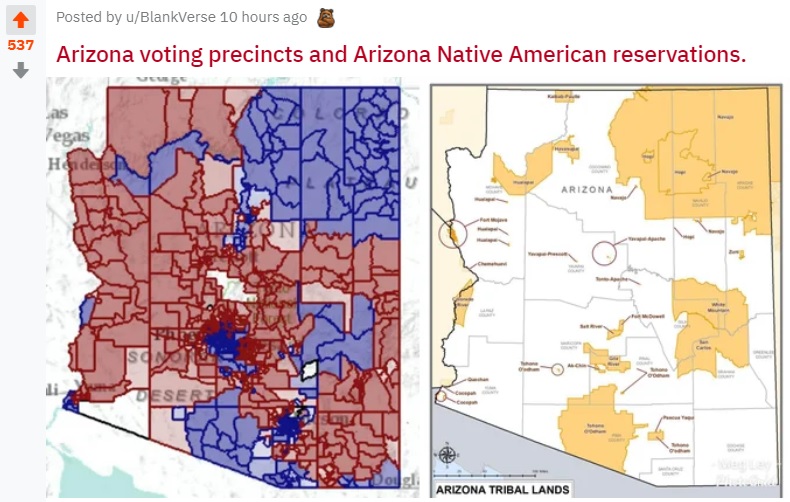
In much of rural America, Native reservations are politically, blue islands on a red prairie.
With respect to Native Americans, he quickly cancelled Obama’s required environmental permitting process and approved the Dakota Access pipeline (which a judge has ruled illegal). He stripped the Wampanoag of land, removing land from trust for the first time ever. And he stripped all tribes in Oklahoma from sovereignty over environmental issues, seeking to protect the oil industry.
Wedges between poor whites and poor people of color in US history go back to Bacon’s Rebellion in 1676, when Virginia Colony first created laws to privilege one over the other. They were attempting to prevent multi-racial alliances of poor people that threaten the rich and powerful.
They were successful. After that, poor whites helped create more wedges. In addition to widely accepting the enslavements of Blacks around them, they wanted Indian land. If they were destitute in the East, they moved West. They became pioneers.
But the poor white pioneers also had conflicts with “big government” in the East. First it was the British, whose proclamation line in 1763 gave all land west of the Appalachians to Native Americans, forbidding any settlers from acquiring it. The American Revolution removed that prohibition. Pioneers poured down the Ohio River and thru the Cumberland Gap.
Conflicts with Native Americans were inevitable. Usually they began with a small offense, perhaps a Native killing a cow or stealing a horse. The final attack was all-too-often a state militia or pioneer vigilante group massacring Native women and children. Thomas Jefferson called those who pushed West “our own semi-barbarous citizens, the pioneers of the advance of civilization”.
While most of the details on Native ethnic cleansing have been erased from white spaces, locals typically have some knowledge of the history of their own county. In Walla Walla, Washington, you can hardly walk a block downtown without some memorial or tribute to Marcus and Narcissa Whitman, famously killed by local Cayuse in 1847.
Historians, beginning with Alexis de Tocqueville in 1835, often noted the anti-establishment character of Americans, fighting back against British tyranny from the start. This anti-government ethic, still very much alive today, was especially prominent along the frontier as the federal government sought to control the “Wild West”. Mostly, they were trying to stop white pioneers from slaughtering Native peoples. Most of the massacres resulted in federal investigations from Washington DC. Perpetrators were condemned, though punishment was usually ignored. White pioneers honored the perpetrators; many towns and counties are named after them: Sheridan, Grant, Custer, even Chivington. Today, the leaders of ethnic cleansing remain heroes.
Trump’s greatest support came from the same regions where ethnic cleansing was most dramatic, where Natives were massacred, where Native land was immediately given to white settlers, and, in many instances, where descendants of those white settlers still live on the same parcels to this day.
Kiowa County, Colorado, where the Sand Creek Massacre took place, went 88% for Trump. Much of the massacre site is still in private hands, the rancher unwilling to sell it to the adjacent national monument.
The Washita Massacre site, where Colonel Custer took at Native girl as his concubine, is in Roger Mills County, Oklahoma, 89% for Trump.
Johnson County, Wyoming, where the US military deliberately attacked the village of families of Dull Knife’s camp in sub-zero weather, sending them into a frozen canyon, went 79% for Trump.
Northern and central Idaho, where the families of Chief Joseph’s Nez Perce clan fled, went 80% or more for Trump.
Counties in northern Georgia, where Cherokee farms were doled out to poor whites before the Trail of Tears, went 70 to 84% for Trump.
In more liberal Minnesota, the former Santee Sioux reservation along the Minnesota River, stripped from them in the “exterminate or banish” campaign in Little Crow’s War, went 60 to 70% for Trump.
Even in California, where Trump only managed 33% statewide, the northeastern part of the state, home to state-funded genocides against several tribes, went 57 to 70% for Trump.
On the flip side of intergenerational trauma, there is intergenerational racism. Whites tell intergenerational stories too. These stories are needed to justify colonization, slavery, and ethnic cleansing. In the 1800s the stories were bold. Manifest destiny said it was God’s plan. The myth of the Mound Builders said the land belonged to the whites before the red man arrived.

Today the stories have evolved, but are still based on myths, lies, and deception. Here are stories I’ve heard since I was a child. Most Indians died from diseases. It wasn’t genocide because some survived. Blacks need the structure provided by sharecropping. Welfare is a huge government program and people are on it their whole lives. Supply-side economics (i.e. tax cuts for the wealthy) is important because you can’t help the little guy without helping the big guy first. Any government program that helps people (especially people of color) is socialism.
Historically, whites received government handouts through the Homestead Act, Social Security, the GI Bill, and FHA home loans that were denied to people of color. Now the socialism, the affirmative action, stops. They do not want their wealth redistributed to people of color, even if that be thru education, health care, and other government services that benefit everyone. Even as the US tumbles into second world status (or at least being “last among developed countries” in so many indicators of social well-being), the wealthy corporate side of the Republican Party uses this racist wedge to get poor white votes while their own supporters suffer. And we all suffer.

 Memories of the People