
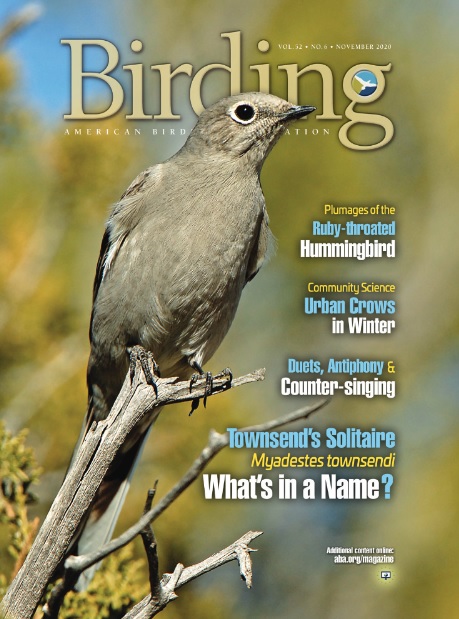
A revolution is about to sweep the world of birders and ornithologists. After decades of intransigence, the most prominent organizations and authors – including prominent field guide authors David Sibley and Kenn Kaufmann – are endorsing “bird names for birds”, a widespread effort to rename eponymous or honorific species names with more descriptive names, focusing on their physical or ecological attributes. For example, Bachman’s Sparrow could revert to Pinewoods Sparrow, Townsend’s Solitaire might become Juniper Solitaire, and Kittlitz’s Murrelet would probably be re-named Glacier Murrelet.
Over a hundred, or about 10%, of bird species in North America are named after people, almost always European colonizers, many with checkered pasts.
We are used to this.
We live in a world dominated by memorials and honorifics to white supremacy. The US capitol is the District of Columbia. It’s nearly impossible to avoid seeing Andrew Jackson’s face every day on a $20 bill. My own town (Port Townsend) was named by Vancouver after a friend in Europe. My county is Jefferson, who owned a slave plantation and plotted to get Natives in debt to steal their land. My state is Washington, who considered Natives “merciless Indian savages”. Our streets are Sheridan, Kearney, Jackson, etc. The whole place is a celebration of white conquest. I cannot walk 100 yards and NOT see something – a street, a plant, a mountain – named to honor a white supremacist. And yes, even the birds.
Decolonizing names, especially names for nature, is a way to reclaim sovereignty.
The effort has grown out of the national reckoning on racial equality in the aftermath of the George Floyd killing. Movements to change names are underway with regard to parks, mountains, streets, other wildlife, and even rock-climbing routes. Current names generally go back to the eighteenth and nineteenth centuries during white American expansion across North America and recall an era of conquest, when species and landforms were “discovered” – and some named after the individual who documented them, or after their friends and colleagues.
Bird Names for Birds, a small group of interested birders, was instrumental in reaching out to the larger organizations to participate in the congress. In their words, “Eponyms (a person after whom a discovery, invention, place, etc., is named or thought to be named) and honorific common bird names (a name given to something in honor of a person) are problematic because they perpetuate colonialism and the racism associated with it. The names that these birds currently have—for example, Bachman’s Sparrow—represent and remember people (mainly white men) who often have objectively horrible pasts and do not uphold the morals and standards the bird community should memorialize.” They describe such names as “verbal statues” that should be removed. The Bird Names for Birds website includes bios of various people memorialized with bird names.
Some of the names are obviously problematic. Bachman was a pro-slavery white supremacist and used his scientific background to argue that position. Audubon was similar, and deliberately made up bird species to sell his books. Townsend robbed Native graves– and his diaries show he knew it was wrong. But it’s the entire practice that is being challenged. Naming species and landforms after people was largely an act of conquest, possession, bravado, and control.
The ornithological world remains dominated by white men. Name changes over social justice concerns began only last year when McCown’s Longpsur was changed to Thick-billed Longspur, after widespread outcry because McCown was a Confederate general and involved in the ethnic cleansing of Native Americans (though the former reason was mentioned far more often than the latter). A proposal in 2018 for that name change was rejected by a 7 to 1 vote.
The last time a bird name was changed for similar reasons was in 2000, when Oldsquaw was changed to Long-tailed Duck, the name it already had in Europe. At that time, the American Ornithologists’ Union, the precursor to the AOS, asserted that the name change was not for reasons of “political correctness” but merely to conform with usage in Europe.

In deference to white fragility, proponents of the changes are emphasizing the positive aspects of new names—that they would be more meaningful and descriptive of the bird—rather than focusing on past racial injustices.
Many suggested using Native names for species, though most stated this could be challenging because 1) names from Native languages may have been lost, or 2) most bird species’ ranges span multiple historic aboriginal territories and languages, creating a conundrum over which indigenous word to use. (The exception to this is Hawaii, where indigenous names are already in widespread use.) I’m not convinced this is a problem. Many species are named after California—California Quail, California Condor, California Gull—none of these are restricted in range to just California. Noteworthy, consultation with tribes was never mentioned; it was basically dismissed as too difficult. Among mammals, moose, raccoon, and skunk are all derived from Algonquian languages.
For now, the effort will be limited to primary eponymous English bird names. The effort will not include secondary names (e.g., American Crow, named after the continent, which was named after Amerigo Vespucci). Other problematic names, such as Flesh-footed Shearwater for a bird with pink feet, will not necessarily be addressed.
Reaction
Responses, as well as the entire rollout, have broken down – sharply – along demographic lines.
The Congress for English Bird Names was held on April 16, 2021. The AOS committee that hosted the webinar was primarily people of color, which is fairly striking because the organization is disproportionately white. The speakers at the webinar – the authors and representatives of the various organizations – were entirely white and mostly men. Some endorsed the name changes whole-heartedly, even though they’d only come to that position recently. Others, especially the database managers, were more begrudging in their support.
The video was posted a week later. I posted a blog on it, for birding audiences, on April 24, linking the video and summarizing the discussion. It was shared widely across dozens of Facebook birding groups and clubs and other social media dedicated to birders.
The online response among birders, who are primarily white liberal environmentalists, has been mixed and sometimes heated. Support for the name changes has been tepid. On my personal Facebook page, which includes dozens of left-wing politically active birders, my blog post received only four likes.
The opposition has been almost entirely white males. Their comments are generally along the lines of “oh for fuck’s sake”, “what a colossal waste of time”, “dishonorable and embarrassing”, “the mindless insanity of the cancel culture”, “virtue signaling on steroids” and “No racial reckoning is needed. We have done nothing wrong.” Comments at the Oklahoma Ornithological Society Facebook page were nearly ninety percent negative. Some used an argument of “unity” and “compassion” to justify keeping the names as they are.
White women, when in opposition, mostly took a softer approach, noting that “a few bad apples spoil the whole thing.”
Strong statements of support were primarily limited to people of color and people under 30 years old.


 Memories of the People