
Afghanistan
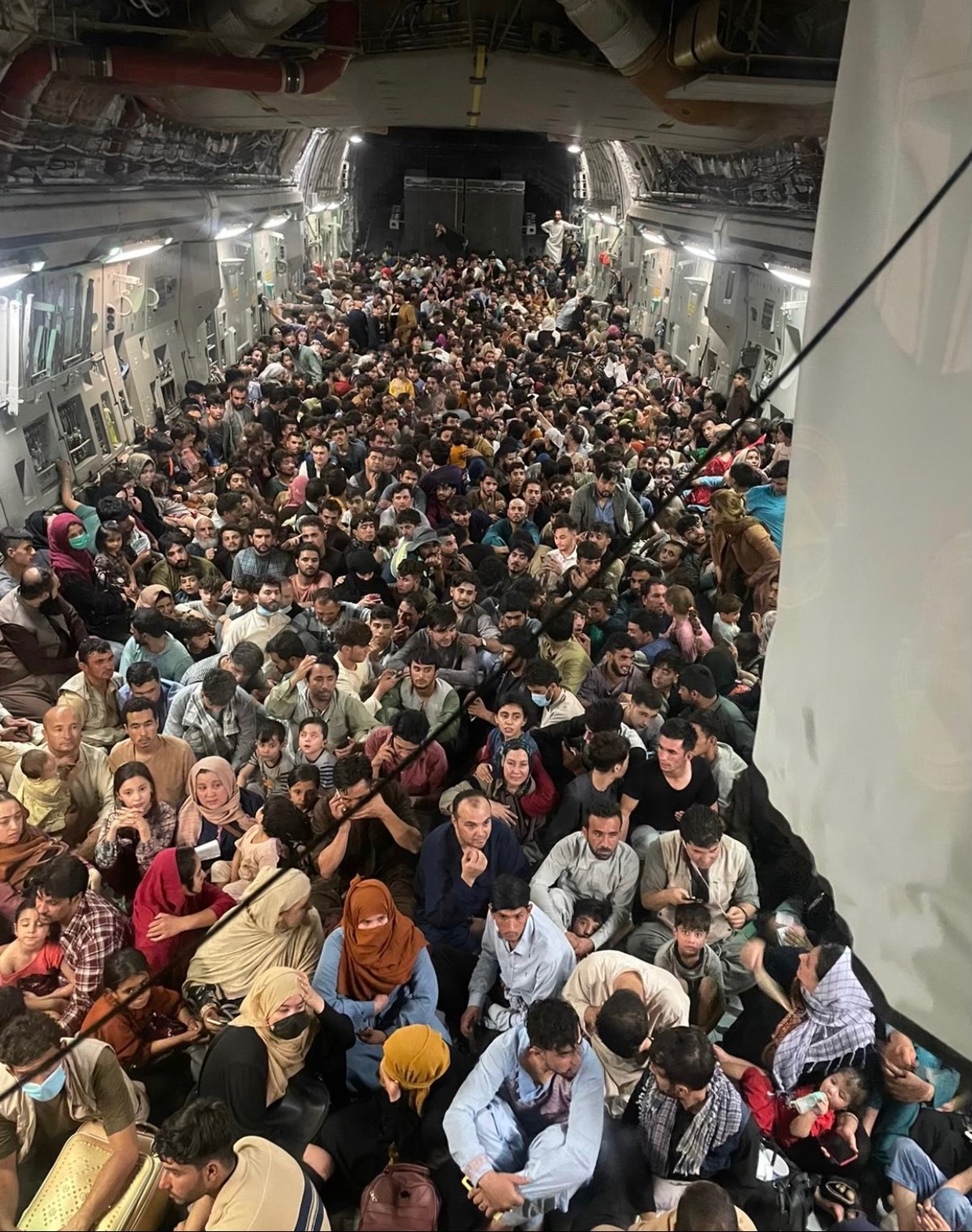
This week the world was horrified to see images of 640 men, women, and children crowded into the hold of a US military cargo plane on the tarmac in Kabul, while hundreds ran alongside the plane as it took off, two fell to their deaths from the wheels, and another was found dead in a wheel well after the plane landed in Qatar.
Earlier this year a report was posted by Brown University entitled, The Costs of Working with the Americans in Afghanistan: The United States’ Broken Special Immigrant Visa Process. It was about those translators, drivers, engineers, and others who worked for the US military in Afghanistan and then found themselves, and their families, at risk of being killed for their service. The report found the program mired in inefficiencies. As of spring 2021, while 18,000 Afghan applicants (along with 45,000 family members) had received Special Immigrant Visas (SIVs), another 18,800 applicants were stuck in review. The average processing time was 658 days.
When Trump called for a “a complete and total ban on all Muslims”, the SIV program nearly ground to a halt. According to the report, “As of 2019, the State Department only had one analyst conducting security checks for the backlog of over 18,000 applications and the position of senior coordinator, overseeing the entire process was unfilled for three years between 2017 and 2020.”
Among Afghans, the program had a reputation as corrupt, unpredictable, and unworkable. In short, this program, for years, spanning Bush, Obama, Trump, and now Biden, was not something the US government really cared about. In the meantime, it is estimated that several thousand Afghan contractors were assassinated while waiting for their visas. It’s hard to know for sure because the US military kept no database of their contractors.
World War II
Most Americans are aware of this history of treating brown allies as potential enemies – and white enemies as potential allies – from World War II. Japanese Americans were sent to internment camps, most losing their farms and businesses in the process. German Americans faced no such trials. Nazi scientists were cultivated for the US nuclear program.
Arizona
In 1886, Geronimo and a band of a few dozen followers famously went “off the reservation”, leaving their concentration camp at San Carlos and heading south toward their Chiricahua homeland.
Brigadier General George Crook led five thousand men deep into Mexico in pursuit. Crook’s troops included 65 Apache scouts, of whom he said, “I cannot too strongly assert that there has never been any success in operations against these Indians unless Indian Scouts were used. [They] were of more value in hunting down and compelling the surrender of the renegades than all other troops… combined.”
Eventually, they captured Geronimo and his band and sentenced them all to exile and prison in Florida, including the 65 scouts because, according to General Nelson Miles, “the boys of today will become the Geronimos of a few years hence.”

The irony doesn’t end there. Apache helicopters were used by the US military to kill Osama bin Laden in 2011. His US military code name: Geronimo.
Boston
This history of treating allies of color as guilty until proven innocent, or just plain guilty, began as early as 1675. During King Phillip’s War, a general uprising of Natives against the English colonists, the so-called “Praying Indians” volunteered to help their white brethren of Boston. But the colonists would not have it. First, they restricted these converted Native Christians to their towns on the perimeter of Boston, then they rounded them up and banished them to Deer Island, a small island on the outer edge of Boston Harbor.
Daniel Gookin, their minister, noted “how submissively and Christianly and affectionately those poor souls carried it, seeking encouragement, and encouraging and exhorting one another with prayers and tears at the time of the embarkment, being, as they told some, in fear that they should never return more to their habitations, but be transported out of the country.” They were right. On the far side of the harbor, they were met by little more than windswept beaches. There was little food or shelter. It was late October. Of the thousand sent there, only 167 survived.

 Memories of the People