
Like Rebecca Nagle, I remember that Monday morning in July, 2020, glued to my laptop, waiting for news from SCOTUSblog. My first indication of the McGirt decision was a tweet from Nagle exclaiming that Gorsuch authored the decision. That was enough to tell us we won. His opening line remains etched in our minds, “On the far end of the Trail of Tears was a promise.” Against all expectation, the Supreme Court had affirmed the Creek (Mvskoke) reservation and, by extension, the reservations of the Cherokee and many others.
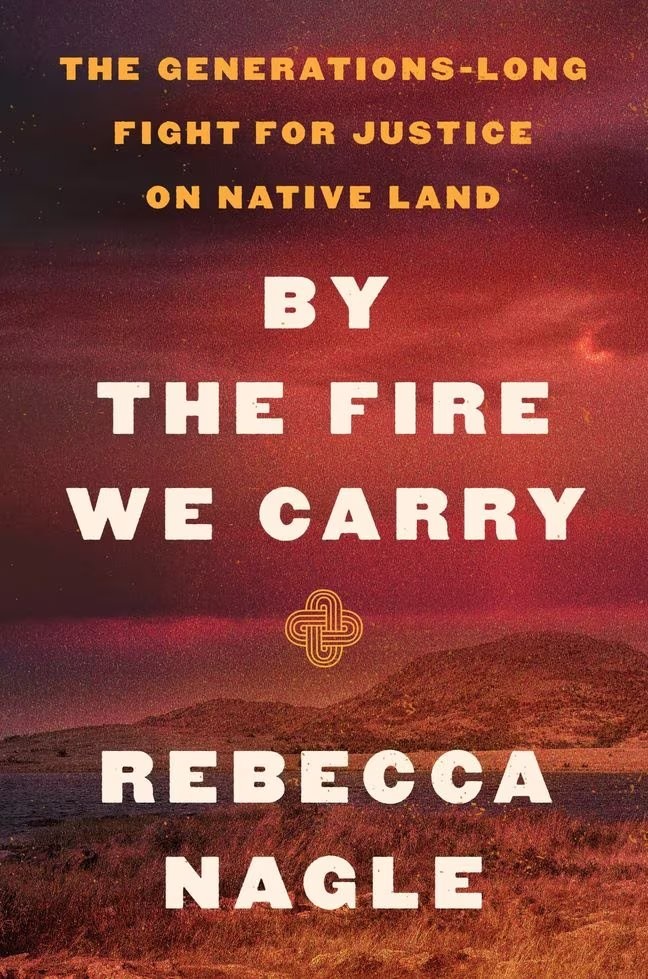
But Nagle’s book, By the Fire We Carry: The Generations-long Fight for Justice on Native Land, is about much more than the McGirt decision. It’s a tour de force, weaving together personal and family memoir, a murder case, and Native history that demonstrates that the present is a loud echo of the past, diminished only by Native resistance and occasional victories such as the McGirt ruling. She casts McGirt not so much as a victory, however, but as a rare instance when existing law supporting tribes was actually honored and upheld by the US government.
Her deep dives into history may seem like rabbit-holes to those who have been denied such history, but are a comprehensive analysis of stories we know well in Indian Country. Her book is an opportunity to un-erase the past in order to understand the present. This is history about Natives by a Native. She tells our stories, and she tells them well and boldly.
Her review of the Indian Removal Act includes not only the saga of the Trail of Tears, but the far-reaching political significance at the time. It was the central issue in the 1832 presidential election, pitting Northern liberals against Southern conservatives. The project involved the commitment of a third of the federal budget. Once implemented, it generated immense wealth for Southern planters, who paved the ethnically-cleansed lands with large slave plantations. As a result of Indian removal, an estimated one-third of Black slave children in Virginia were separated from their mothers and shipped further south to new plantations.
A direct descendant of Major Ridge of the Treaty Party, Nagle describes their betrayal of the Cherokee leadership and their personal sacrifice in no uncertain terms, bringing as much resolution to this long-standing schism as anything I’ve ever seen. She also does well to embrace the tribal claims of Freedmen. (Thank you, Rebecca. My family comes from the other side of Honey Creek, just six miles away from your family cemetery. Like so many Cherokees, they include scores from both sides of the Cherokee Civil War).
Nagle doesn’t stop in the 1800s. She spends considerable time detailing the plunder of Indian Country after the Allotment Act. She casts Oklahoma as a state primarily founded to steal wealth and land – and oil – from Natives. The criminal graft depicted in Killers of the Flower Moon was not unique to the Osage. Through the lens of Millie Narharkey – a Mvskoke child abducted, swindled, raped, cheated, and swindled again – Nagle describes the plunder of Natives by a network of cowboys, oil men, fiduciary trustees, lawyers, policemen, judges, and politicians, all finding ways to exonerate white criminals. Just like what Georgia did in the 1830s, which led Major Ridge to embrace removal in the first place.
Nagle also details Supreme Court decisions in recent decades, which have served to strip Native nations of their sovereignty. In contrast to the hyperbole of Oklahoma lawyers after McGirt, these other decisions really did lead to increased crime, only the victims were Native. SCOTUS thus appears as just another enabler of robber barons, like the other white men who’ve sought to exempt Natives from legal protections and create the paperwork required for exploitation. If SCOTUS is concerned about “lawless reservations,” they need look no further than a mirror.
McGirt was a 5-4 decision. The other side argued that, because the US and Oklahoma had broken the treaty so many times, it was null and void. Using the example of Ruth Bader Ginsburg, Nagle illustrates something most Native activists have experienced: the unreliability of white liberal allies. In the mixed-up world of white colonizers, Gorsuch is a Native ally, while RBG was an uncertain swing vote. The only thing sure is that they don’t really understand us or know our history. In that context, she paints a picture of a world in which 5-4 decisions by strangers affect our lives in profound ways they will never know. She describes the loss of language and culture associated with boarding schools. In the face of such challenges, the only thing that sustains us is the desire to sustain ourselves.

In reviewing the backlash to McGirt and the following Castro-Huerta decision of 2022, she excoriates Governor Stitt and the Oklahoma lawyers for conjuring up false data about freed criminals. They spread that misinformation to The Washington Post and Wall Street Journal, who regurgitated the racist trope of “complete, dysfunctional chaos” and “criminal anarchy in tribal areas.” The Oklahoma team than stood before SCOTUS, pointing to the so-called journalism as evidence. Nagle makes the case that Oklahoma committed willful perjury before the high court, and, as so often in history, it was exactly what SCOTUS was looking for. She also highlights her own small role in the case – her article in The Atlantic countering the falsified numbers. Her article was cited by the Mvskoke attorneys during the trial. Regarding Stitt, she goes further than current Cherokee Nation Principal Chief Chuck Hoskin Jr., sharing the stories of Stitt’s family – that they faked their Cherokee ancestry to gain thousands of acres of allotments.
Of all the stories Nagle tells that connect the past to the present, none are more evocative than the fire for which the book is named. As is so common in Indian law, the issue at hand – tribal jurisdiction and the mere existence of a reservation – came to the courts via a completely unrelated route. In this case, a murder. The critical question was: Did the crime occur in Indian Country, as defined by law? One of the legal criteria for Native land included the continued presence of Natives and Native customs. Just a few miles from the crime scene is a traditional Mvskoke ceremonial ground – a stomping ground. It is marked by a perpetual fire, carried to that location on the Trail of Tears. That fire has never gone out.


 Memories of the People