The town wasn’t moving because of climate change, per se, but as people moved out of the flood plain, rainstorms were getting more frequent and severe. There have been multiple major floods in the region in recent years, culminating in a 2016 deluge that led the governor of Wisconsin to declare a state of emergency.
“In a way, Odanah was very successfully moved right before the monster flood, the 2016 flood, came through. That saved many hundreds of structures from potential flood damage,” says Pinter.
[A version of this was originally published in the Davis Enterprise.]
In 2002, the cover of The New York Times Magazine featured a silhouetted man standing on frosty mauve ice and staring through binoculars into a rosy polar sky. The title read, “Watching the World Melt Away: The future as seen by a lonely scientist at the end of the earth.” The article was about seabird biologist George Divoky and his decades of work studying the black guillemot, a high arctic seabird, on Cooper Island off the coast of Barrow, Alaska. The guillemots were struggling to feed their chicks. Their preferred food, Arctic cod, lived at the edge of the sea ice. In the past, this was five miles from the island. Now it was thirty. Divoky, moreover, found himself sharing his tiny island with several hungry polar bears stranded by the vast expanse of open water. At the time, the story was one of the first concrete examples of climate change impacting an ecosystem in way that was easily seen and understood.
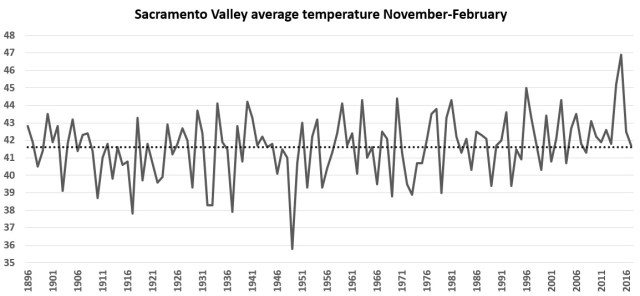
Sixteen years later, birders in Yolo County are now witnessing those kinds of changes at our latitude. Winters are suddenly filled with species previously associated with warmer climates to the south, while some other winter visitors no longer come this far south. In the summer, new species are arriving from more arid regions and have started nesting locally.
A shift of a few degrees may not seem like much, but a winter above freezing makes autumn fruit and berries available longer, resulting in a plentiful food supply. This past
Orchard Oriole in Davis last winter
December, birders were astounded to find eight species of warblers and three species of orioles in the county at once. Normal would be three and zero, respectively. These birds are neotropical migrants, spending the summer nesting in the northern United States and Canada, and wintering in Southern California, Mexico, or Central and South America. In the last few years, Cassin’s vireos, black-throated gray warblers, and blue-gray gnatcatchers have been present at many locations throughout the cold months. It is now possible to find hooded orioles and western tanagers year-round. Last winter, rarities like orchard oriole, northern waterthrush, and palm warbler turned up and stayed for weeks or months. The prevalence of unusual over-wintering migrants has enabled birders to rack up quite a winter list. Holly Coates shattered previous “big year” records by tallying 200 species in Yolo County by March 20 this year.
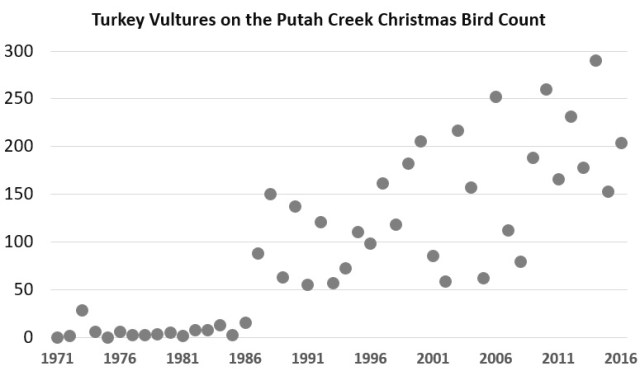
The Putah Creek Christmas Bird Count, an annual effort to count all the birds in a 15-mile diameter circle near Winters on one day each December, has tracked winter bird populations since 1971. In recent years, the number of neotropical migrants found on the count has swelled. These include warbling vireo and Wilson’s and Townsend’s warblers, in addition to the species mentioned above. Perhaps the most dramatic shift in the count data has been with the turkey vulture. With the absence of tule fog, these birds, which rely on warm thermals to give them some lift, have gone from sparse, rarely more than 15 birds on a count through 1985, to over 150 individuals per count in each of the past eight years.
A warming climate is expected to create more increases than decreases in bird life in Yolo County. This is because species diversity is greatest in the tropics. As bird ranges shift north, we expect to see more arrivals than departures. Among the departures are some northern species that are growing scarcer in winter. Most notable is rough-legged hawk, a tundra species that journey south to agricultural areas to eat rodents in winter. They have, however, become decidedly hard to find in recent years, perhaps finding the Willamette Valley and other more northern valleys suitable for their wintering grounds. Another species to watch is the beautiful cedar waxwing, which descend on fruits and berries in the winter months. The more they can find food in the north, the less likely they will come this far south. They are erratic from year to year, however, so it is too early to identify a trend.
Though less dramatic, our hotter summers have brought some changes as well. Great-tailed grackles have expanded up the Central Valley from the Salton Sea. Say’s phoebes, which previously nested only south of the Delta in the Central Valley, moved into Napa and Solano Counties in 2014. Perhaps they are focusing on certain species of insects. This spring, Michael Perrone found them nesting in Davis and Joan Humphrey discovered them feeding young in Woodland, representing first nesting records for the county.
The Yolo Audubon Society is currently revising its Checklist of the Birds of Yolo County, a useful little booklet that will list all 369 species recorded in the county, each with a bar chart showing their abundance through the year. The last version, published in 2004, had a special section called “Recent Changes” highlighting the wetland restoration projects at the Yolo Bypass Wildlife Area and Davis Wetlands. In the coming 2018 version, the Recent Changes section will focus on two big issues: the expansion of orchards and our changing climate. Perrone, author of that section, states that “winters have become milder. In particular, prolonged periods of cold, all-day tule fog have ceased, giving way to sunnier weather.” Davis birders may not be standing on the edge of the continent looking at retreating sea ice, but nevertheless, in the last few years they have witnessed dramatic changes in bird distributions. A look at the graphs, moreover, suggests these changes began before that article about Alaska was published.
Many of the stories associated with the development of the atom and nuclear bombs in the US are well within their half-lives, enduring in the dirt and dust we walk on, and in the stories we tell ourselves and our children. The uranium contamination at Navajo Nation, the plan to use a bomb to create a harbor in Alaska on the coast of the Chukchi Sea, and the fallout from tests in the American West and at Bikini Atoll come to mind. For anyone involved with toxic waste cleanup — which I was for twenty-five years — the Hanford cleanup site in eastern Washington is legendary. Not far from there, a school continues to honor the actions that ended a war, contaminated their region, and killed 80,000 people: the Richland High School Bombers.
Richland is located on the dry steppes of eastern Washington at the confluence of the Columbia and Yakima Rivers, and just a few miles from the confluence with the Snake River. Historically, this was salmon-harvesting country, where the Yakama, Nez Perce, Umatilla, and others would converge.
Richland was a small farm town from 1906 until 1943, when the US Army purchased the whole town, two other nearby farming communities, and the surrounding land, totaling 640 square miles, half the size of Rhode Island. This land included many of the villages of the Wanapum, a Native group that had never signed a treaty, never been moved to a reservation, and still lived in traditional tule houses along the Columbia River upstream of Richland. Here the US Army built the Hanford Engineering Works. Seeking to construct the world’s first nuclear weapon, they were looking for some place remote, in case of an accident, with as few white people as possible, and lots of water to cool the reactors used to make plutonium.
Richland became the “company town” for Hanford, growing from 300 to 25,000 residents in two years. The entire town was fenced and access was restricted, like a military base. Black employees, 15,000 of them, lived in the “colored barracks” outside of town. At Hanford, the whites and Blacks came together and built Fat Man, the bomb dropped on Nagasaki on August 9, 1945. It took the creation of an entire town to build a weapon to destroy another town half a world away.
While not exactly a hang fire, the people of Richland, indeed people all around, have also been victims of the bomb. For decades, the US Army deliberately released radioactive water into the Columbia River from operations at Hanford, affecting salmon. This disproportionately affects the Yakama and other Natives who eat fish at levels much greater than the white population. These releases were kept secret until 1986. Today, pollution accidents from the site continue to plague the region, with releases of radiation filling the news annually. Of the original 640 square miles purchased by the Army, 586 remain closed to the public due to contamination. As “the most toxic place in the nation,” Hanford is now ground zero for environmental cleanup. It is the largest cleanup site in North America, costing taxpayers over $2 billion/year to keep the radiation under control. Ironically, the Hanford Site cleanup is now the largest source of jobs for the people of Richland today. The Toxicologists would be a more accurate contemporary mascot.
All of this sordid history makes Hanford and Richland a kind of poster child for the concept that wars have no winners, only losers.
Nevertheless, in what looks like a desperate attempt to justify the past, just a few months after the bombing they changed the high school mascot from the Beavers to the Bombers. They made the mushroom cloud logo official in the 1980s. It now serves as a kind of civic religious symbol, the town’s focal point for celebrating and defending its role in the bombing of Nagasaki. Other high schools in the area are the Falcons, Bears, Bulldogs, Lions, Riverhawks, Suns, and Panthers. There is also the Kamiakin High School Braves, complete with a spear and feather logo, a Native warrior logo, school functions called Tomatalk, TRIBE, and Trading Post, and, on their website, a short respectful but white-washed history of Chief Kamiakin, as if all is resolved and in the past. The usual Native mascot stuff.
Much has been written about the use and social purposes of Native mascots. I summarize most of the peer-reviewed literature, 18 papers, at this blog post. Several of those papers describe how the choice of mascot asserts the power and privilege of one group over another, defining history and the morality of history in the process, while denying “cultural citizenship” to others.
At Richland High, here is what you can find:
The mushroom cloud logo adorns everything from their website to athletic socks. The distinctive atom bomb cloud is, writ large, all around campus, including the center of the gym floor.
Letterman’s jackets include mottos such as the offensive “Nuke ‘em” and defensive “Proud of the Cloud.”
At sports events, the students chant, “Nuke’em ‘till they glow!”
At the Bombers Drive Thru, a popular hamburger joint with the high school crowd, you can buy a mushroom burger called “The Meltdown.”
The other prominent symbol on campus is a large mural of Day’s Pay, a B-17 Flying Fortress. The nickname comes from a fundraiser during the war in which 51,000 workers at Hanford each contributed a day’s pay to financing the plane (back in the day when they held fundraisers for the US military). This aircraft was not used in the bombing of Nagasaki; it was actually used primarily in bombing Germany. Attempts to change the meaning of the “Bombers” mascot to this plane have not been fully successful, especially with the school maintaining the distinctive mushroom cloud logo.
Equally shocking is the minimal controversy and media coverage about this mascot. An online search yields just these:
Al-Jazeera wrote a comprehensive story (July 21, 2015) covering the history of the name, a visit to the school by Tom Brokaw with a Japanese delegation in 1988, a track coach that refused to have the logo on his team’s uniforms, and efforts to shift the mascot’s focus to a different “bomber”, a B-17 that flew over Germany.
A story in the local Tri-City Herald (May 27, 2017) repeated much of the information from the Al-Jazeera piece, adding more on various attempts to change the name.
That was Mitsugi Moriguchi, who was eight-years-old when his town was destroyed. Five of his siblings died of cancer.
Moriguchi (in center with beige jacket and black pants) at Richland High.
Last year, a Hiroshima survivor came to Davis, California, and spoke to students at a school assembly, promoting peace thru forgiveness. There was no such healing in Richland, however. There was no assembly for Moriguchi. Most students never knew he was there, and school officials were openly nervous about his visit, at first denying media access. A seven-minute video of his visit is here.
His stated goal, after seeing the apparent celebration of the bomb at both Hanford and the high school, was to get Americans to “look under the cloud.” In the video, at least one student does, telling Moriguchi that his visit reminds her that the Japanese were real people, that they existed.
The public comments to the news stories and at an online debate at Buzzfeed illustrate just how easy it is to convince a new generation of a viewpoint that is morally shocking to most others. The overwhelming majority of the comments, often made by former students of Richland High, defend the mascot using painfully immature and illogical arguments. In defense of the mascot, supporters generally make these points:
The bombing was justified because it was in response to Pearl Harbor and other offenses.
The bombing ended the war, thus saving American lives (and some add Japanese lives to this argument).
It’s part of our history.
All of these statements, regardless of how true or false they may be, are mere deflections and irrelevant to the central issue. It is entirely possible to affirm all three of these points and still reject the notion that a high school celebrate and honor a specific violent act that killed 80,000 people (nearly all of them civilians). It is entirely possible to agree with all three of the points above and still mourn the cloud.
Absent in the online discussion is the affect this mascot has on others in the community and our nation. When I mentioned the mushroom cloud logo to a Japanese-American friend of mine, she was momentarily breathless with shock. It is a bold in-your-face display of white American power and privilege. It is difficult to imagine a Japanese-American or even Asian-American student feeling included at Richland High. In the words of Strong (2004), Asian-Americans in this context are denied any “cultural citizenship;” they do not belong. To quote Farnell (2004) from the Native American mascot literature, the use of a mascot like this asserts the school as white American “public space” where the Nagasaki bombing is justified and celebrated and alternative views are rejected, sometimes by majority vote. The displacement of Natives, segregation of Blacks, and contamination of the environment all associated with the building of the bomb is ignored. It’s a town where Japanese and Asian-Americans do not count at all.
The nature of the comments, and even the mere existence of the mascot and mushroom cloud logo, suggests the people of Richland are uncomfortable with their history and have a desperate need, even seventy-five years and four generations later, to defend their participation in the bombing. Deep down, they know that celebrating a mass killing is warped at best, appalling and alienating at worst.
Because they deliberately targeted a civilian population, many (mostly outside the US) consider the Hiroshima and Nagasaki bombings as examples of state terrorism, as well as the world’s largest terrorist attacks. Pearl Harbor and the aerial bombardments of Tokyo, London, and Dresden are also described as examples of state terrorism.
The population of the bald eagle, the US national bird that is also much revered by Native Americans, reflects political trends in the US.
In the latter parts of the 1900s, the bald eagle faced extinction, or at least extirpation in the Lower 48, from low reproduction. This was caused by their uptake of DDT from the fish they ate. The DDT caused their egg shells to be so thin they broke when they sat on them. For anyone with chickens, you know how variable eggshell thickness is, how much they vary depending on the birds’ diet and if they are getting enough calcium. Too thin and the eggs break; too thick and the chicks can’t break out.
Bald Eagle population in the Lower 48 as measured by annual Christmas Bird Counts nationwide.
Thanks to the Endangered Species Act, signed into law by Richard Nixon in 1973 back when the Republican Party considered conservation a conservative idea, the eagles are returning. They now nest in lakes even around downtown Los Angeles. In some highly polluted areas, such as the waters between Los Angeles and the islands off southern California, eggshells are only just now returning to normal. Everywhere, across the Lower 48, the eagles are coming back. The battle is not over. The Republicans today are trying to overhaul the Endangered Species Act, which could again put this great bird at risk.
After several weeks of shock, horror, tears, and rage, we are back from the abyss of war crimes and a level of racial terrorism that seemed unimaginable since the Civil Rights Era. Make no mistake, this was a defining moment in modern US history, revealing exactly where we are on that slope between a democratic bastion of human rights and a pariah nation implementing ethnic cleansing.
The Good
We learned that a massive public outcry can still affect US policy, even Trump, who usually tends to double-down in the face of opposition. This time, fortunately, he caved. The voices of rage poured in from social media, celebrities, faith leaders, and from around the world. This seemed to embolden some key conservative constituents to also raise their voices: some evangelicals, some Republicans, and, importantly, Melonia and Ivanka. Protest worked. We didn’t have to blockade detention centers, burn tires in the streets, rattle the White House fences (or tear them down), or worse. In a week that caused me to evaluate just how much I was willing to sacrifice to fight this battle, the threat of violence in the streets was averted.
The Bad
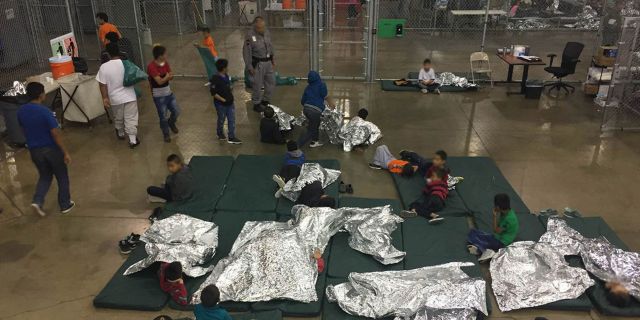
Obviously, we’re not out of the woods. Trump’s new policy has caveats and there are likely devils in the details. Several thousand children remain separated from their parents, often by thousands of miles, and the government appears unable and unwilling to reunite them. That the policy was implemented with no clear plan to track and eventually reunify the families reveals the Trump Administration’s cavalier attitude toward the lives of people of color. They simply didn’t care. The former head of ICE has stated that, based on his experience, some of these children will simply be lost in the system and never reunited. They will be adopted out to US parents. Thus, some Latino parents, simply asking for asylum, will suffer the ultimate penalty: the loss of their children forever.
Trump’s executive order will put the new families at the front of the line, possibly pushing the current parents with separated children behind them. The current wait for an asylum case to be heard is 670 days, nearly two years. History has shown that abducted children, after just six months, bond with their captors as a survival mechanism. After a year or two, they barely recognize their original parents and forget their native language.
The Ugly
We learned that the Trump Administration is so far out of touch with history, human rights, and basic human decency that they failed to anticipate the public outrage of their policy. In defense of their policy, they assaulted our senses. They tweeted about immigrants “infesting” the land and laughed at a suffering ten-year-old with Down Syndrome separated from his parents. Even Melonia, en route to visit a child concentration camp, work a jacket with bold letters on the back that proclaimed, “I REALLY DON’T CARE.”
We learned how easy it was for the Trump Administration to garner significant public support. Using a combination of absurd legal claims, outright lies, and a willing megaphone in the form of Fox News and other conservative media, 27% of Americans (and 58% of Republicans) embraced the Trump party line. With faith in their leader and news sources, they were unable to think for themselves, unable to reach the obvious moral conclusion that the policy was abhorrent by any moral or historical measure.
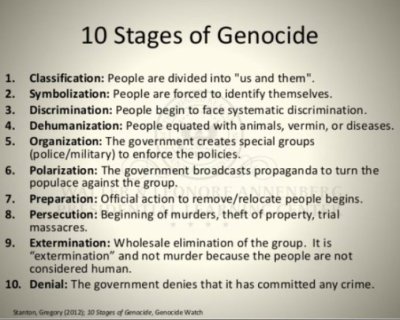
We no longer wonder how a society can get a large segment of its members to dehumanize others to the point of terrorizing their children and destroying their lives. All those Germans who implemented the Holocaust, all those Rwandans who killed their neighbors, how the Japanese internment happened, are no longer a mystery to us. We heard the justifications; we saw the poll numbers. We stared into a collective heart of darkness.
We also saw companies like General Dynamics, Microsoft Azure, and United Rentals cash in on the concentration camps. (A full list is here and more discussion is here.) It is the ultimate white privilege to turn ethnic cleansing into a business opportunity. Doctors and child care providers were torn between whether to work with the children or not, whether to help the suffering but enable the oppressors, like serving food at Auschwitz. Here is the story of one child care worker who quit.
This battle is ending but the war is not over. The election of Donald Trump was the gravest threat to national unity since the Civil War. That threat is not over. That pot is still on the stove and may keep boiling for years, even after Trump is gone.
Liberals and progressives were caught unprepared, realizing that the usual Facebook debates yielded nothing but an unsatisfying catharsis while little children rocked themselves to sleep, too exhausted to cry. The usual tools of non-violent action in a democratic society rarely work with Trump. He laughs at petitions and protests only seem to galvanize him. Efforts to target complicit contractors and boycott them were only in the planning stages, and it wasn’t clear those would work. There was no well-defined strategy to hurt Trump economically.
Lessons from history, from Indian Removal or “extermination” in the 1800s to boarding schools in the 1900s, from the abolitionist movement in the US, to the ramp up to the Holocaust or Japanese internment, reveal more failures than successes. Most of the time, progressives were too conciliatory for too long until it was too late.
We won this battle, mostly, but the war continues. We are still on our back foot, reacting more than acting.
Long before climate change was controversial, before Al Gore’s Inconvenient Truth, before the public was even aware of greenhouse gases and sea level rise, the oil industry knew pretty much what we now know today. They have been studying, researching, and modeling climate change as a result of their greenhouse gas emissions for over 50 years. Their research was in concert with the scientific community and decades ahead of public knowledge of the problem. Their predictions were typically exactly in line with the rest of the scientific world, and actually more aggressive than predictions by the United Nations’ Intergovernmental Panel on Climate Change (IPCC).
The evidence is all laid out in the First Amended Complaint by the City of Oakland and State of California in their climate change lawsuit against BP, Chevron, ConocoPhillips, ExxonMobil, and Shell.
Here I re-post from Oakland’s First Amended Complaint the section on Big Oil’s knowledge and research of climate change:
DEFENDANTS HAVE PRODUCED MASSIVE AMOUNTS OF FOSSIL FUELS DESPITE HAVING FULL KNOWLEDGE FROM THEIR IN-HOUSE SCIENTIFIC STAFF, OR FROM API, THAT FOSSIL FUELS WOULD CAUSE GLOBAL WARMING.
For decades, Defendants have known that their fossil fuel products pose risks of “severe” and even “catastrophic” impacts on the global climate through the work and warnings of their own scientists and/or through their trade association, the American Petroleum Institute (“API”). Defendants, large and sophisticated companies devoted to researching significant issues relevant to fossil fuels, also were aware of significant scientific reports on climate change science and impacts at the time they were issued. Yet each Defendant decided to continue its conduct and commit itself to massive fossil fuel production. This was a deliberate decision to place company profits ahead of human safety and well-being and property, and to foist onto the public the costs of abating and adapting to the public nuisance of global warming.
The API is a national trade association that represents the interests of America’s oil and natural gas industry. At all relevant times, Defendants, their corporate predecessors and/or their operating subsidiaries over which they exercise substantial control, have been members of the API. On information and belief, the API has acted as Defendants’ agent with respect to global warming, received funding from Defendants for the API’s global warming initiatives, and shared with Defendants the information on global warming described herein.
Beginning in the 1950s, the API repeatedly warned its members that fossil fuels posed a grave threat to the global climate. These warnings have included, for example, an admission in 1968 in an API report predicting that carbon dioxide emissions were “almost certain” to produce “significant” temperature increases by 2000, and that these emissions were almost certainly attributable to fossil fuels. The report warned of “major changes in the earth’s environment” and a “rise in sea levels,” and concluded: “there seems to be no doubt that the potential damage to our environment could be severe.” Similar warnings followed in the ensuing decades, including reports commissioned by the API in the 1980s that there was “scientific consensus” that catastrophic climate change would ensue unless API members changed their business models, and predictions that sea levels would rise considerably, with grave consequences, if atmospheric concentrations of CO2 continued to increase.
The API’s warnings to Defendants included:
a) In 1951, the API launched a project to research air pollution from petroleum products, and attributed atmospheric carbon to fossil fuel sources. By 1968, the API’s scientific consultant reported to the API that carbon dioxide emissions were “almost certain” to produce “significant” temperature increases by 2000, and that these emissions were almost certainly attributable to fossil fuels. The report warned of “major changes in the earth’s environment” and a “rise in sea levels,” and concluded: “there seems to be no doubt that the potential damage to our environment could be severe.”
b) Between 1979 and 1983, the API and Defendants, their predecessors, and/or agents formed a task force to monitor and share climate research, initially called the “CO2 and Climate Task Force” and later renamed the “Climate and Energy Task Force” (“Task Force”). The API kept and distributed meeting minutes to Task Force members. Task Force members included, in addition to API representatives, scientists from Amoco (a predecessor to BP); Standard Oil of California, Texaco, and Gulf Oil Corp. (predecessors to Chevron); Exxon Research and Engineering and Mobil (predecessors to or subsidiaries of current Exxon); Shell; and others. In 1980, the Task Force invited Dr. J.A. Laurman, a “recognized expert in the field of CO2 and climate,” to make a presentation. Attendees to the presentation included scientists and executives from Texaco (a predecessor to Chevron), Exxon, and SOHIO (a predecessor to BP). Dr. Laurman’s written presentation informed the Task Force that there was a “Scientific Consensus on the Potential for Large Future Climatic Response to Increased CO2 Levels.” He further informed the Task Force in his presentation that, though the exact temperature increases were difficult to predict, the “physical facts agree on the probability of large effects 50 years away.” He warned the Task Force of a 2.5 ºC [4.5 ºF] global temperature rise by 2038, which would likely have “MAJOR ECONOMIC CONSEQUENCES,” and a 5 ºC [9 ºF] rise by 2067, which would likely produce “GLOBALLY CATASTROPHIC EFFECTS.” He also suggested that, despite uncertainty, “THERE IS NO LEEWAY” in the time for acting. API minutes show that the Task Force discussed topics including “the technical implications of energy source changeover,” “ground rules for energy release of fuels and the cleanup of fuels as they relate to CO2 creation,” and researching “the Market Penetration Requirements of Introducing a New Energy Source into World Wide Use.” The Task Force even asked the question “what is the 50 year future of fossil fuels?”
(c) In March 1982, an API-commissioned report showed the average increase in global temperature from a doubling of atmospheric concentrations of CO2 and projected, based upon computer modeling, global warming of between 2 and 3.5 ºC [3.6 to 6.3 ºF]. The report projected potentially “serious consequences for man’s comfort and survival,” and noted that “the height of the sea level can increase considerably.”
On information and belief, Defendants were aware of the industry Task Force and API findings described above, which were distributed by the API to its members. Each Defendant (or its predecessor) was a member of the API at relevant times, or had a subsidiary that was a member of the API at relevant times. Each subsidiary passed on information it learned from the API on climate change to its parent Defendant (or Defendant’s predecessor) and acted as the agent for its parent company, which remained in charge of setting overall production levels in light of climate change and other factors.
On information and belief, each Defendant was also actually aware (at the time they were made) of public statements on climate change described above, including the 1979 National Academy of Science findings and Dr. Hansen’s 1988 testimony. Because these statements were centrally relevant to Defendants’ ongoing investment of billions of dollars in fossil fuel production and billions of dollars in profits, and because Defendants employed experts charged with evaluating climate change and other energy and regulatory trends, Defendants were in a superior position to appreciate the threat described in these statements. Defendants’ representatives attended congressional hearings on climate change beginning as early as the late 1970s.
In addition to the API information, some of the Defendants produced their own internal analyses of global warming. For example, newly disclosed documents demonstrate that Exxon internally acknowledged in the late 1970s and early 1980s that its products posed a “catastrophic” threat to the global climate, and that fossil fuel use would have to be strictly limited to avoid severe harm:
a) Exxon management was informed by its scientists in 1977 that there was an “overwhelming” consensus that fossil fuels were responsible for atmospheric carbon dioxide increases. The presentation summarized a warning from a recent international scientific conference that “IT IS PREMATURE TO LIMIT USE OF FOSSIL FUELS BUT THEY SHOULD NOT BE ENCOURAGED.” The scientist warned management in a summary of his talk: “Present thinking holds that man has a time window of five to ten years before the need for hard decisions regarding changes in energy strategies might become critical.”
b) In a 1979 Exxon internal memo, an Exxon scientist calculated that 80% of fossil fuel reserves would need to remain in the ground and unburned to avoid greater than a doubling of atmospheric carbon dioxide.
c) In a 1981 internal Exxon memo, a scientist and director at the Exxon Research and Engineering Company warned that “it is distinctly possible” that CO2 emissions “will later produce effects which will indeed be catastrophic (at least for a substantial fraction of the earth’s population).”
d) A year later, the same scientist wrote another memo to Exxon headquarters, which reported on a “clear scientific consensus” that “a doubling of atmospheric CO2 from its preindustrial revolution value would result in an average global temperature rise of (3.0 ± 1.5) ºC [2.7 ºF to 8.1 ºF].” The clear scientific consensus was based upon computer modeling, which Exxon would later attack as unreliable and uncertain in an effort to undermine public confidence in climate science. The memo continued: “There is unanimous agreement in the scientific community that a temperature increase of this magnitude would bring about significant changes in the earth’s climate, including rainfall distribution and alterations in the biosphere.”
e) In November 1982, an Exxon internal report to management warned that “substantial climatic changes” could occur if the average global temperature rose “at least 1ºC [1.8 ºF] above [1982] levels,” and that “[m]itigation of the ‘greenhouse effect’ would require major reductions in fossil fuel combustion.” The report then warns Exxon management that “there are some potentially catastrophic events that must be considered,” including the risk that “if the Antarctic ice sheet which is anchored on land should melt, then this could cause a rise in sea level on the order of 5 meters.” The report includes a graph demonstrating the expected future global warming from the “CO2 effect” demonstrating a sharp departure from the “[r]ange of natural fluctuations.” This graph is attached hereto as Exhibit 3.
f) By 1983, Exxon had created its own climate models, which confirmed the main conclusions from the earlier memos. Starting by at least the mid-1980s, Exxon used its own climate models, and governmental ones to gauge the impact that climate change would have on its own business operations and subsequently took actions to protect its own business assets based upon these modeling results.
Exxon’s early research and understanding of the global warming impacts of its business was not unique among Defendants. For example, at least as far back as 1970, Defendants Shell and BP began funding scientific research in England to examine the possible future climate changes from greenhouse gas emissions. Shell produced a film on global warming in 1991, in which it admitted that there had been a “marked increase [in global temperatures] in the 1980s” and that the increase “does accord with computer models based on the known atmospheric processes and predicted buildup of greenhouse gases.” It acknowledged a “serious warning” that had been “endorsed by a uniquely broad consensus of scientists” in 1990. In the film, Shell further admits that by 2050 continued emissions of greenhouse gases at high levels would cause a global average temperature increase of 1.5 to 4º C (2.7 to 7.2º F); that one meter of sea level rise was likely in the next century; that “this could be disastrous;” and that there is a “possibility of change faster than at any time since the end of the ice age, change too fast, perhaps, for life to adapt without severe dislocation.”
The next section is entitled,
DESPITE THEIR EARLY KNOWLEDGE THAT GLOBAL WARMING WASREAL AND POSED GRAVE THREATS, DEFENDANTS PROMOTED FOSSIL FUELSFOR PERVASIVE USE WHILE DOWNPLAYING THE REALITY AND RISKS OFGLOBAL WARMING.
The document also includes this graph:
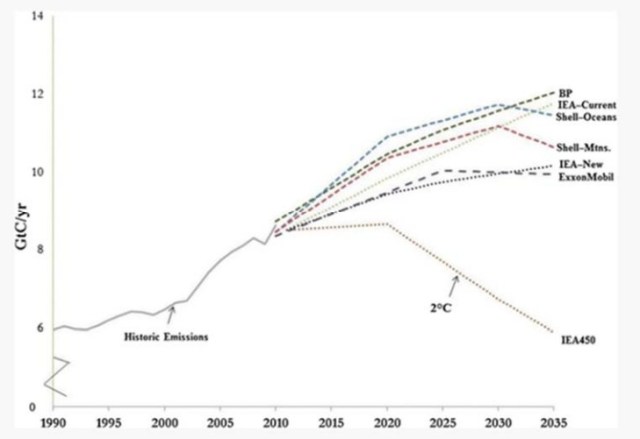
The graph compares the greenhouse gas emissions trajectory necessary to prevent global warming from exceeding a 2º C increase over the pre-industrial temperature (IEA 450 from International Energy Agency) to BP, Exxon and Shell’s projections of total worldwide future emissions that they use to make long-term business plans.
Wikipedia provides a nice history of climate change research. Global warming as a result of CO2 emissions was first described in 1896. The theory attracted more attention in the 1950s. The term “greenhouse” was used in a government report in 1965. However, it was not until the mid-1970s that a scientific consensus began to emerge on the level of global warming associated with CO2 emissions. The oil companies not only followed it closely, but developed their own models that corroborated the science. The dangers of global warming did not attract public attention until 1988, long after Big Oil had thoroughly studied it and knew of its impacts.
Few images evoke a more visceral reaction than seeing authorities tear children from the arms of their mothers. As the men in uniform pry hands from their mothers’ legs, the children are wide-eyed in terror while the mothers scream in panic.
Since early May, ICE employees, acting on orders from Trump, have been separating parents and children at the border, including those seeking political asylum. The children have included 18-month old toddlers and a six-year-old blind girl. ICE is prosecuting the parents as “child traffickers” while declaring the children “unaccompanied minors” and sending them off to relatives or foster homes. There are plans to house them at military bases. A lawsuit by the ACLU seeking a restraining order against the separations is pending.
There is little video footage from the border, but this scene in San Diego, in which a woman who has lived in the community for years, is taken from her family provides an indication of the trauma:
The comments on the video illustrates the widespread public support for this cruelty.
This scene, involving white authorities and brown children, is a recurring pattern on US soil over the centuries. It is a policy designed to make America whiter by terrorizing people of color, specifically by targeting mothers and children. Each time it is part of an over-arching policy to build a white society, and each time it has had the support of at least a third of the white population.
Most Americans are familiar with this drama at slave plantations, such as this scene depicted in Roots, made more tame by the fact that Kizzy is a young adult:
Less familiar to many, child separations occurred repeatedly from 1879 to at least the 1950s with regard to Native American children and boarding schools. The enlightened policy articulated by Richard Pratt, the founder of the Carlisle Indian Industrial School, was to “kill the Indian, save the man”. That is, instead of massacring them all, it was more humane to simply take their children and strip them of their name, language, identity, and culture. Tens of thousands of children were sent across the country to boarding schools far away, forever disrupting their lives and connection to their home communities.
There was resistance. Parents hid their kids when government officials arrived. In 1895 nineteen Hopi men were imprisoned on Alcatraz Island in San Francisco Bay for refusing to allow their children to be taken to a boarding school. They were to be “held in confinement, at hard labor, until they shall show they fully realize the error of their evil ways, until they shall evince a desire to cease interference with the plans of the government for the civilization and education of its indian wards.” As they were loaded onto the boat at the Clay Street Wharf, a crowd of whites teased them while the local paper reported that there were “cruel, cold-blooded savages”.
There are no videos from that time, but there are some accounts from boarding school survivors, such as this one:
“Billy Frank Jr. is a big reason he decided to change the way he runs his farm. It was Frank who encouraged Wilcox to stop using pesticides, plant trees by waterways and keep chicken manure out of the water. That would earn him a “salmon-safe” certification for his eggs.”


 In 2002, the cover of The New York Times Magazine featured a silhouetted man standing on frosty mauve ice and staring through binoculars into a rosy polar sky. The title read, “Watching the World Melt Away: The future as seen by a lonely scientist at the end of the earth.” The article was about seabird biologist George Divoky and his decades of work studying the black guillemot, a high arctic seabird, on Cooper Island off the coast of Barrow, Alaska. The guillemots were struggling to feed their chicks. Their preferred food, Arctic cod, lived at the edge of the sea ice. In the past, this was five miles from the island. Now it was thirty. Divoky, moreover, found himself sharing his tiny island with several hungry polar bears stranded by the vast expanse of open water. At the time, the story was one of the first concrete examples of climate change impacting an ecosystem in way that was easily seen and understood.
 A shift of a few degrees may not seem like much, but a winter above freezing makes autumn fruit and berries available longer, resulting in a plentiful food supply. This past
 The Putah Creek Christmas Bird Count, an annual effort to count all the birds in a 15-mile diameter circle near Winters on one day each December, has tracked winter bird populations since 1971. In recent years, the number of neotropical migrants found on the count has swelled. These include warbling vireo and Wilson’s and Townsend’s warblers, in addition to the species mentioned above. Perhaps the most dramatic shift in the count data has been with the turkey vulture. With the absence of tule fog, these birds, which rely on warm thermals to give them some lift, have gone from sparse, rarely more than 15 birds on a count through 1985, to over 150 individuals per count in each of the past eight years.
 A warming climate is expected to create more increases than decreases in bird life in Yolo County. This is because species diversity is greatest in the tropics. As bird ranges shift north, we expect to see more arrivals than departures. Among the departures are some northern species that are growing scarcer in winter. Most notable is rough-legged hawk, a tundra species that journey south to agricultural areas to eat rodents in winter. They have, however, become decidedly hard to find in recent years, perhaps finding the Willamette Valley and other more northern valleys suitable for their wintering grounds. Another species to watch is the beautiful cedar waxwing, which descend on fruits and berries in the winter months. The more they can find food in the north, the less likely they will come this far south. They are erratic from year to year, however, so it is too early to identify a trend.
 Richland became the “company town” for Hanford, growing from 300 to 25,000 residents in two years. The entire town was fenced and access was restricted, like a military base. Black employees, 15,000 of them, lived in the “colored barracks” outside of town. At Hanford, the whites and Blacks came together and built Fat Man, the bomb dropped on Nagasaki on August 9, 1945. It took the creation of an entire town to build a weapon to destroy another town half a world away.
 Nevertheless, in what looks like a desperate attempt to justify the past, just a few months after the bombing they changed the high school mascot from the Beavers to the Bombers. They made the mushroom cloud logo official in the 1980s. It now serves as a kind of civic religious symbol, the town’s focal point for celebrating and defending its role in the bombing of Nagasaki. Other high schools in the area are the Falcons, Bears, Bulldogs, Lions, Riverhawks, Suns, and Panthers. There is also the Kamiakin High School Braves, complete with a spear and feather logo, a Native warrior logo, school functions called Tomatalk, TRIBE, and Trading Post, and, on their website, a short respectful but white-washed history of Chief Kamiakin, as if all is resolved and in the past. The usual Native mascot stuff.


 words of Strong (2004), Asian-Americans in this context are denied any “cultural citizenship;” they do not belong. To quote Farnell (2004) from the Native American mascot literature, the use of a mascot like this asserts the school as white American “public space” where the Nagasaki bombing is justified and celebrated and alternative views are rejected, sometimes by majority vote. The displacement of Natives, segregation of Blacks, and contamination of the environment all associated with the building of the bomb is ignored. It’s a town where Japanese and Asian-Americans do not count at all.

 parents, often by thousands of miles, and the government appears unable and unwilling to reunite them. That the policy was implemented with no clear plan to track and eventually reunify the families reveals the Trump Administration’s cavalier attitude toward the lives of people of color. They simply didn’t care.
  We learned how easy it was for the Trump Administration to garner significant public support. Using a combination of absurd legal claims, outright lies, and a willing megaphone in the form of Fox News and other conservative media, 27% of Americans (and 58% of Republicans) embraced the Trump party line. With faith in their leader and news sources, they were unable to think for themselves, unable to reach the obvious moral conclusion that the policy was abhorrent by any moral or historical measure.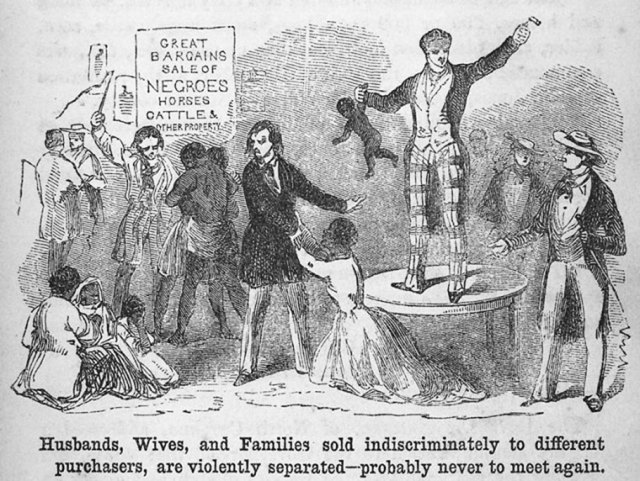
 This battle is ending but the war is not over. The election of Donald Trump was the gravest threat to national unity since the Civil War. That threat is not over. That pot is still on the stove and may keep boiling for years, even after Trump is gone.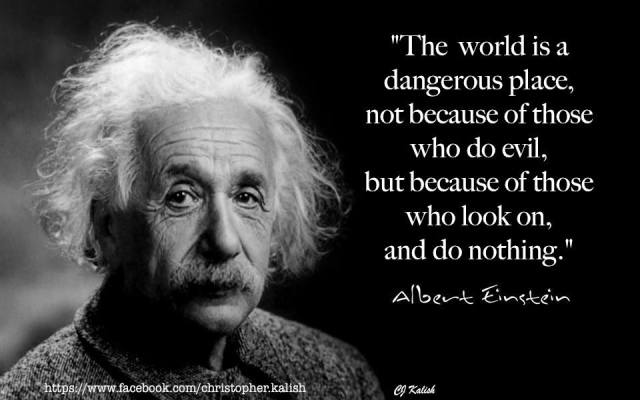
 Their research was in concert with the scientific community and decades ahead of public knowledge of the problem. Their predictions were typically exactly in line with the rest of the scientific world, and actually more aggressive than predictions by the United Nations’ Intergovernmental Panel on Climate Change (IPCC).


 Memories of the People