The basics of sea level rise

sealevel-summerI was lucky to be out of town for a week during “the greatest statewide heat wave ever recorded in California.” When I arrived in Seattle, I was quickly informed that they had just set a record of 55 consecutive days without rain—and that the record would still be increasing had it not been for 0.02 inches late one night a few weeks earlier. Seattle has also set a number of heat records the past four summers. The same people that bragged about this “beautiful weather” scoffed that I believed in climate change. They asserted that no sea level rise would occur during our, our children’s, or our grandchildren’s lifetimes because, 1) Puget Sound was not really part of the ocean; and 2) those NOAA flood maps are “bureaucratic bullshit”.  These same people live on the water in homes that are a few feet above current maximum high tides. Days later we all swept ashes off decks while marveling at the sun, which was reduced to a rosy red disc by smoke from a record 68 large uncontained fires burning across the West.

Astounded by the number of homes, roads, and railroad tracks located just toe-dipping distance above Puget Sound, I set out to learn about sea level rise, talking to experts and reading published studies and reports from the Intergovernmental Panel on Climate Change (IPCC) .  Here’s what I found out.

  • sealevel-temp

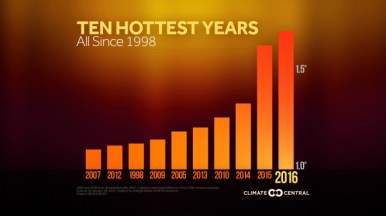
    Climate change via rising temperatures is abundantly clear, dramatically so in recent years.

    Increases in sea level lag quite a bit behind climate change. We set the record for the warmest year on earth in 2016, breaking the record from 2015, which broke the record from 2014. For something as variable as weather, which has all kinds of ups and downs, this kind of consecutive record-breaking suggests runaway global warming. It is dramatic. But not so with sea levels.

  • Sea level rise is a function of several different factors:
    1. Thermal expansion: This happens because, like air or most anything else, water expands when it is warmer, taking up more space. As ocean temperatures increase, they bulge up a bit, and the sea level rises. This can be quantified with pretty good precision and is already occurring. In fact, this explains nearly all of the sea level rise currently underway.
    2. Antarctic Ice Sheet: While melting ice in the Arctic Ocean affects weather and ocean currents, it doesn’t add to the sea level because the ice was already in the ocean to begin with. An ice cube that melts in a glass of water does not change the water level. But glaciers that are on land, like in Antarctica, will flow into the sea when they melt, thus adding to sea levels. They are like an ice cube perched on the edge of the glass, melting into it.
    3. Greenland Ice Cap: While not as big as the Antarctic Ice Sheet, the Greenland Ice Cap will melt faster. In fact, it is already becoming the next big contributor to sea level rise.
    4. Other glaciers and other factors: Smaller glaciers from Alaska to New Zealand are melting, and also adding to sea level.


  • Sea level rise is underway, currently at a rate of 3.4 mm/yr (or 13 inches per 100 years). It has already risen 2 ½ inches since the year 2000, and 6 ½ inches since 1900.


  • The rate of sea level rise is increasing as ice melt from Greenland, Antarctica, and other glaciers begin to contribute. The standard practice is to estimate total sea level rise by the year 2100, as compared to 2000. Because the rate is increasing, it will certainly be more than the 13 inches described above, because ice melt from Greenland, Antarctica, and other places is beginning. However, estimating that increase is difficult. The 2013 report from the IPCC estimated total sea level rise by 2100 at 1 foot to 3.2 feet, depending upon assumptions about CO2 levels. Because Greenland and other Arctic glaciers are melting faster than anticipated, the IPCC report has come under criticism from scientists, who have now adjusted their estimates up to 1.7 feet to possibly 6 feet by 2100. (Revision from November 2017:  A new study estimates sea level rise at 6 to 11 feet by 2100.)

    sea level rise house diagram

    The projected range of sea level rise, depicted in scale over a waterfront home.

  • The rate of sea level rise will continue to increase at an increasing rate for several hundred years. The Antarctic Ice Sheet and Greenland have a lot of ice, and melting takes time. This melting, which is only just beginning, will increase with time, but may still take hundreds of years to really pick up steam. This appears to be “virtually certain”. The Antarctic Ice Sheet is now considered to be “past the point of no return”, with large scale melting “unstoppable.” Still, the exact timing is unknown. It will begin slowly but then suddenly increase rapidly, possibly during this century. This caveat is included in all predictions. The “conservative” estimate is that ocean levels will rise 3 to 10 feet by the year 2300, depending upon future CO2 levels and temperature increases. At that point, however, it will still be rising at a rate more than double the current rate. It thus appears that a total sea level rise over 10 feet, largely if not entirely due to anthropogenic CO2 emissions, is inevitable in the long run.


  • In the next few decades, sea level rise will be mostly felt during acute events, such as during high tides or large storms, or a combination of the two. This will, unfortunately, cause my friends in Puget Sound to attribute their flooded living rooms to unusually high tides or large storms, but not to rising sea levels.

To examine flooding in Puget Sound under various levels of sea level rise, you can surf a map and toggle the level of sea level rise at this interactive website.

Posted in news | Tagged , , , , , , , , | 1 Comment

Totality Visions

“It’s so beautiful.” My voice was uncontrollably shaking and tears were welling up in my eyes.  Like Jodie Foster at the end of Contact.

pano1

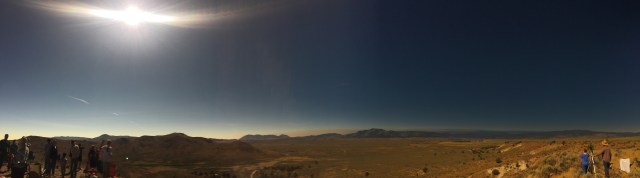
I took this photograph about ninety seconds before totality. It’s a 180-degree panorama, looking south, with the east on the left edge and the darkening west on the right.

From atop a sagebrush bluff in eastern Oregon, we felt the day cool and the bright yellow landscape fade into muted tones. Ten minutes before totality, in a half-light like some strange Instagram filter, a Brewer’s Sparrow started singing. Three minutes before, Venus appeared almost directly overhead and the horizon and sky in the west sank into a deep velvety midnight blue, as if blackness was pouring down from the heavens. Distant smoke from a fire on the southern horizon lit up like a sunset. Two minutes to go, with darkness from the west spreading, threatening to envelope us, the crowd began to exclaim, “It’s coming!” and “Oh my God!”  And, then, suddenly, we looked up, and there it was– floating in cool peaceful stillness, a perfect black disc surrounded by a silky silver corona. In its serene beauty, it seemed to be looking at us. Benevolently.  It felt much closer to me than the sun normally feels, perhaps just a few thousand feet up. It was real; everything else was surreal.

example corona2

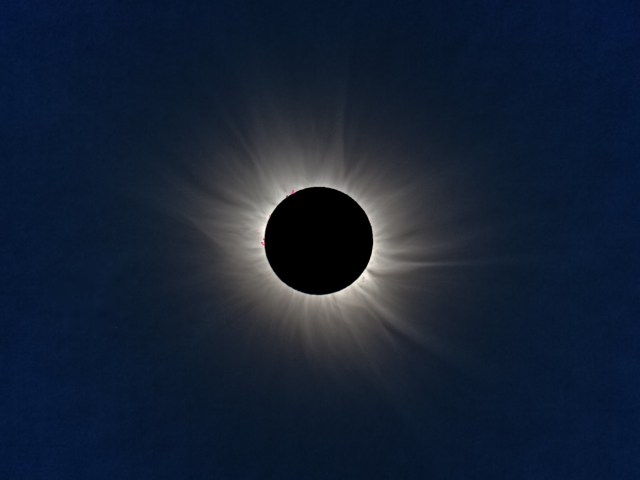
I elected to avoid fussing with my camera during totality, but I searched the internet for the image that came the closest to what I saw. Nothing comes close to what it’s like in real life, but this one from a different eclipse in Norway came the closest.

Our time in its presence lasted just shy of two minutes and eight seconds, but the memory is seared in my mind. I still cannot explain why it felt so meaningful. It certainly sent a message that the universe was tightly held together, that everything was in order, that at 10:23:37.6 in the morning, on schedule, it came to us. It was beautiful– yes, possibly the most beautiful thing I’ve ever seen, and certainly the most unique– but it was just physics. Yet it felt so emotionally fulfilling.

Through binoculars we saw little red solar prominences on the perimeter of the black disc, and the little hot dot of Mercury just off to the left. As the corona blinked and turned into a diamond ring, we watched diffuse “shadow bands” dance on a white sheet I had draped over a large sage. The great tranquil eye was turning its gaze eastward. I thought of friends in Carbondale and Charleston and the joy coming their way. Eclipses should be longer. There should be more of them. If I think about this experience on my deathbed, I’ll die with a smile on my face.

Here is a seven-minute video, which captures our view southwest of the valley before us (the town of Unity, Oregon is just left of center), and the audio of our reactions.

Key moments:
2:00 The shadow is coming
2:30 It’s coming
3:20 Totality!
5:40 Sunlight returns; shadow bands are called out

Total eclipses have a long history of inspiring visions that changed the course of human events. In North America, Wovoka’s epiphany from a similar sage-covered hilltop in northern Nevada during the January 1, 1889 eclipse had dramatic ramifications.

From Suggestions for Observing the Total Eclipse of the Sun on January 1, 1889, published by the University of California:

What is first noticed is the change which takes place in the color of the surrounding landscape, which begins to wear a ruddy aspect. This grows more and more pronounced, and gives to the adjacent country that weird effect which lends so much to the impressiveness of a total eclipse. The color changes because the earth’s atmosphere absorbs a larger proportion of the blue rays than of the red…

The color of the light becomes more and more lurid up to the moment when the sun has nearly disappeared. If the spectator is upon the top of a high mountain, he can then begin to see the moon’s shadow rushing towards him at the rate of about a mile in a second. Just as the shadow reaches him there is a sudden increase of darkness; the brighter stars begin to shine in the dark lurid sky, the thin crescent of the sun breaks up into small points or dots of light, which suddenly disappear, and the moon itself, an intensely black ball, appears to hang isolated in the heavens.

 An instant afterward the sun’s corona is seen surrounding the black disc of the moon with a soft effulgence quite different from any other light known to us.

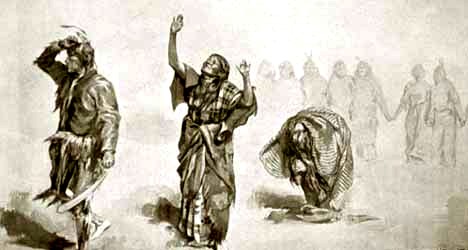
Around 2pm on that day, as the land and sky turned dark, stars appeared, and the corona blinked on like a benevolent eye, Wovoka of the Northern Paiute saw more than all that. For two minutes of totality, he saw a new earth, filled with the resurrection of the dead,

GhostDancePaiute

Paiute Ghost Dance, 1890

living in peace as in times of old, in a land teeming with deer and buffalo. His vision spread throughout the West, from reservation to reservation. Tribes sent emissaries. The vision grew. Jesus will return to save his people, the American Indians. (Does He not look like one? Did not the whites kill him the first time he came?) Living in His presence, there will be no hunger, no disease, and no death; no tears, pain, or mourning. The whites will sink into the soil. All will be made new. This will come to pass if the people perform the Ghost Dance.

The US responded to the dancing Natives. In less than two years, to stop the dancing, Sitting Bull was assassinated and hundreds of elders, women, and children were slaughtered at the Wounded Knee Massacre.

For more information about the significance of eclipses to various Native ethnic groups, see this recent collection just compiled by the National Museum of American Indians.

Celestial events put human troubles in perspective. We live in a different time than Wovoka, when the laws of nature exemplified by the eclipse boomerang on us, in the form of CO2 levels in the atmosphere. Humans have no power to alter the course of the earth and moon, but, unfortunately, we can screw up the planet’s climate, which follows certain natural rules. As we walked down the bluff after the eclipse, surrounded by former NASA scientists and others intimately familiar with climate change, the rebounding desert temperature was a quick reminder. It is the problem that supersedes all others. Were there visions of peace and resolution to this problem? And will the forces arrayed against this dance succeed?

Coming Total Eclipses

For a list of all future total and annular eclipses, with interactive Google maps and details about totality, see this amazing webpage.

Here is a short summary:

July 2, 2019 – northern Chile and Argentina, with 2 minutes of totality in Chile

December 14, 2020 – southern Chile and Argentina, with 2:10 of totality

April 20, 2023 – Eastern Timor and western Australia, with 1 minute of totality in Australia

April 8, 2024 – Mazatlan to Newfoundland (sometimes described as Texas to New England), with 4 1/2 minutes of totality in Mexico

August 12, 2026 – Iceland to Spain, with 2 minutes of totality

August 2, 2027 – a massive eclipse from Gibraltar, Spain and Morocco across northern Africa and the Middle East, including Mecca, with over 6 minutes of totality near Luxor, Egypt.


Posted in my own thoughts | Tagged , , , , , , , , , | 1 Comment

The rapid rise and fall of racist symbols

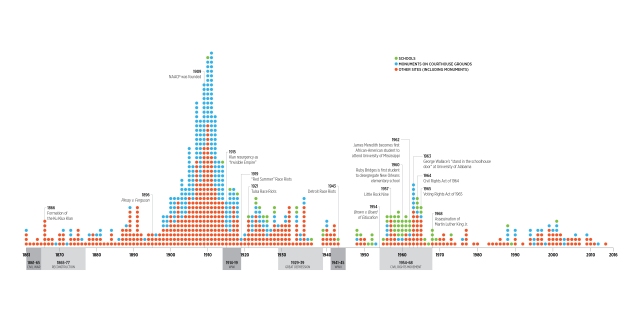
confed1The Southern Poverty Law Center prepared this remarkable diagram, illustrating when Confederate symbols, such as statues, flags, and monuments, were erected in public places– mostly around 1910 and then again in the 1960s during the Civil Rights movement.  Their full report is here.  CNN has a summary here.  Point being there were rather sudden and pronounced political and social motivations to put these things up in the first place.  They weren’t just always there from the beginning.  There are lots of parallels when it comes to symbols of control over Native Americans.  Here are three:

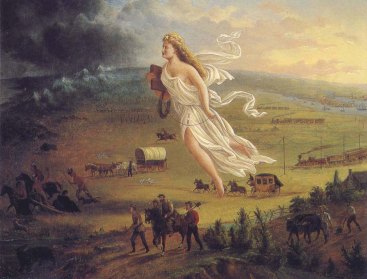
  1. manifestdestiny

    This painting from 1872, American Progress, features the woman Columbia leading ‘civilization’ while the ‘savages’ flee. 

    “Columbia” – a name that adorns the nation’s capitol, as well as many other cities and one of the largest rivers in North America (with, historically, the most salmon), is derived from Christopher Columbus, which seems strange since he was Italian, worked for Spain, and never set foot in the US.  The term “Columbia” began to be used in the mid-1700s, when the European population on the Eastern seaboard began to pass the Native population.  Nearly 250 years after Columbus lived, the American colonists were clearly claiming the continent for Europeans.  The name persists nearly everywhere.

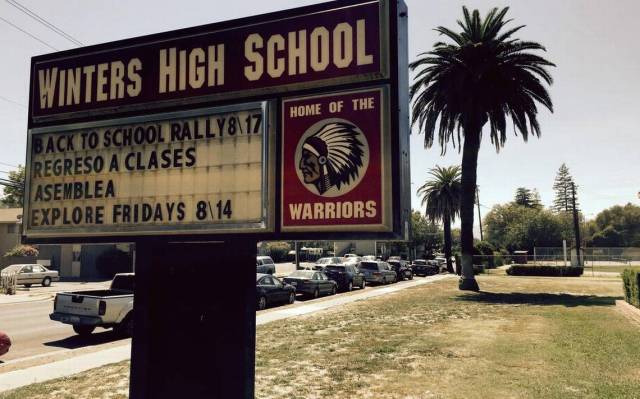
  2. Pocahontas7Native mascots for universities and professional sports teams started in 1909 and really took off in the early to mid-1900s, when Natives were largely confined to reservations and no longer posed a military threat. Many Indian mascot names have since been revised.
  3. Pocahontas, who died in 1617, was largely ignored by history for over 200 years. She was resurrected during the Indian Wars of the 1800s as a model “good Indian”.  Her story was revised– she went from being a raped captive to a willing convert and wife.   The recast Pocahontas appeared in children’s stories and a wide variety of product advertisements.  She continues to be appropriated and marketed today.
Posted in news | Tagged , , , , , , , , , | Leave a comment

Native mascots and logos: A good op-ed from Winters, California

Though the author is not Native, this is really one of the better op-eds I’ve seen on this topic.  Thank you Debra DeAngelo.  It comes from the Davis Enterprise in northern California and is about the Winters High School Warriors logo.

Racism, ignorance fuel resistance to drop Native American chief logo

Winters

Posted in reblogs | Tagged , , , , , | Leave a comment

Mapping Native America

There are lots of maps of Native America floating around in books and on-line, most suggesting a sea of an indigenous nation-states that was fixed in time until the Europeans arrived. In reality, these “tribes” labeled on maps were most often broadly

mapseurope

As with Europe, any map of North America is merely a snapshot in time.

defined ethnic groups that moved and shifted over the centuries. They had widely varying political structures. Some were loose aggregations of towns and villages, others, like the Haudenosaunee (Iroquois) Confederacy, were vast empires with a centralized government.  Over time, territories grew or shrank at the expense of others. Any map is a snapshot in time– and many maps seem to draw on different times in history and merge them together.

Regardless, there are now some excellent mapping efforts that seek to identify traditional indigenous lands, however imperfectly. Most recent is Native-Land.ca, an interactive geographic database created by Victor from the Okanagan region. He describes his interactive map as “a work in progress” and invites public comment and participation.  He states, “I feel that maps are inherently colonial, in that they delegate power according to imposed borders that don’t really exist in many nations throughout history.” Maybe, but often rivers and other geographic features did provide well-defined borders. Landmarks like the Ohio River or the Red Pole (“Baton Rouge”) in Louisiana were honored border checkpoints for centuries.

maps1

Native-Land.ca provides an interactive and searchable map.

Another recent cartographic effort are the beautiful maps created by Aaron Carapella, who lives in current Cherokee (and former Osage) lands in Oklahoma.  Eschewing borders and their inherent uncertainty, Carapella’s map provides original tribal names, with the anglicized versions underneath  (such as “Dakota” over “Sioux”).  While large printed versions are available for purchase, a full pdf version is available here.  He has expanded his original effort to include maps of Mexico, Canada, Alaska, and South America. His maps have been covered by NPR; also see his Facebook page.

maps2

One of Aaron Carapella’s artistic maps.

I would be remiss if I didn’t point out some confusion on-line. Some maps have made well-intentioned rounds on Facebook and other social media. These are mostly innacurate, merging different periods in history and implying artificially hard boundaries across the continent. Most notable is the “America before colonization” map. Snopes did some investigation of this one. It turns out it’s a hypothetical map prepared for a fiction novel. Snopes concludes, “Rather than showing the state of America prior to European colonization, this image is one author’s idea of what America might look like today if Europeans had never colonized it.”

mapsfake

A fictional map prepared for a novel that has fooled many on Facebook. 


Posted in my own thoughts | Tagged , , , , , , , , | Leave a comment

Standing Rock: Court victory may be short lived

I’ve just finished reading the 91-page ruling from US District Court Judge Boasberg. Touted as a “major victory” for the Standing Rock and Cheyenne River Sioux Tribes, there’s still a lot to be worried about as legal proceedings continue.

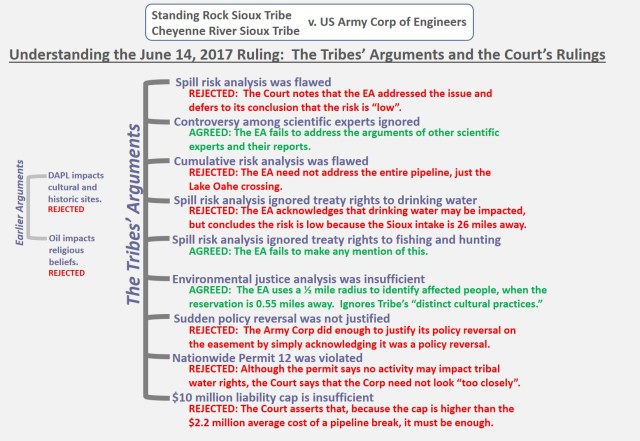
First, the Tribes only prevailed on three of nine arguments; the other six were rejected. Counting two earlier arguments rejected last year, the Tribes are three for eleven. But it only takes one to stop the pipeline. Yet, the pipeline is not yet stopped. More on that later. First, here’s a summary of the Tribes’ arguments and the judge’s replies:

court rulings infogram

The most disturbing trend in the judge’s logic is his repeated refrain that he will not question the Army Corps’ analysis in the Environmental Assessment (EA), but will instead defer to their expertise and judgement in evaluating an issue. He only requires that they consider an issue and give it a “hard look”.  For example, the EA acknowledges that a spill might impact the Tribes’ drinking water, but the risk of a spill is “low” and the nearest drinking water intake is 26 miles away. For the judge, this is enough. The Corps has considered the issue, used facts, and reached a conclusion. End of story.

Upon reading the entire decision, I get the impression that the Corps can satisfy this judge by simply amending the EA and adding in a few sentences about competing scientific reports (e.g. “Scientific experts disagreed on stuff.”), another sentence on treaty rights to hunting and fishing (e.g. “The risk of impacts to hunting and fishing is low.”), and perhaps a paragraph or two on environmental justice (e.g. “The Tribes’ cultures give special value to the water, but the risk to impacts is low.”). With these boxes checked, it seems this judge would be satisfied.

Another indication of where this is heading is the judge’s “remedy”. Normally, when an EA is found to be insufficient, all permits are revoked, the project is put on hold, and additional environmental review is required. Not so in this case. While the judge acknowledges this is the “standard remedy”, he states he is exercising his “discretion” because of the “serious consequences” to the pipeline. He will rule on this later, after hearing additional arguments from both sides. The judge provides no justification, but presumably he is concerned about the flow of oil and economic impacts of shutting down the pipeline. This is baffling considering the pipeline is scarcely needed under current Bakken output, which is depressed because of the low price of oil, which in turn is primarily driven by the US flooding the world markets (and its own refineries) with too much oil. Indeed, the only serious consequences are to the pocketbooks the Energy Transfer Partners (ETP) and their attempt to steal market share from the other pre-existing Bakken pipelines. Meanwhile, the serious risk to the Tribes is ignored, who face catastrophic impacts if there was a significant oil spill (and several have occurred along the Missouri River watershed in the past few years).

The judge’s unwillingness to take a “hard look” himself at the Corps’ analysis and conclusions, as well as his hesitancy to shut down the pipeline or demand an Environment Impact Statement (EIS), reeks of a familiar bias often encountered by tribes in US courts. In the introduction to the ruling, the judge lays out an astounding case against the Corps. An EA must reach one of two conclusions:

  1. Finding of No Significant Impact (FONSI), in which case the project can move forward; or
  2. Require an EIS, a detailed study of all possible impacts, with expert and public comment.

In this case, when the Corps released the Draft EA in December 2015, the Standing Rock Sioux Tribe (SRST), Cheyenne River Sioux Tribe (CRST), Department of the Interior (DOI), and Environmental Protection Agency (EPA) all commented that a FONSI was unsupported and that an EIS was warranted. It’s unusual for one federal agency to comment on another.

[For a full discussion of EA’s, EIS’s, the process, and links to the actual documents, see this post.]

Nevertheless, the Corps ignored all of this and issued a Final EA and FONSI, largely prepared by ETP, on July 25, 2016. The SRST filed this lawsuit two days later. Meanwhile, ETP was busy building the pipeline at breakneck speed, even though they did not have all the permits in place.  That’s when the water protectors stepped in. It was clear ETP wanted to pressure the various government agencies, and, thinking ahead, this judge, with a fait accompli.  Obama asked them to stop twenty miles from the river in case an alternate route was selected. In the late summer and fall of 2016, ETP ignored this request, knowingly plowed Sioux gravesites, and laid pipe up to the river, with all the attendant military support and use of violence.

The judge’s write-up reveals some interesting history. The local Corps officials were in ETP’s camp all along. When pressured from Obama and officials in Washington to engage the SRST in “additional discussion”, the Corps reluctantly agreed, meanwhile defending their EA/FONSI as “warranted”. On December 3, 2016, the day before the momentous decision to not grant the easement and instead pursue an EIS, the local Corps District Commander still wanted to grant the easement. In their statement on December 4, the Corps still slipped in a comment asserting that, while they would do an EIS, the EA/FONSI was “legal”. Considering the Corps devastated both these Tribes in 1960 with the creation of Lake Oahe, forcing people from their homes and flooding the most fertile parts of the reservations, this treatment is part of a long and sordid history. Yet the judge sees no bias in the Corps’ behavior and EA, and makes no mention of ETP’s pressure tactics and cozy relationship with the Corps.

The judge’s rejections of some of the Tribes’ arguments are frustratingly difficult to comprehend.  First, there was his rejection last fall regarding DAPL impacts to cultural and historic sites, ruling that the Corps and ETP did their due diligence in consulting a national database, even while the SRST told them repeatedly that there were additional historic sites not in the database (which is quite common). In the end, the SRST provided ETP with the lat-longs of the additional sites in the way of the pipeline. ETP responded by leapfrogging ahead of schedule and bulldozing those sites. Furious Sioux were then beaten back with attack dogs.

In the recent ruling, the judge’s analysis of the $10 million liability cap is fraught with bad math and bad logic. When requiring insurance coverage, we generally want the insurance to cover most but not necessarily the most extreme accidents. This requires some knowledge of the distribution of costs. In this case, the only number the judge had was the average cost of an oil spill, which was $2.2 million for the particular database. This may or may not have included a myriad of small leaks (thus bringing down the average) and likely included spills to dry land that never reached water (which are much cheaper to clean up). Even a moderate spill to water, like Lake Oahe, would have a daily burn rate of at least $300,000 in cleanup costs—and this doesn’t even include addressing impacts to third parties (such as the Tribes) and future habitat restoration. It’s not hard to imagine a spill impacting Lake Oahe exceeding $50 million in total costs. The total costs for the 2010 Kalamazoo River pipeline spill exceeded $500 million. With no knowledge of the range of potential costs, or the factors that drive costs (such as impacts to water), the judge reasoned that 10 was higher than 2.2 so it must be sufficient. It’s a bit like saying the average homeowner’s insurance claim is $2,000, so a $10,000 policy must be sufficient, even though your home is worth a whole lot more than that.

With this ruling, the Tribes may have received some small victories, but the pipeline is still running, delivering extra profits to one company, while the Tribes’ homes, livelihoods, and cultural practices remain at risk.  The Tribes may have to hope for a better judge should they appeal a future ruling.


Posted in news, Standing Rock | Tagged , , , , , , , , , , , , , , , | 3 Comments

Photography of Native Americans, past and present

photos3

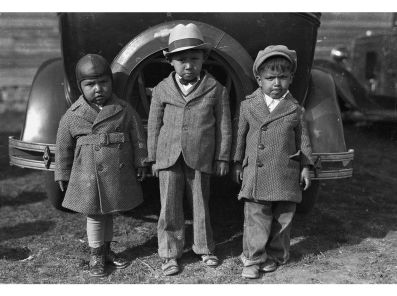
Photograph of Kiowa children, by Horace Poolaw, Oklahoma, 1928.

Teju Cole, a Nigerian living in New York City, is one of my favorite writers and photographers. In his recent column in New York Times Magazine, he compares the portraits by Horace Poolaw, Kiowa, with those by Edward Curtis.  Poolaw’s images show us “life as it was being lived”, while Curtis photos are contrived and “stilted”.


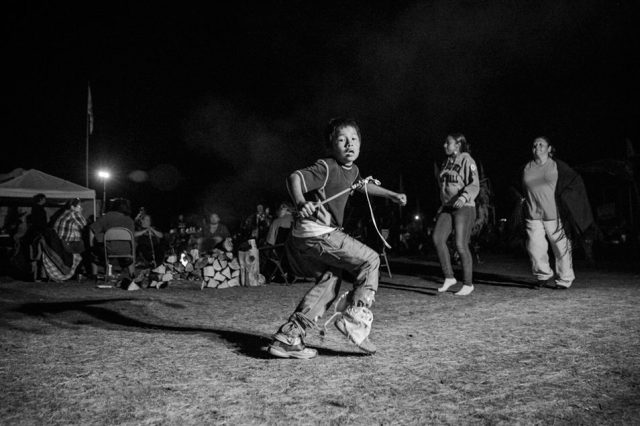
Cole then goes on to give shout-outs to a number of contemporary Native American photographers:  Brian Adams (Inuit), Josué Rivas (Mexica), Camille Seaman (Shinnecock), as well as the work of Daniella Zalcman, a non-Native covering the boarding school experiences of indigenous people in Canada.

photos4

One of Josué Rivas’ many iconic photographs from Standing Rock. 

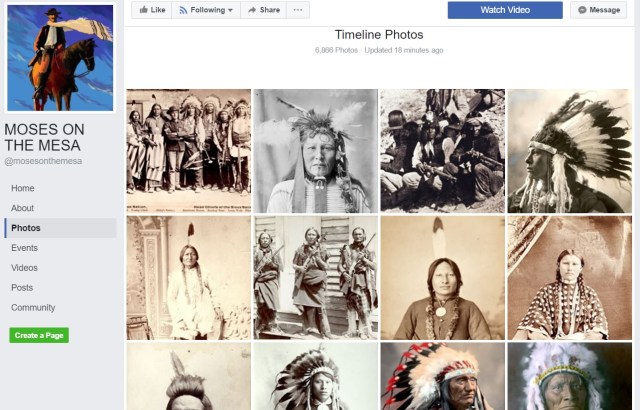
All of this reminds me, a spontaneous crowd-source event has occurred at the Facebook page for Moses on the Mesa, a short film about a German Jewish immigrant living at Acoma Pueblo in the 1800s.  A discussion on the page led followers to begin posting old photographs of Native Americans, especially those not by Edward Curtis.  Click on Timeline Photos.  As I write, it was updated 18 minutes ago and now contains an astounding 6,866 photos, making it probably the largest on-line collection of Native American photographs.

photos1

Screenshot from the Moses on the Mesa Facebook page


Posted in my own thoughts, news, Standing Rock | Tagged , , , , , , , | Leave a comment

Standing Rock: Victory in Court

war-zone-15

The judge has essentially overruled Trump and returned us to this moment when an EIS was required. 

A federal judge made a mixed ruling today, though largely in favor of the Standing Rock Sioux Tribe (SRST), that the permitting process for the Dakota Access Pipeline was flawed.

Earthjustice, whose legal team represented SRST, has issued a press release.

The full 91-page decision by the judge is available online.

The judge will rule next week whether or not the pipeline should be shut down while a proper permitting and review process takes place.

This ruling is in keeping with my analysis of the environmental permitting process. When Trump abandoned the Environmental Impact Statement (EIS), the old and deeply-flawed Environmental Assessment (EA) became, once again, the permitting document for the pipeline. It concluded with a Finding of No Significant Impact (FONSI), while ignoring important tribal issues. The judge apparently felt the same.

For background on the EIS process, and a summary of the Dakota Access EA and its flaws, see this post.

Further analysis of the judge’s decision will be forthcoming on this blog.


Posted in news, Standing Rock | Tagged , , , , , , , , , , , , , | Leave a comment

Standing Rock mercenaries’ secrets revealed

war-zone2

Threatening and violent behavior by ETP mercenaries was commonplace during the pipeline standoff.

In recent weeks, whistleblowers have revealed documents and stories regarding renegade behavior by private security firms hired by Energy Transfer Partners (ETP) to protect the Dakota Access Pipeline from protesters.  But the mercenaries went a lot further than that, creating military hype to demonize the Standing Rock Sioux and their allies, infiltrating their camps to plant weapons as a pretext for arrest, and deliberately setting the fire on the Backwater Bridge.  Here are the recent news stories:

  1. The Intercept story (with leaked documents) Part 1.
  2. The Intercept story (with leaked documents) Part 2.
  3. High Plains Reader story about Kourtni Dockter, the former security guard who is speaking out about the unethical and illegal activities of the mercenary firms.

This previous blogpost, Red pilgrimage: right-wing counties send their cops to Standing Rock, documents how it was primarily the most conservative counties, both from local rural areas and from conservative suburbs of Chicago and even New Orleans, that sent their officers with surplus US military equipment to Standing Rock. The three progressive counties that sent law enforcement all recalled their officers as the police brutality became evident.


Posted in Standing Rock | Tagged , , , , , , , , , , , | Leave a comment

Birding in Gambell: Native and White cultures come together at the edge of the world

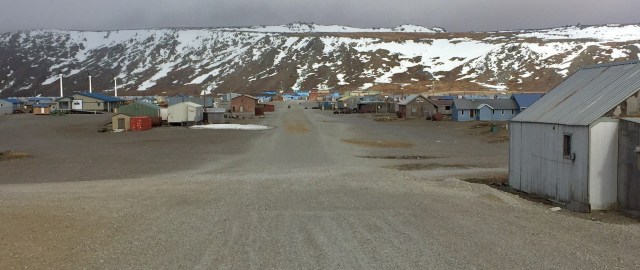
Gambell17

Main street in Gambell, St. Lawrence Island, Alaska.

Gambell7

Yesterday’s bowhead whale on the beach between the town and the point.

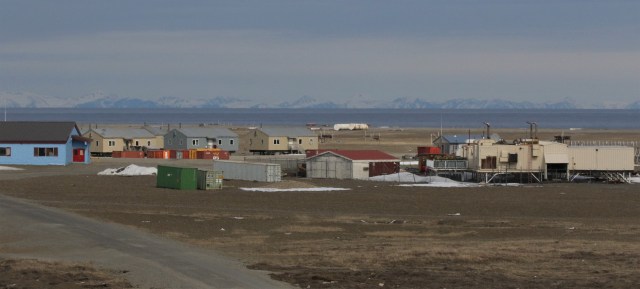
In the middle of the Bering Sea, where the only other visible land are the gleaming snow-clad peaks of the Russian Far East, two cultures meet in a strange symbiotic juxtaposition.  Gambell is a Siberian Yupik village, named for the missionary that lived there for a few years in the 1890s.  Its original name was Sivuqaq, still a widely used moniker.  Its seven hundred residents are packed into small box houses on a gravel plain Gambell1on the northeast tip of St. Lawrence Island.  Because of its location, midway between North America and Asia, it attracts an extraordinary collection of bird life. Seabirds wing around the point, en route from wintering areas in the Pacific to breeding grounds in the Arctic. Migrating songbirds, both Asian and American, find it a literal island in a storm.

Gambell11

A “Siberian” Common Chiffchaff, of which there are fewer than 15 North American records.

It’s the latter feature that attracts the birders, hardcore “listers”, mostly from the Lower 48, keying in on Asian vagrant songbirds and the fact that the American Birding Association, perhaps relying more on political boundaries than natural geography, considers the island “North America”.  During spring and fall migration, birders can add an eye-popping list of mega-rarities to their North American list in just a few days. Personally, I saw Eyebrowed Thrush, Common Chiffchaff, and Pallas’s Bunting in my first forty-eight hours there.

Gambell10

Crested Auklets with a Least Auklet; the Yupik occasionally hunt the former.

The birding here is quite different from a peaceful saunter in the woods back home, and it’s not for everyone. It takes on the feel of a military operation on frozen tundra. A group of birders may be seeking a warming break from the thirty-three-degree air in the lodge, which has all the accoutrements of a double-wide used by a duck club. Another group, from a different tour operator, may be out at the point, braving the chill wind at a “seawatch”. Some unaffiliated “independents” may be elsewhere around the village, down along the lake, or over at the seabird nesting cliffs.

Simultaneously, all of their walkie-talkies crackle with a report of an Asian vagrant at the Far Boneyard. This is an ancient village site, a midden littered with walrus bones and other artifacts from thousands of years of human survival in an icy world rich with marine life. The decomposing nutrients of the bones create fertile soil for various grasses and plants, which in turn attract birds in this treeless landscape. There is the Near Boneyard, the Far Boneyard, and the Circular Boneyard, all within a short walk of the current townsite.

But walking is a chore here, slogging thru deep pebble gravel. It warms you up, strengthens your ankles, and wears you out. The birders jump on their ATV’s (called “Hondas” by the locals) and rumble to their destination. The twenty-Honda convoy rumbles through the village, swings to one side of the boneyard, everyone hops off, and then forty birders, for they all rode double, assemble into formation. Spread out in a line, they walk in lock step, sweeping the boneyard for any movement with their Swarovski binoculars, Leica scopes, and Canon 400mm lenses, the total cost of which just about equals the $8,000 per capita income for Gambell. When one considers that a few days on Gambell, including airfare from Nome, lodging, and Honda rental, will set you back a thousand dollars or more, those who travel here are only the most dedicated, committed, or obsessed.

Gambell13

Gambell15

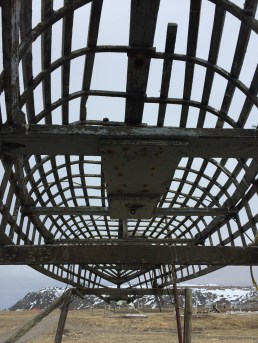
An umiaq frame, to be covered with walrus hide for hunting whales.

The native Yupik are likewise determined, though they use nature in a different way. While the birders are, in general, wealthy, older, and white, the Yupik are poor, eking out an existence that utilizes both subsistence hunting and modern entrepreneurship to make ends meet. For them, nature is a resource they have relied on for thousands of years and, despite a connection to the modern world, they still rely on it extensively.

They take a few bowhead whales each spring, physically throwing an explosive-tipped harpoon from a small skiff (called an umiaq) powered by a small outboard motor.  In the old days they used sails, which the elders still prefer. The skiff may be aluminum or walrus-hide.

When we were there, they brought in a minke whale, which they take when they can get them.  The meat is shared around the community, but the credit went to the seventeen-year old at the helm of the harpoonist’s boat. We also saw many gray whales migrating past, but these are not typically on the Yupik menu.  Racks outside some of the homes were hung with seal meat, drying in the Arctic sun.

For anyone questioning the morality of subsistence whale hunting, and for any birder about to visit Gambell or Utqiaġvik (Barrow), I recommend you read Whale Snow: Iñupiat, Climate Change, and Multispecies Resilience in Arctic Alaska before you pass judgement. 

Gambell4

Seal meat left to dry on a rack.

The primary target of the islanders is the walrus, prized for their ivory tusks.  The St. Lawrence Islanders are known for their ivory carvings. But the walrus can only be hunted when the sea ice is thick enough to hold them and leads open to allow boat access.  This past winter the ice did not arrive until January and was gone by late April, allowing few opportunities for a hunt.

The only news I received of the outside world while I was on the island was from an elder informing me that Trump had pulled out of the Paris climate agreement. Sitting in the Alaska Airlines boarding area in Nome a few days later, I listened to two women from the region bemoan the difficulties their hunters had this season. They talked like it was a one-off bad year, but we all know it’s not.

Gambell5Gambell felt like villages I’d been to in Africa, India, or the Amazon. Children were everywhere and had freedom to play. Twelve-year-olds jumped from rooftop to rooftop, ten-year-olds drove Hondas, and six-year-olds poled small rafts out across icy ponds. Dust swirled down the main street, dogs adopted homes (not the reverse), and the single general store was the central gathering place, festooned with notices about church activities, new cigarette prices, and the dates this summer when a dentist would visit. While the adults spoke Siberian Yupik to each other, the kids spoke English, suggesting their language may be vanishing like the sea ice.

Gambell8

Seabirds wing past the point as the mountains of the Russian Far East define the horizon.

Yet Gambell’s isolation and latitude gives it a unique air. With twenty-four hours of daylight, the town seemed to come awake after noon, enjoy the slightly warmer evening, and to not retire until after midnight. The only exception to this was youth basketball practice, held outdoors at 7am in thirty-two-degree weather. Native Alaskan villages take their basketball seriously. The largest trophy on display in the general store, a multi-tiered two-foot-tall golden and fake marble masterpiece, was for first place in the Annual Gambell Shootout.  The town is tethered to the outside world by four flights a day from Nome (two each from Ravn and Bering Air).

Gambell14

The passengers on our flight from Nome included me, my son, and lots of Dr. Pepper.

A doorknob or water heater part (for the lodge) can be requested by phone, purchased in Nome, and arrive in Gambell before the day is out. When a plane lands, a half dozen Hondas race from the village several hundred yards to the tarmac, help the pilot offload the boxes, and promptly bring the requested appliance parts to those who ordered them. A fuel barge arrives each summer, delivering the year’s supply of gasoline for the Hondas, heating oil for the household furnaces, and diesel for the local electricity generating plant, as well as any larger items that don’t fit on a small plane.  They get television, and the young people that wash dishes in the lodge play hip hop on their iPhones while they work.  The only other town on the hundred-mile-long island is Savoonga, which is thirty minutes by air or six hours by Honda. One man told me he did it in less than two hours in winter by snow mobile.

The entire island, all 1,800 square miles, is privately owned by the Sivuqaq and Savoonga Native Corporations. They hold the keys and access is a privilege. The birders are guests

Gambell6

Inside the store, where a bag of Doritos will set you back $12.

and must acquire a $50 “crossing permit” upon arrival. This allows them free reign to about two square miles, leaving burial sites and hunting areas for the locals. Even within this area, local hunters have priority over birders, and they do enjoy the occasional Crested Auklet or waterfowl to supplement the expensive canned goods from the general store. Even near Nome, I saw Alaska Natives harvesting Glaucous Gull eggs on an island in Safety Lagoon. They explained that, this early in the season, the birds will re-nest.

The relationship between the villagers and the birders, on a day to day basis, is a bit like two ships passing in the night, in that they rarely converse with each other, though they walk past, or ride past on their Hondas, each other all the time. I imagine it’s a bit like the relationship between Himalayan climbers and the Sherpa communities. Like the Sherpas, the Yupik reap an economic windfall from the birders. The lodge is owned by the community, by the Sivuqaq Native Corporation, and its proceeds are presumably distributed to meet community needs. The Hondas are rented by private individuals who post their names on a list. Every evening locals come into the lodge common area to offer ivory carvings, other art pieces, or even old artifacts from the boneyards for sale.

Gambell9

The dining hall in the lodge.  It’s basic, but clean, with hot showers and a large kitchen.

Their sales pitches often include a personal note regarding their economic need such as what basic expense they can cover by selling this carving. To their credit, the birders bought generously.

The lodge was originally created as the barracks for the construction crew that built the large K-12 school, but was then converted into a guest lodge for tourists. Peak season is early June and late September, during spring and fall migration. During the rest of the year, the Yupik of Gambell are largely free of binocular-clad Honda caravans crossing back and forth through their village to chase the next Asian warbler. The mutually beneficial relationship is, in part, the work of dedicated souls from both communities, such as Paul Lehman and Clarence Irrigoo.
Gambell16

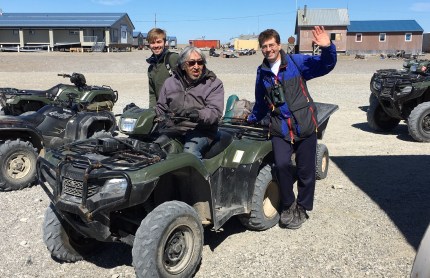
My son and me with Hansen Irrigoo, liaison between the lodge and the birders.

I met Clarence on my first day there. I was out in the Near Boneyard, walking among walrus bones, hoping to flush a mega-rarity. Off to my right, an old man was meandering about, seeming to be looking for something, and gradually drifting closer to me. I imagined he wanted to sell me an ivory carving, or perhaps tell me I was doing something wrong. Instead, his first words, difficult to understand because of his lack of teeth, were, “I found a thrush.” Without binoculars, he was birding, trying to help us. As he went on to describe it, his excitement conveyed he too enjoyed finding Asian vagrants. He told me he was leaving on the next plane, later that afternoon, to join a Russian research vessel to the north. “We’re going to see,” he jiggled with joy and his voice rose in anticipation, “so many walruses!”

“Will you be hunting them?”, I asked.

“No,” he replied. “Biopsies!”

He was just happy, after the dismal lack of sea ice and walrus this winter, to get a chance to be around his beloved animals. As for me, I was grateful the Yupik allowed us to come to their island.
Gambell2

Gambell, the Bering Sea, and the Russian Far East; June 1, 2017

Posted in my own thoughts | Tagged , , , , , , , , , , , , , , | Leave a comment