 Here are the basic facts. There’s an oil boom in North Dakota in a region called the Bakken oil fields, which produces high quality oil, so pure that some workers up there have put unrefined Bakken crude oil straight into their trucks and it worked. What’s more, they get this oil by fracking—injecting water and chemicals, under pressure, deep into the earth to break up the rocks and drive the oil out.
  There’s so much Bakken oil (and similar fracked oil coming from West Texas) that the US has basically flooded the market and caused the worldwide price collapse (from about $100/barrel to $50/barrel). That’s taken some of the desire out of oil production in the Bakken, but nevertheless, industry is preparing for the price to eventually come back up. To that end, they need to address their biggest problem, moving the oil from North Dakota to refineries, which are mostly on the East Coast, West Coast, and along the Gulf of Mexico. There’s only a few pipelines connected to North Dakota, so they’ve been moving the stuff in trains—often in really old tank cars. As we’ve learned in the last few years, shipping Bakken oil by train has its risks; the oil is so close to gasoline that it often explodes and catches fire during a derailment. It’s also cheaper in the long run to ship oil by pipeline. Hence, the Dakota Access pipeline.

Dakota Access LLC, a subsidiary of Energy Transfer Partners, wants to build an underground pipeline from North Dakota to Illinois. At 30 inches in diameter, it will be able to carry 470,000 barrels per day, almost half of all Bakken production. It will connect North Dakota to a transport center in Illinois, and thus to Gulf Coast and East Coast refineries and markets.
Permits and Laws
To do this, the company needed to get a lot of permits: from various state agencies in each state it passes thru (North Dakota, South Dakota, Iowa, and Illinois), and from at least two federal agencies (the US Army Corp of Engineers and the US Fish and Wildlife Service). All of the states have approved the pipeline, although some farmers in Iowa are especially upset and have sued the state over dirty dealing involving bribes with teenage prostitutes; their case may go to the Iowa Supreme Court. The US Environmental Protection Agency, the US Department of the Interior, and the Advisory Council on Historic Preservation, requested that the US Army Corp require a full Environment Impact Statement (EIS) (basically an extensive study with an opportunity for public comment) but this never happened. The final approval, from the US Army Corp, came in late July 2016.
Under the law, the company did not need direct approval from President Obama. However, the federal permitting agencies (the US Army Corp) did need to consult with federally-registered tribes wherever the project has the potential to impact tribal lands. This did not happen.

Drone photo showing the pipeline corridor approaching Lake Oahe in the distance.
Because the pipeline crosses under the Missouri River less than a mile upstream from the Standing Rock Indian Reservation, and the Sioux depend upon the river for drinking water and irrigation, the Standing Rock Sioux immediately filed suit against the US Army Corp on July 27, 2016.
On August 10, construction began several miles north of Standing Rock—and so did Sioux confrontations with authorities. Standing Rock Sioux Tribal Chairman Dave Archambault was among eighteen arrested on that day.
On August 29, a local landowner just north of the reservation permitted Tim Mentz, a professional archaeologist who previously worked for the State Historic Preservation Office, to examine the pipeline corridor route immediately west of Highway 1806. Mentz documented “82 significant historical markings, of which 27 were grave locations.” On September 2, the tribe filed in federal court for an immediate injunction to halt construction and released the precise locations of the historical sites (which tribes generally don’t do unless it’s absolutely necessary). Chairman Archambault described what happened next: “The corridor work was many miles away from the historic site that was identified. The next day after we filed, Saturday, September 3, the construction workers and equipment leap-frogged ahead and bulldozed the site.” (This betrayal of sacred site information will likely have repercussions nationwide.)
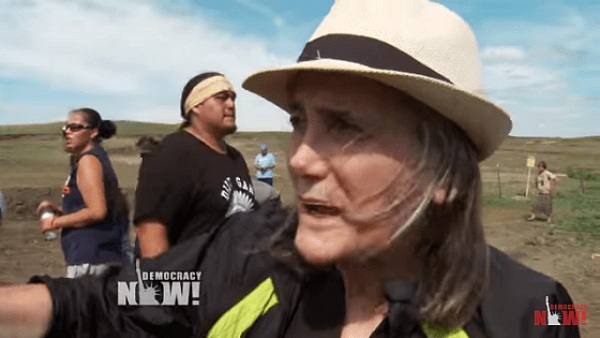
 As it was the Saturday of Labor Day weekend, with a court ruling on the injunction expected in a week, the sudden construction on this parcel caught the protesters by surprise. They were enraged. When some women ran out in front of the tractors, dogs from a private security firm were used to attack them. Amy Goodman’s dramatic video of that incident for Democracy Now! quickly went viral and led to mainstream news attention. (The North Dakota State Attorney then had her arrested and charged with rioting, as a journalist, but the case against her was dismissed by a judge.) Governor Jack Dalrymple declared a state of emergency and activated the North Dakota National Guard.
On September 9, 2016, a federal judge ruled against the tribe’s request for an emergency injunction and in favor of the US Army Corp, saying the Corp “likely complied” with the law and the tribe “has not shown it will suffer injury…” (This is surprising since the tribe had been speaking out against the pipeline since 2014.) Minutes later, in an extraordinary move and under orders from President Obama, the US Department of Justice, the US Department of the Interior, and the US Department of the Army issued a joint statement halting construction of the pipeline on US Army Corp property along the Missouri River and Lake Oahe (near the Standing Rock Reservation), pending reconsideration under the National Environmental Policy Act (NEPA), which basically means they are revoking permission and will probably require the company to prepare an EIS, which the US Army Corp can then reject and stop the pipeline as currently planned. It’s a long process. The statement also asked the company to voluntarily pause all construction for 20 miles on either side of the river (where the federal government does not have jurisdiction).
The feds’ joint statement made some additional broader statements regarding federal relations with tribes in general. It went on to say, “this case has highlighted the need for a serious discussion on whether there should be nationwide reform with respect to considering tribes’ views on these types of infrastructure projects.” The joint statement then concluded with, “we fully support the rights of all Americans to assemble and speak freely” and “we have seen thousands of demonstrators come together peacefully, with support from scores of sovereign tribal governments, to exercise their First Amendment rights and to voice heartfelt concerns about the environment and historic, sacred sites. It is now incumbent on all of us to develop a path forward that serves the broadest public interest.”
So, where are we now? Both the Standing Rock Sioux lawsuit and the federal government will likely require an EIS for resolution. Because the EIS will take many months to prepare, a final federal decision on the pipeline route will likely fall to the next administration, probably Hillary Clinton. And while Obama visited Standing Rock (the first president ever to do so), Clinton has been remarkably silent and non-committal on the protest.
 The battle on the ground now appears to be over the voluntary buffer. The federal agencies requested the company to stop construction for 20 miles either side of Lake Oahe, presumably to allow for re-routing of the pipeline. However, because the federal government only owns the land immediately adjacent to the lake, it cannot enforce this request. The company has an incentive to ignore the request and built right up to the edge of Lake Oahe. This will set the stage, months from the now, when the federal government presumably considers an EIS. If the company voluntarily obeys the request and honors the 20-mile buffer on each side, the government can more easily suggest an alternative route. If the pipeline is already completed right up to the lake on each side, there will be strong pressure to allow the rest of it to continue as planned. This is clearly the company’s plan, and consistent with their brazen approach of beginning construction before all the permits were in place. Note, however, that any likely route will pass upstream of the Standing Rock and Cheyenne River reservations and still place them at risk.

The Land
There are two aspects of the pipeline route that rub the Standing Rock Sioux the wrong way. First, while the route is decidedly not on the reservation, it passes under and poses a risk to the Missouri River on which the Standing Rock Sioux depend. On this point, the past and present run together rather seamlessly, at least to the Sioux.
The pipeline corridor lies north of the reservation in areas the Sioux call “unceded lands” which they were given in the Fort Laramie Treaty of 1851 but were not relinquished in the Fort Laramie Treaty of 1868. (More on these treaties in a future blog post.)
The Standing Rock Indian Reservation is home to the Hunkpapa Lakota and Yanktonai Dakota bands. See this blog post for a diagram of the various Sioux bands and a summary of the storied history of the Great Sioux Nation and its devolution into the Standing Rock, Cheyenne River, Pine Ridge, Rosebud, and Crow Creek Reservations. The reservation was created in 1877 in the aftermath of the Great Sioux War, contrived by President Ulysses Grant to annul the Treaty of 1868 and steal the Black Hills from the Sioux after gold was discovered there. (The Supreme Court has since ruled that the war was unjust and the tribes should be compensated for the Black Hills.) The war included Custer’s Last Stand and the assassination of Crazy Horse while in captivity. Standing Rock made the news again in 1890, when the legendary and world famous chief Sitting Bull was shot and killed by reservation police trying to detain him during the Ghost Dance movement, which sought to reassert Native traditions and identity in the face of systematic oppression and economic deprivation.

Iconic image during the Wounded Knee standoff in 1973.
The Wounded Knee Massacre, also to repress the Ghost Dance movement, occurred on the Pine Ridge Reservation two weeks later. Cut to the early 1970s, and a similar movement came to a head again at Wounded Knee, when the American Indian Movement sought to challenge political oppression, corruption, and collusion of reservation leaders with the US government. (For details of that conflict, as well as the related story of Leonard Peltier, see this blog post.) The upside-down American flag flown during the 1973 Wounded Knee protests can be seen at the Standing Rock protest site today.
Far from an isolated event, the protest at Standing Rock is the culmination of long-standing grievances between the Sioux and the federal government, specifically with regard to the Standing Rock Natives and the management of the Missouri River by the US Army Corp. They’ve been here before. In 1960, the Army Corp constructed the Oahe Dam and created Lake Oahe, one of the largest reservoirs in the nation. It converted the Missouri River into a 231-mile-long lake that stretches from Pierre, South Dakota to Bismarck, North Dakota. The entire length of the Missouri River along the Standing Rock and Cheyenne River reservations is now part of this lake. The lake flooded homes, towns, sacred sites, burial grounds, river valley agricultural land, and 90% of the woods and timber on the reservation. It flooded 200,000 acres on the Standing Rock and Cheyenne River reservations, and robbed them of the deer and wildlife they had used for subsistence in the midst of poverty. (This was part of an Army Corp dam-building spree nationwide that flooded Native lands and destroyed livelihoods. Other examples include the drowning of Celilo Falls on the Columbia River in 1957, and the Kinzua Dam on the Allegheny River, made famous in a song by Johnny Cash.) The town of Cannon Ball, in the northeast corner of the reservation along the lake, and ground zero for the protests, was named by white settlers after the unique round sacred stones along the river which were flooded by the lake. As lake levels change, historic village sites and even bones of ancestors routinely appear along the shoreline. Trespassers have made off with skulls, perpetuating a long, dark history in the traffic of Native remains and artifacts. To this day, the Sioux say the land seizure was illegal, in violation of their treaty, and that they were never fully compensated. In a classic case of environmental injustice, those living on the reservations benefitted least from the navigation and hydropower benefits of the dam. They argue that their poverty (with an unemployment rate of 79% on the Standing Rock reservation) was made worse by the dam. They compare it to the deliberate eradication of the buffalo, a kind of biological warfare that deprived them of their ability to sustain themselves.

Frontline Camp along Highway 1806, with pipeline corridor scar in background.
They now view the pipeline as a similar threat, where they bear only the risk and reap little of the benefit. A spill could contaminate the Missouri River/Lake Oahe, which they depend on for drinking water and agriculture, because the groundwater on the reservation is too high in minerals to be used. And they have no faith that the federal government and petroleum industry would protect or compensate them in the event of a spill. In the words of Tribal Chairman Archambault in 2015, “Standing Rock has always opposed oil development and pipeline development. Our biggest concern is our water. We want to make sure a lot of the things being done today for economic benefit don’t damage the future.”
The second aspect of the pipeline that touches a raw nerve is that the original pipeline route in North Dakota used to be closer to Bismarck. It was relocated because a spill near Bismarck would threaten the water supply for the city. This is a classic violation of “EJ”—environmental justice, which was codified in 1994 when President Bill Clinton issued Executive Order 12898, requiring all federal agencies to consider how their action may impact minority communities. According to the US EPA, EJ “means no group of people should bear a disproportionate share of the negative environmental consequences resulting from industrial, governmental and commercial operations or policies.” EJ became an issue exactly because, from Richmond, California to the Navajo Nation to industrial sites in the East, industrial infrastructure with negative environmental consequences are located near their communities.
The Risk
While the Standing Rock Sioux are appalled at the deliberate destruction of sacred sites by the pipeline construction, their larger concern is the threat to their water supply posed by an oil spill. This concern is not without merit.
The largest tributary of the Missouri River is the Yellowstone River. This river suffered two significant oil spills in recent years, both from pipeline breaks:
- July, 2011. ExxonMobil pipeline ruptured near Billings, Montana, spilling 63,000 gallons into the river. The pipe broke adjacent to the river during high flows, when the water scoured the river bottom, exposing the pipe.
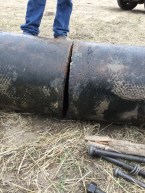
Bridger pipeline
- January, 2015. Bridger pipeline ruptured in Montana just upstream of the North Dakota border, spilling 50,000 gallons into the river. The pipe broke exactly where it crossed under the river. Responders used a submersible robot to investigate. They reported, “Information from the submersible camera showed 120 feet of pipeline is exposed and located one foot off the river bed for 16-22 feet.” Again, the river had scoured deeper and exposed the pipe, which cracked under the weight of the current and possible debris in the river. Cleanup was delayed due to ice on the river. Drinking water in the town of Glendive was contaminated and water monitoring was required 90 miles downstream.

Cleanup crews battle tar sands on the Kalamazoo River.
Two other spills loom large in the collective conscious of the Sioux: 1) the massive Enbridge pipeline oil spill into the Kalamazoo River in Michigan in 2010, a million-gallon spill that spread heavy crude oil for thirty-five miles and required four years to fully clean up; and 2) the on-going battles of indigenous peoples in the Amazon in the face of repeated pipeline oil spills contaminating the waters they depend on for sustenance.
(More on pipeline risks and spills in a future blog post.)
The Protest
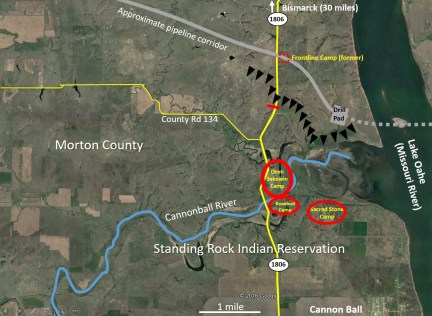
Rallying under the hashtag #NoDAPL, the protesters (who, as defenders of a sovereign nation, prefer to be called water protectors) have created a massive camp along the Cannonball River just north of the little reservation town of Cannon Ball. At present, it has 700 people (but swells to several thousand on weekends) digging in for the winter. They have organized a small city with committees for food, water, shelter, medical care, child care, a small school, and of course planning for protest actions, legal support, and non-violence training. A baby was born there the other day. The camp, called Sacred Stone Camp, has become a rallying point for indigenous peoples nationwide. The movement parallels the “Idle No More” movement among Canada’s First Nations, whose goal is “to protect the land and water”. The encampment has received letters of support from over 300 Native nations and dozens of cities. Tribes across the continent have donated water, food, firewood, and over $300,000 for legal defense. It is possibly the most complete gathering of Native American tribes in the history of North America.

The latest developments occurred on October 22, when over a hundred protestors were arrested in a confrontation that included police in riot gear using pepper spray and mace on people standing peacefully and still. This video of this event is emblematic of white/Native conflict in North America; it shows a vast landscape and a heavily militarized white force aggressively confronting Native men and women seeking to protect access to their natural resources. Other reports describe police shooting down drones with rubber bullets. In response to police brutality, the protestors have established road blocks to keep the police out, as well as a Frontline Camp directly on the pipeline corridor.
To follow the latest developments, see:
Here is a list of just some of the GoFundMe campaigns:
More GoFundMe campaigns can be found by searching under Sacred Stone.
My new post explains why the Dakota Access Pipeline no longer makes economic sense:
Here are my previous posts on Standing Rock and the Dakota Access Pipeline, which focus more on the history and current status of the conflict on the ground:


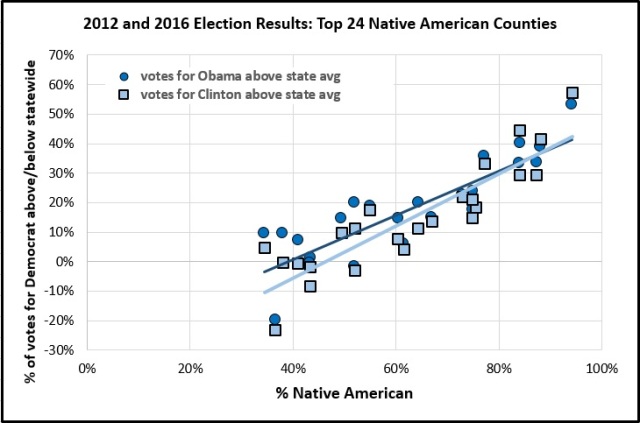
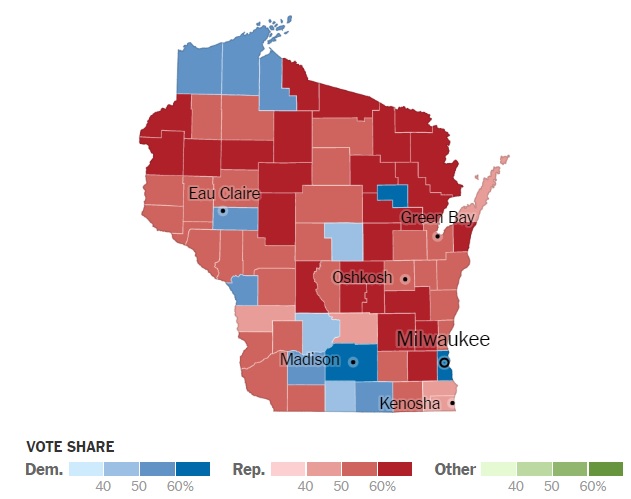
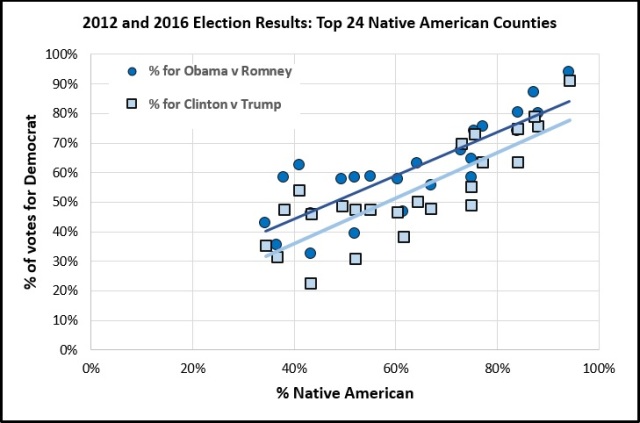 Native Americans voted overwhelmingly against Donald Trump, consistent with their previous support for Barack Obama. In a review of 24 of the most Native American counties in the nation, it is clear that the more Native Americans there are in the county, the greater the percentage of votes there were for Hillary Clinton. The relationship is close to one-to-one, ranging from Cherokee County, OK (34% Native American, 35% for Clinton) to Oglala Lakota County, SD (formerly known as Shannon County) on the Pine Ridge Indian Reservation (94% Native American, 91% for Clinton). Many of these predominantly-Native American counties are in rural areas in red states, surrounded by extremely conservative white ranchers. On county-level maps of election returns, the blue squares are either urban areas or Indian reservations.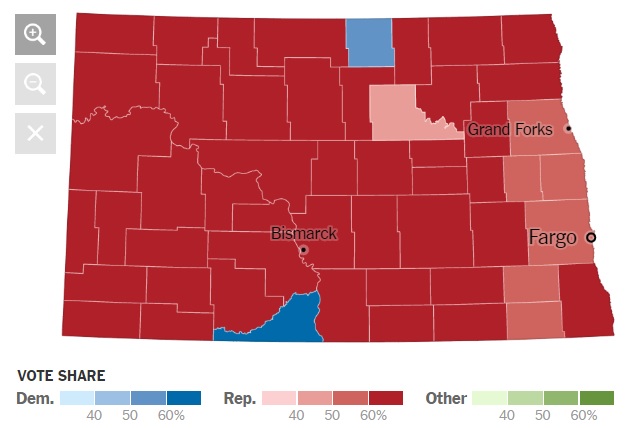
 On October 27, a combination of military-equipped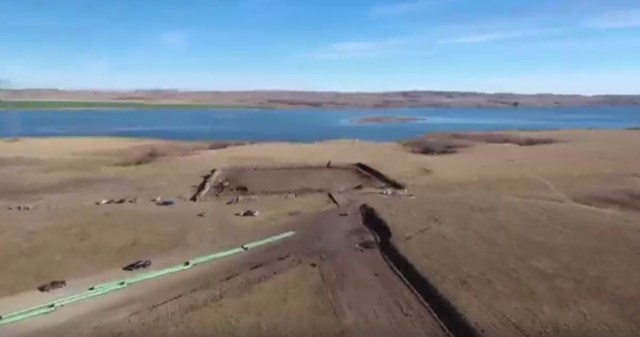
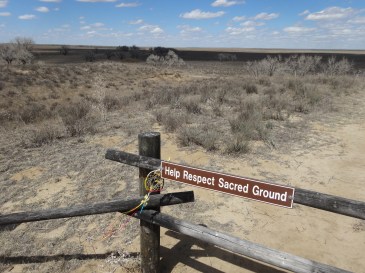
 The commitment to non-violence of the protesters at Sacred Stone Camp, the headquarters for the movement, can be seen both in the video footage above and in this sign posted at the entrance to the camp. For a more complete account of life at the camp, see this
 I’m re-blogging

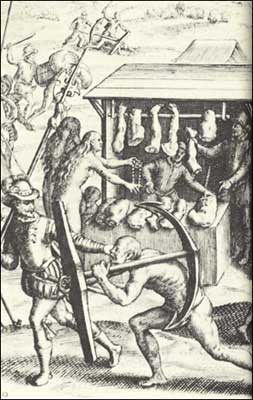 the Spaniards train their fierce dogs to attack, kill and tear to pieces the Indians. It is doubtful that anyone, whether Christian or not, has ever before heard of such a thing as this. The Spaniards keep alive their dogs’ appetite for human beings in this way. They have Indians brought to them in chains, then unleash the dogs. The Indians come meekly down the roads and are killed. And the Spaniards have butcher shops where the corpses of Indians are hung up, on display, and someone will come in and say, more or less,”Give me a quarter of that rascal hanging there, to feed my dogs until I can kill another one for them.” As if buying a quarter of a hog or other meat.
 He relates another story where a Spanish expedition, traveling through Nicaragua, was running low on food for their dogs. They tore a child from his mother’s arms, cut off his arms and legs, and fed him to the dogs.
 near Tampa Bay. They were a key instrument in De Soto’s deadly foray through the American southeast in the 1540’s, terrifying local chiefs into compliance. An entire book has been written on the subject,

 Memories of the People