Bernie’s attention to Native issues is unprecedented

Bernie Sanders appointed a respected Native advocate as his adviser on Native issues– and it appears she’s doing a good job and he is listening to her.  It’s hard to think of a presidential candidate– ever– that gave such attention to Native concerns.  Here is the latest summary from Indian Country Today Media Network.

bernie

Posted in news | Tagged , , | 1 Comment

Solar arrays in the desert: Killing more birds than you imagine

In the past three years there has been a stunning and seemingly reckless increase in solar farms in California.  Before 2013, solar farms covered four square miles of land.  They now cover nearly 60 square miles and more are planned.  (Here is a Google Maps file that shows the solar arrays in California; zoom in to see their actual footprints –or switch to satellite view.)  They represent some of the largest solar arrays in the world.  There are other smaller farms as well, and a few larger operations in Nevada, Arizona, and elsewhere.  The majority, however, are in California.

solar4Ivanpah1

The Ivanpah solar array with its “power towers” kills birds thru collisions and outright scorching them in mid-flight.  This array is 4 1/2 miles from end to end.

solar10table

*CSP = Concentrated Solar Power (essentially using mirrors to create a heat source)

solar7CalifValley

California Valley Solar Farm, as seen from a flight between Sacramento and Burbank.

Located mostly in the desert and Coast Ranges, they convert the sun’s rays to energy through several different processes:  some use standard photovoltaic cells; others essentially boil groundwater with giant mirrors, creating steam to generate electricity.  While all involve vast expanses of mirrors or solar panels, some include evaporation ponds and others have giant power towers collecting high intensity heat.  Opposition has mounted regarding their massive footprint on the habitat, impacts on viewsheds, impacts to Native American artifacts and resources, impacts to the endangered desert tortoise, and, most especially, their massive impact on birds.  This blog post details the last item.


solar3YRWA

Dead Yell0w-rumped Warbler, scorched flying over the solar array at Ivanpah.

The solar farms, probably each solar farm, are killing thousands of birds annually.  From a distance, at the right angle, the arrays shimmer like water in the desert, attracting a variety of migrating loons, grebes, rails, pelicans, hummingbirds, swallows, thrushes, and warblers.  For a list of 134 species found dead at various solar arrays, see Table B.1 of this report.  The birds arriving at the solar fields crash into the mirrors, get burned alive by the reflected heat (called “solar flux”), or simply circle the arrays until they are exhausted.  It is a strange thing to see, as I have, six exhausted Spotted Sandpipers crashing into a chain link fence in the desert, or to find a dead Red-breasted Merganser twenty-five miles from the nearest water.

Fortunately, there have been several comprehensive mortality studies at some of the solar arrays, with careful sub-sampling, and specific analyses of scavenging rates and search efficiency.  Here is a summary of the results:

  • solar2PEFA

    Photo from the Ivanpah report.

    Ivanpah—a comprehensive report, HT Harvey (2015), estimated annual mortality at 2,496 to 5,705 birds, almost all songbirds. It categorized this impact as “low” because “Total detections (and fatality estimates) of any one species represent a small proportion of local, regional, or national populations.”  (This is a common argument made by oil companies to dismiss the significance of oil spills.)  And also because “the cause of death for 42.2% of the detections of species with 10 or more detections was unknown and thus cannot be determined with certainty to have been ‘facility-caused’.”

  • California Valley Solar Ranch—a comprehensive report estimated annual mortality at 4,048 birds (although this total is buried in the pages). Unlike the wide variety of species found at other sites, the majority of the birds impacted at this site are from just three species:  Mourning Dove, Horned Lark, and House Finch.
  • Comprehensive studies are also underway at Topaz Solar Farm and Genesis, but they do not appear to be publicly available.
  • A preliminary study, Kagan et al. (2014), did not systematically estimate annual mortality, but did find 141 carcasses in just three days at Ivanpah (where they observed one bird killed every two minutes at one point). They also collected 61 carcasses at Desert Sunlight and 31 at Genesis, suggesting significant impacts.  These later two locations included a significant proportion of water birds, mostly grebes.
  • California Solar One at Daggett—an early study was conducted in 1984 at this small prototype power tower (only 10 MW) and estimated mortality at only six birds/year (although apparently failing to adjust for carcass persistence). I cannot locate a copy of the study, but it is discussed in Turney and Fthenakis (2011) and Walston et al (2016).
solar4bIvanpah2

Ivanpah, demonstrating the lake effect.

It is understandable that Ivanpah would take such a toll.  It serves a huge attractant for birds migrating across the desert and is visible from many miles away.  The fact that they have even collected a dead Lapland Longspur suggests it is sucking in everything in its path and then some.  What is no less disturbing is the take at California Valley Solar Ranch just north of Carrizo Plain National Monument.  While probably less of a migration corridor, and using less reflective photovoltaic panels, the bird kill estimates are similar, although limited to local species.  To the extent that they are simply wiping out resident birds, mortality may diminish with time simply because there aren’t any more birds left to kill.  The two studies suggest bird kills between 500 and 1000 birds/square mile of solar array.  If extrapolated across California’s 60 square miles of solar farms, the result is a staggering 30,000 birds per year.  This is consistent with Walston et al (2016), just published in the journal Renewable Energy, who stated,

solar1map

Map showing where solar power is most likely to be employed.

“We estimated annual USSE-related avian mortality to be between 16,200 and 59,400 birds in the southern California region, which was extrapolated to between 37,800 and 138,600 birds for all USSE [utility-scale solar energy] facilities across the United States that are either installed or under construction.”


[Walston et al. calculate bird mortality per MW of energy produced in order to compare the take at solar farms with birds killed at wind farms (which turns out to be about the same per MW) and fossil fuel use (which has a much higher mortality, although their analysis seemed crude at best).  Studies at wind farms have revealed that most of the birds are killed by a minority of the wind mills (depending on blade type and location relative to ridges), suggesting there are ways to minimize mortality.  Such information is not yet available for solar farms, although one small discovery at Ivanpah has been shown to help reduce bird kills in a limited context—but it is not the silver bullet that this public relations piece purports.  The proper bird impact comparison for large solar arrays, however, should be to scattered rooftop solar in urban and suburban areas.]

solar5lakeeffect

Another example of the lake effect.

The growth of the solar arrays (many of which are located on public lands) has been motivated by a number of policies that have both subsidized and fast-tracked their approval, and discouraged rooftop solar.  California utilities are mandated to get a third of their energy from renewable sources by 2020, and rooftop solar does not count in that equation.  In fact, in California there have been strong disincentives for installing more rooftop solar than you personally need, although new rules may help promote it.

Environmental Impact Statements for solar farms on large swaths of desert have been approved quickly and say little to nothing about bird kills.  Some have offered “mitigation” in the form of protecting adjacent lands that are under no threat of development.  The federal agency in charge of environmental review, the US Department of the Interior, is literally in bed with industry.  At the same time, the investigation of bird kills is hampered at both the state and federal levels.  As long as the power companies have the full blessing of Governor Jerry Brown and the California Energy Commission, other state agencies are limited in their ability to enforce environmental regulations.  Federally, President Obama has lauded the Ivanpah array, while Republicans are seeking to gut the already-rarely-enforced Migratory Bird Treaty Act, the primary tool the feds have to enforce most of the bird kills (since the number of endangered species impacted is small).

Walston et al (2016) calculate that “full build-out of the nearly 48 GW of potential future USSE developments may account for as many as 480,000 bird deaths annually in the United States.”  Here is what is needed:

  • Comprehensive mortality estimates at all sites

The comprehensive studies at a few sites, taking into account the difficulty in finding carcasses and the rapid removal of carcasses by ravens, are very welcome.  They all need to be available to the public.  Because impacts are likely to vary from site to site depending on the type of mirrors, panels, technology, and geographic setting, these studies should be replicated at all sites.  It would be interesting to know, for example, the difference in impacts between Ivanpah (which resembles a lake in the desert) and Mount Signal (less reflective photovoltaic panels surrounded by green agricultural land and near a large lake).

Most of the reports attempt to minimize bird impacts with nonsensical statements at odds with basic biological facts.  They note that an unspecified proportion of the dead birds may be naturally occurring (as if a solar array provides habitat for these species), that the majority of birds die from unknown causes (heart attacks?), and cast doubt on the “lake effect” of the reflective panels because the proportion of water birds is not always high (ignoring that swallows and migrating songbirds over the desert are attracted to water as well).

This is standard industry fare, but reports that minimize bird deaths or cast doubt on the “lake effect” are both ludicrous and not helpful.  Because hazing is notoriously difficult and anything short of removing the mirrors is unlikely to stop attracting birds (one report suggested marking the mirrors to show birds it is not water—which seems highly unlikely since birds will fly into a window within twelve inches of a decal), it is likely the industry will simply continue to deny the severity of the problem.  Serious solutions are needed, and this requires honest and transparent studies.

Aerial Views Of First Solar's Desert Sunlight Solar Farm

Desert Sunlight, occupying 2.1 square miles east of Joshua Tree National Park.

  • Stop building solar farms and support rooftop solar

Both the state and federal governments should stop the subsidies, loan guarantees, and public land give-aways immediately.  They should give environmental enforcement back to the appropriate agencies.  They should also do everything to promote rooftop solar so that it becomes integral to the grid.

  • Explore creative ways to minimize mortality, such as decoy habitat adjacent to solar arrays

One possible strategy to minimize mortality would be to encircle these facilities with suitable habitat that would intercept birds attracted to the panels from a great distance.  For songbirds, stationing small clumps of trees (even fake trees) and water drippers, at intervals around the edges of an array, would provide cover and a stopping point for migrating birds.  Ideally, they would prevent the birds from further flying around the array until they are killed.  These way-stations would be small enough to not be visible until birds already attracted by the mirrors get close.  Arriving songbirds would be attracted to the trees, outside of the solar arrays, much like a vagrant bird lost over the sea is attracted to the few trees at the lighthouse at Point Reyes or the two trees on Southeast Farallon Island, or a warbler over Lake Erie is attracted to Point Pelee, or other migrants over the desert are attracted to the trees at the Silver Saddle Ranch near Galileo Hill, the community of Desert Center, or the Furnace Creek Golf Course at Death Valley.  They could rest, drink, recover, and move on from tree clump to tree clump until they are beyond the facility.

solar9waystationsFor water birds, a pond of real water, outside but near the array, would have to be provided as an alternative, perhaps with some cattails to signal it is real water.  It would need to be long enough to allow for loons and grebes to take off and land.  Such a pond was built at Searles Dry Lake near Trona.  Hundreds of birds still die each year in the four-square miles of hypersaline discharge, but that mortality is reduced probably ten percent or more by a single one-acre pond that frankly could be improved; it looks very industrial.

solar8PrimmValleyGC

Google Earth image showing Ivanpah on the left and Primm Valley Golf Course upper right.

Further evidence for the success of an alternative pond with real water comes from Solar One near Daggett in the 1980s, where an adjacent pond may have accounted for low mortality there, and at Ivanpah today.  The Primm Valley Gold Course, a green oasis in the desert with several small ponds, is less than a mile from the Ivanpah array and may explain the relatively low proportion of water bird impacts there.  In contrast, the total lack of alternative water around Desert Sunlight and Genesis is correlated with relatively high water bird mortality.

While this recommendation makes perfect sense to birders, it is at odds with current government thinking.  Presently, the USFWS forbids any provision of water near solar arrays, not wanting to provide a water source for ravens, which prey on the desert tortoise (and extensively scavenge the dead birds).  Any ponds within the array fields are netted to avoid creating more of an attractive nuisance.  For songbirds, water drippers could be fenced to exclude ravens but allow smaller birds.  There would be no way to exclude ravens from a pond for water birds.

I offer no guarantee these ideas would work, but they and other creative solutions should be researched immediately.

  • Compensate for the impacts through bird restoration projects

Obviously, large numbers of birds are being removed from their populations.  These can be compensated for by restoring riparian habitat and other efforts that “create” more birds.  Ivanpah has proposed donating funds to feral cat spay-and-neuter programs to help offset their bird impacts.  It’s a nice gesture, but the idea: 1) is of highly questionable utility; and 2) does not really create birds.

Posted in my own thoughts | Tagged , , , , , , , , , , , , , , , , , , , , , | 7 Comments

Happy St. Patrick’s Day from the Choctaw Nation

Here is a wonderful story of how the impoverished Choctaw Nation took up an offering and sent $170 to Ireland during the Great Potato Famine of 1847.  This monument to that act of charity stands in Ireland today.

stpatricks


Posted in news, Uncategorized | Tagged , , , , , , , | 2 Comments

Will the GOP Deny Trump his Manifest Destiny?

trump2.jpgThe Republican Party faces an epic meltdown:  either they yield to the redneck zombie apocalypse brought on by Donald Trump, or they face a brokered convention.  With Trump’s loss in Ohio, the latter is now more likely.
Here are a few thoughts on the upcoming election:

  • For a Democrat, watching the Republican Party now is like watching your chief rival eaten alive by a grizzly.  It’s a horrifying fate you wouldn’t wish on your worst enemy. Yes, it’s good for the Democrats to have the GOP disemboweled, but then there’s that grizzly in the room.  And that grizzly is racism.
  • Trump’s calls to eliminate “political correctness” and make America “great again” are nothing more than thinly veiled code for a return to white hegemony.  His primary policies are simplistic calls to deport brown people, prevent them from coming in, or kill them.
  • His rallies are little more than a cathartic experience for racist rednecks—a pseudo-religious revival meeting calling for a return to an oppressive and racist white America. That he is a billionaire from New York City who has been a Democrat most of his life just adds to the snake-oil-salesman flavor of his campaign.
  • He feeds off the individual protesters inside his venues, making public spectacles of each one. He exhorts the crowd to “knock the crap out of them” while explaining that “these people are bringing us down.  These people are so bad for our country folks, you have no idea.  You have no idea.  They contribute NOTHING!  NOTHING!”  In this, he dehumanizes them very much like Hitler did the Jews in the 1930s.
  • From the Puritan restrictions of intermarriage with Native Americans, to the Declaration of Independence description of Native Americans as “merciless Indian savages” and the Constitution’s quantification of African Americans as 3/5ths of a person, to the broad scale ethnic cleansing under the Indian Removal Act, to the genocides and calls for “Indian extermination” under the name of “manifest destiny”, to the immigration policies that gave citizenship to Europeans but not to Asians, to housing and education policies that kept whites segregated and protected, to the internment of the Japanese, (I’m leaving a lot out here) Trump’s proposals are another dot on the timeline of race manipulation in the United States.
  • Trump has exposed the racist underbelly of America. That a remarkable 40% of Republicans would support him suggests that race is an enormous issue, perhaps the dominant issue, in the United States.  By making a racist platform part on the mainstream political dialogue, Trump’s impact on American society may greatly exceed his impact on this one election.
  • It’s not just Trump or the candidates that cannot talk about race, it’s a large part of the Republican electorate. A conservative friend of a conservative friend made this comment on Facebook: “I don’t think Trump is a racist, although some of the things he says are racist.”  This statement, absurd to liberals, highlights the gulf in just talking about this issue.
  • No candidates, even on the Democratic side, are talking about issues unique to people of color (aside from immigration reform).  Some examples regarding African American (whose votes are taken for granted) and Native Americans (who are too few to matter): There is no discussion of the massive disparities in primary and secondary education between black and white communities, no one demanding federal oversight of all cases involving police violence, no calls for federal intervention (or criminal charges) regarding the water crises in Flint, no investigation into the astounding percentage of urban blacks whose wages are garnished, no discussion regarding returning the Black Hills, no mention of Leonard Peltier or the life expectancy at Pine Ridge Indian Reservation (less than Haiti) (although credit to Bernie Sanders for a willingness to learn about Native American issues).
  • Trump does not represent some outside force taking over the GOP.  He is the result of decades of the GOP playing the race card and the racists fears of poor whites.
  • Trump has had some luck.  His opposition remains remarkably splintered even now.  This has allowed Trump to be the front-runner even though he rarely tops 40% of the GOP vote.  And the order of the primaries and caucuses has mattered.  Had Rubio’s Florida or Cruz’s Texas or Kasich’s Ohio been earlier in the line-up, the story would have been different.
  • After Obama was reelected in 2012 with an unprecedented coalition of women and people of color (he lost the white male vote), Fox News’ Bill O’Reilly bemoaned that “the demographics are changing; it’s not a traditional America anymore. The white establishment is now the minority.” Others suggested the GOP would have to make strong overtures on immigration reform to win back the Hispanic vote.  But they didn’t.  And now history may show they have instead doubled-down in the other direction.
  • Trump may be the only candidate that Hillary can easily beat.  Both have very high negatives for national candidates.  Hillary has been vilified for decades, mostly for attributes not acceptable in women (assertiveness, leadership, etc.).
  • California’s Democrats may ultimately decide the GOP nominee.  With an open primary and the Democratic race possibly over by then, they could be in a position to put Trump over the top. However, every Democrat I talk to said they wouldn’t do it, “It’s too risky.”
  • One of the greatest impacts of Trump on the election is to make Ted Cruz seem moderate. He is not.
  • Donald Trump is not a viable candidate. For that matter, neither is Ted Cruz or Bernie Sanders. The mainstream political parties will only nominate a candidate that is moderate enough to win a general election.  That leaves us with Clinton and Kasich, but the GOP will have to go thru lots of gyrations at the convention in Cleveland to get Kasich on the final ticket.  That said, Kasich may win in Ohio in March and July and November.  In the last three very tight elections, Ohio has held the keys to the kingdom.
  • Latinos may ultimately swing the general election in November in favor of the Democrats regardless of whether or not Trump is the nominee; he has already done his damage to the GOP.  Like California after Prop 87, the GOP has alienated one of the fastest-growing political demographics and screwed themselves for decades to come.
  • Ironically, for Latinos, this makes immigration reform less likely. With Latinos firmly in the Democratic camp and immigration fully politicized, the Republicans have no incentive to compromise and the Democrats can assume their support without really having to do anything (as they do with African Americans).
Posted in news | Tagged , , , , , , , , , , , | Leave a comment

Racism at Nebraska High School Basketball Tournament

just re-tweeting this; it speaks for itself

http://panicbutton.sportsblog.com/posts/13931503/racism-alive-and-well-at-nebraska-state-basketball-tournaments.html


Posted in news | Tagged , , , , | Leave a comment

Trump: anti-Denali and full of racist imagery

trump1

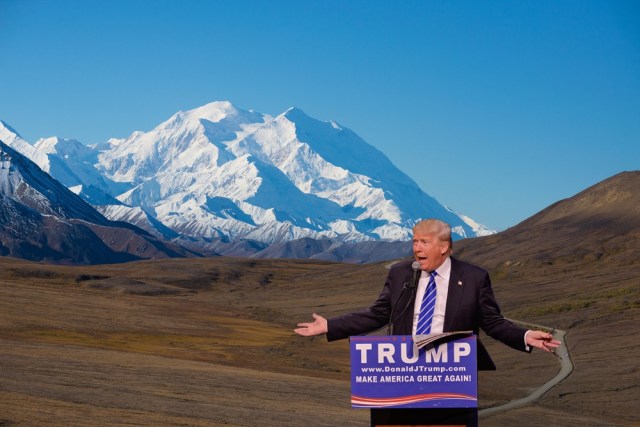
Presidential candidate and National Idiot Donald Trump recently stated that changing the US government’s official name of the continent’s highest mountain from McKinley to Denali (which is what all the locals call it anyway) was “a great insult to Ohio”  – apparently because white people name other people’s lands after some random person that was born 3,000 miles away and that’s important to them.   More obviously, the Alaskans don’t count.  He said he would change the name back.  This is classic trump, ignoring the existence of other people.

Trump’s willingness to use racial stereotypes to motivate white audiences is well-known. Here are a few examples regarding Native Americans from his past business dealings.

http://nativewarriors.co/2016/02/24/not-satisfied-with-his-war-on-immigrants-trump-picks-a-fight-with-native-americans/


Posted in news | Tagged , , , , , , | Leave a comment

Malheur update: Native artifacts impacted

In the aftermath of the militia takeover, the FBI released a statement detailing their process for checking for booby traps, investigating the crime scene, and ultimately re-opening the refuge.  Their statement addressed impacts to Native artifacts:

the FBI is deploying experts with its Art Crime Team to work on the refuge. These agents are specially-trained in cultural property investigations. They will be responsible for working with the U.S. Fish and Wildlife Service and the Burns Paiute Tribe to identify and document damage to the tribe’s artifacts and sacred burial grounds.

They will start with an archeological field assessment to determine any potential violations of the Native American Graves and Repatriation Protection Act (NAGPRA) and the Archeological Resources Protection Act (ARPA). This work will likely take a number of weeks to complete.

Note that, during the militia takeover, the militants rifled through Native artifacts at the refuge, claiming they were helping the Paiute.

An update on the latest findings is here:  ‘It’s So Disgusting’ Malheur Militia Dug Latrine Trenches Among Sacred Artifacts

Paiute


Posted in news | Tagged , , , , , , , , , , | Leave a comment

Re-post: Malheur is now free of militants

Here is my original post on the occupation.

https://memoriesofthepeople.wordpress.com/2016/01/04/more-range-wars-and-white-privilege/


Posted in Uncategorized | Leave a comment

Chris Rock, the Academy Awards, and Native Americans

With the Academy Awards under scrutiny for its all-white nominations, and Chris Rock schedule to host the awards show amid boycotts (he was schedule to be the host before the nominations came out), NPR interviews the 1491s about the The Revenant and plays a clip of Rock discussing Native Americans.  It all starts about 3 minutes in.

chrisrock

Posted in news, Uncategorized | Tagged , , , , , , | Leave a comment

A Dead Hawk-Owl, Native Americans, and Bird Conservation

hawkowl1

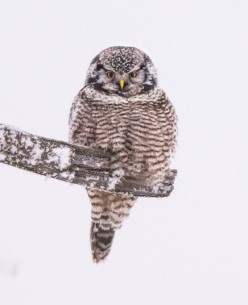
One of the first photographs of the Northern Hawk-Owl at Colville, posted on eBird by Walker Noe.

On December 30, 2015, Dan Waggoner, a bird-watcher, discovered a Northern Hawk-Owl near Brewster, Washington, on the Colville Reservation.  A charismatic bird, and very rare south of Canada, the news spread on social media, resulting in a steady flow of birders (as they call themselves) making the four-hour drive from the Seattle area to see and photograph the bird.  The owl sometimes perched in a tree along a rural road near a house.  The resident of the house, a member of the Confederated Tribes of the Colville Reservation (a conglomeration of twelve tribes), made it clear to the birders that they were not permitted to trespass nor even photograph the owl on his property.

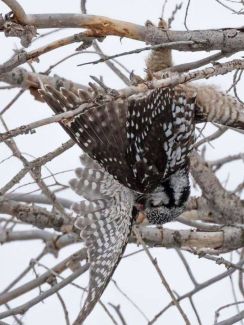
On January 9, 2016, the owl was apparently shot by the resident.  Nearby birders, after hearing the gunshot, arrived to find the owl hanging upside down, dead, still clinging to a branch by one foot.  Outrage by the birding community was so pronounced that King5 News in Seattle, Indianz.com, and other media outlets covered the story.

hawkowl2In social media discussions, birders wrote about their anger over a senseless killing, the illegality of it, and the behavior of fellow birders that may or may not have contributed to it.  Few made the connection between the shooting of the owl and the fact that the shooter was a tribal member on reservation land.
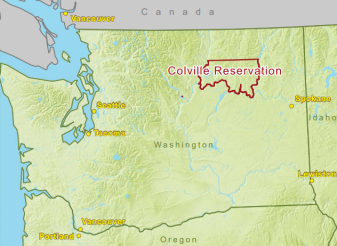
The first thing to understand is that reservations are not public land. Technically, they are held in trust by the federal government for tribes, historically to contain Indigenous people and/or protect them from white colonizers, and currently to allow tribes some measure of sovereignty.  Tribes need not allow public access (with limited exceptions—primarily roads paid for with state or federal funds). In this case, access was open to the public. Per an agreement with the county, the road was maintained by the county and thus was indeed a public road. Nevertheless, the non-Native public would do well to remember that they are guests and they do not have the same rights to behave as they would in their own neighborhood. Here is a typical guide to etiquette for guests on sovereign tribal land. Rules regarding photography are nearly always included.

hawkowl4The second thing to understand is that, on reservations, state laws typically do not apply and federal laws only apply because of a Supreme Court ruling that says the United States can unilaterally alter the terms of a treaty with Native tribes any time they want—a ruling greatly resented in Indian Country. This allows the federal government to hold tribes accountable for newer laws passed since the signing of the treaties and establishment of the reservations. Specifically, the applicability of the Migratory Bird Treaty Act (MBTA), which makes killing this bird illegal, has been subject to legal debate since 1941. In this case it is somewhat of a moot point because the reservation itself has their own regulations that mimic the MBTA. The tribe’s laws specifically state, “It shall be unlawful for any Coleville Tribal Member to hunt or kill any eagles, hawks, owls or any other protected species.”  The Colville Tribes Department of Fish and Wildlife is investigating the incident. This may or may not make prosecution more likely than it would under the federal MBTA. But the bar is low, for the MBTA is probably the least enforced law in the nation.
This legal context may help explain the alleged actions of the resident. While an ornery white rancher is perfectly capable of committing this crime, I suspect, largely because of the context and the peculiar ban on photography, that the shooting of the owl was an act of anger rooted in a desire to make a statement about his rights and sovereignty as a Native on his own land.

I submit this as an explanation, not a justification. The resident lives in a different world from the ambient largely-white society that produced the birders, with a completely different set of experiences and frame of reference. The Colville Reservation has a sordid history from its inception thru the present, with constant battles and lawsuits with the federal government (most recently over federal mismanagement of tribal lands). The reservation is most well-known as the final destination of Chief Joseph and his band of Nez Perce; their descendants live there today. It is no exaggeration to say that the shooter’s people live on the margins of white society, pushed into a backwater bantustan. Perhaps in his mind, the traffic of illegitimate occupiers, traveling a great distance to see a single bird, replete with optics and cameras that cost a good share of the per capita income of the reservation, suggests an opulence shoved in his face, paraded by his house, and stolen from his people. He has control over very little, but he does control the land around his home. So he asserts his sovereignty. He is also playing the nature card, asserting that he, as a Native, knows more about wild animals than urban white liberals, that the hawk-owl population can handle the loss of one individual. Perhaps he hunts and fishes regularly, and thus is used to the taking of animals. Of course, such rationale, if true, was totally lost on the white audience.

While indigenous peoples generally do live close to the land and value sustainable living with the environment, there have been other examples of Natives deliberately shooting birds to screw with visiting white birders. On the Pribilofs in the 1970s, Native teenagers would regularly shoot Asian vagrants (the birding term for species that are otherwise common in Asia but occasionally stray to North America) that birders were seeking, sometimes right in front of the birders. The teens seemed to enjoy having rich white guys at their mercy, shooting the birds as much for amusement as to assert their control over their homeland.

hawkowl5

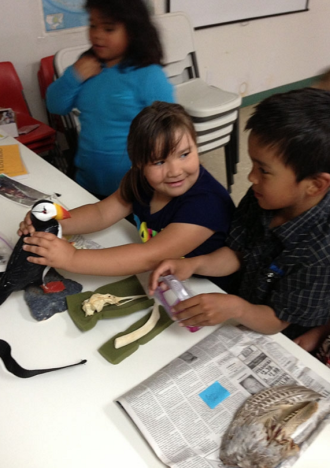
Children working on seabird conservation with the Seabird Youth Network.

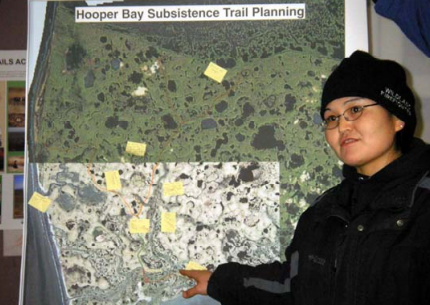
That said, it would be wrong to assume that these actions are representative of all of Indian Country.  For example, times have changed on the Pribilofs. Native children now participate in the Seabird Youth Network, learning about marine biology and conservation, building nest boxes, and studying the enormous seabird colonies on their islands. In Hooper Bay, Alaska, tribal elders have instituted a program, targeted at their own youth, to minimize disturbance to nesting waterfowl and teach sustainable harvesting. On Haida Gwaii (formerly known as the Queen Charlotte Islands), the Haida Nation has partnered with Parks Canada to eradicate rats to restore Ancient Murrelets. In New Zealand, the Maori have done the same to protect major nesting islands for Sooty Shearwaters, Mottled Petrels, and a host of endemic species.  In California, the Yurok are playing an active role in preparing to restore the California Condor to the Northwest Coast.

hawkowl6

A tribal community leader discusses conservation of bird nesting areas at Kokechik Flats, Alaska

In fact, Native American tribes in general are involved in environmental battles and restoration efforts across the continent, though a few are considering their own resource extraction endeavors (mostly coal) as a way to earn income. The strongest, most recent example of tribal environmental activism comes from British Columbia, where First Nations (as they are called in Canada) are battling Enbridge over the proposed Northern Gateway Pipeline, which would transport tar sands from the interior to the coast, where it would be shipped to China. As for the Colville tribes, they are actively involved in creek and watershed restoration projects on their reservation that will benefit native fish and plants.

Whatever his rationale, the shooter of the hawk-owl at Colville has little support among many Native Americans, who are largely leaders in battles to protect and restore the environment.

Posted in news, Uncategorized | Tagged , , , , , , , , , , , , , , , , | 3 Comments