Movie: Rhymes for Young Ghouls

young-ghouls1Rhymes for Young Ghouls is a 2013 film showing the struggles of Native youth against white authority, as personified by the reservation agent and the boarding school he runs.  The setting is the Red Crow M’igMaq Reservation from 1969 to 1976. The film’s heroine is played by Kawennáhere Devery Jacobs, Mohawk from Kahnawake, Quebec, where the movie was filmed.  It is well-cast, with interesting symbolic imagery and great music.  View the trailer.  The movie can be watched on Vudu.

young-ghoulsYoung Ghouls recalls the mystical atmosphere of Beasts of the Southern Wild, but is more confrontational and less hopeful.  The story rests in the on-going struggle against cultural genocide and leaves you with the message that the struggle is… on-going.  The symbolism is especially interesting to explore.  The young ghouls are clearly our teen heroes, who dress in Halloween costumes during the climatic confrontation.  They remind us of the opening dialogue regarding children lost to the government school and becoming zombies, and a dream-like story from grandmother involving a wolf that eats many dead children (as well as itself).  Perhaps our young ghouls are rising from the dead, or the near-death of cultural imperialism, to reclaim their identities.  They receive guidance from several elders and our heroine’s father, who sacrifices himself twice, for crimes he did not commit, to spare his family.  The wolf may represent white power, and calls to mind this essay on colonialism as a trickster.

Here are some of the awards the film has won, as listed at Indian Country News:

Best Director: Jeff Barnaby, American Indian Film Festival 2014
Best Actor: Glen Gould, American Indian Film Festival 2014
Best Canadian Feature Film, Vancouver International Film Festival 2013
Best Director of a Canadian Film: Jeff Barnaby, Vancouver Film Critics Circle 2014
Best Canadian First Feature: Jeff Barnaby, Vancouver Film Critics Circle 2014
Outstanding Actress in a Supporting Role: Roseanne Supernault, Red Nation Film Festival 2014

Posted in news | Tagged , , , , , | 1 Comment

Night Birds Returning: Restoring Native Lands at Haida Gwaii

????????????????????????????????????????????Here’s a wonderful six-minute video about the restoration of Ancient Murrelets to some of the islands of Haida Gwaii (formerly called the Queen Charlotte Islands) in Canada.  This project, eradicating non-native rats, was implemented by the Haida Nation and Parks Canada, who co-manage Gwaii Haanas National Park.

gwaii-hanaas

Posted in news | Tagged , , , , , | Leave a comment

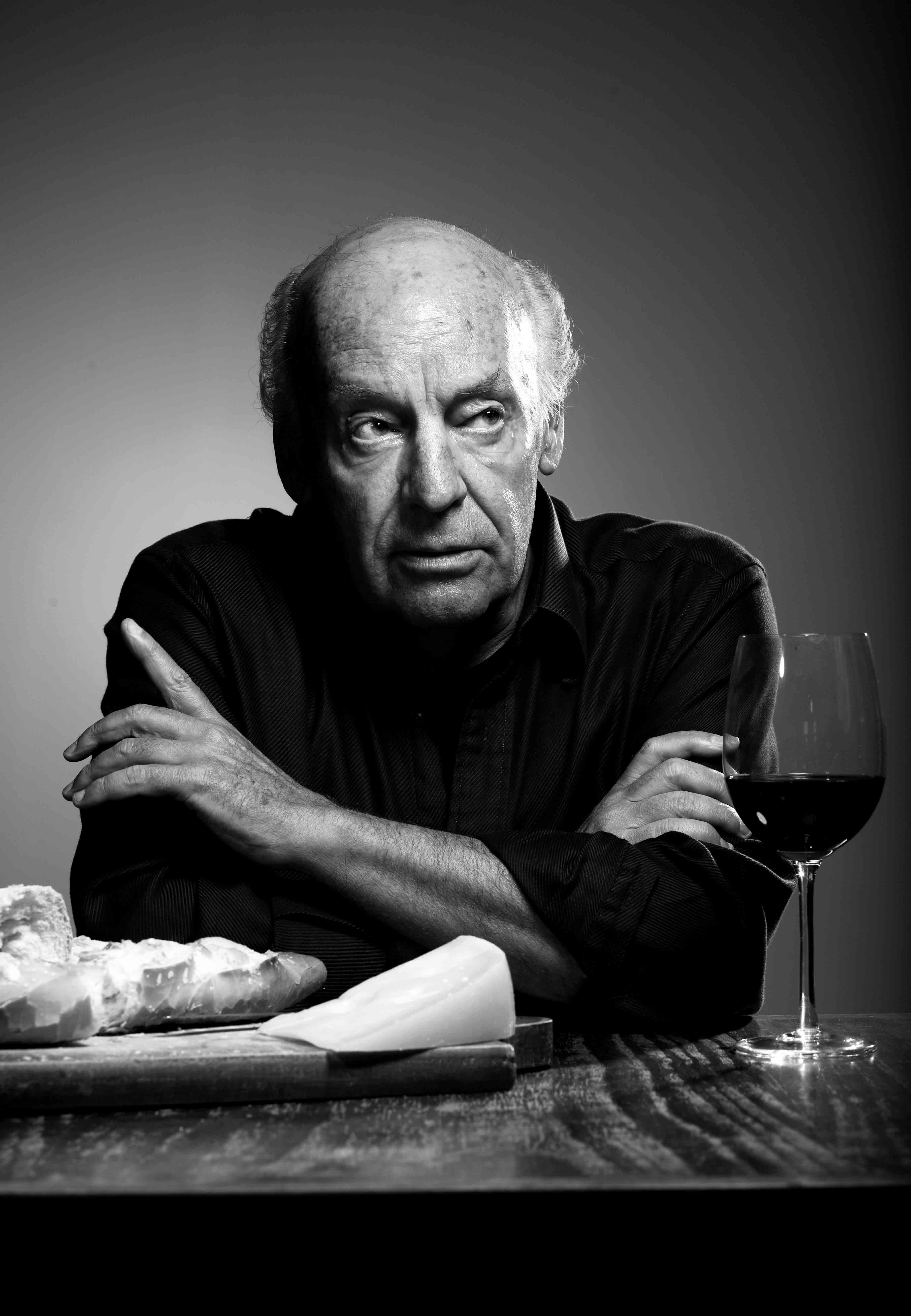
Eduardo Galeano, 1940 – 2015

Today Eduardo Ggaleanoaleano died.  He is one of my favorite writers.  A fierce advocate for the poor, the least, the indigenous, the woman, the child, some of his most famous works are:

  • Open Veins of Latin America
  • The epic Memory of Fire trilogy
  • Futbol in Sun and Shadow

I leave you with a review of one of Galeano’s latest works, written by Teju Cole.

Posted in news | Tagged , , , , , , | 1 Comment

Could a Cherokee Woman Replace Andrew Jackson on the $20 Bill?

The vote to replace Andrew Jackson on the $20 bill is down to the Final Four, and Wilma Mankiller is on the list!  She wasn’t even on the original ballot, but advanced to the last round as a write-in candidate.

You can still vote in the final ballot! 

WomenOn20s started the campaign with this brilliant ad.  Once the voting is over, they will petition President Obama that the winner be put on the $20 bill.  For his part, Obama has said that putting a woman’s face on currency is “a pretty good idea.” Furthermore, he can do it without congressional approval.  He just needs to ask the Secretary of the Treasury.

Wilma Mankiller was the first woman chief of the Cherokee Nation.  She is also the subject of a recent documentary, The Cherokee Word for Water.  Andrew Jackson infamously created the policy of Indian Removal and ordered the Cherokees forcibly moved at gunpoint from North Carolina and Georgia to Oklahoma, openly defying a Supreme Court ruling in the Cherokee’s favor.  As about one in four died along the way, this is known as the Trail of Tears. He also initiated an official policy of ethnic cleansing that, within fifteen years, led to open calls for Indian extermination from Minnesota to California.

cropped-trail_tears_painting.jpg

Native Americans have called for Jackson’s removal from the $20 bill for decades.  I put this #1 on my list of twelve things more offensive than the Washington Redsk*ns.   Suddenly, these demands are gathering forces with women’s activists and leading to a perfect storm of public action.  Wilma Mankiller replacing Andrew Jackson would be poetic justice indeed.

Posted in news | Tagged , , , , , , , | Leave a comment

Federal Court Victory for Oglala and Rosebud Sioux Children

The Geneva Convention defines genocide as “…any of the following acts committed with intent to destroy, in whole or in part, a national, ethnical, racial or religious group, as such:

Siouxchild(a) Killing members of the group;
(b) Causing serious bodily or mental harm to members of the group;
(c) Deliberately inflicting on the group conditions of life calculated to bring about its physical destruction in whole or in part;
(d) Imposing measures intended to prevent births within the group;
(e) Forcibly transferring children of the group to another group.”

It’s that last one that has been a chronic issue in the US for decades.  Up to a third of Native children were removed from their homes in some areas in recent years.  Now comes a rare victory in South Dakota:

Federal Judge Says South Dakota Officials Violated Native American Families’ Rights

Posted in news | Tagged , , , , , , , , | 2 Comments

On this date… March 22, 1621 and 1622… Massachusetts and Virginia

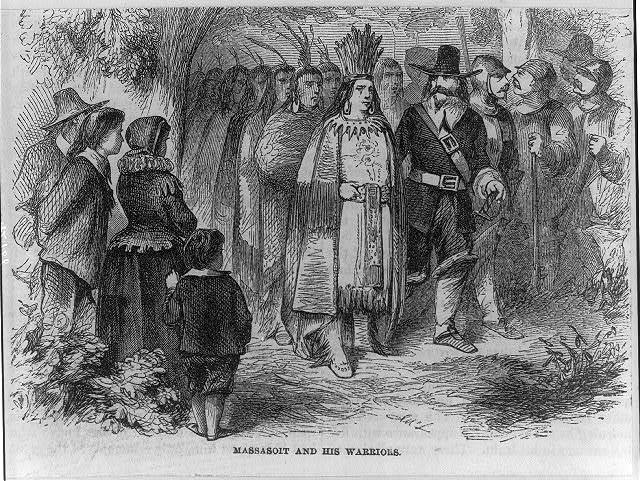
massasoitMarch 22 was a significant date two years in a row. In 1621, Massasoit, the Great Sachem of the Wampanoags, negotiated a mutual defense pact with the Pilgrims recently ensconced at Patuxet, which they called Plymouth. Though his people were depleted by plague, Massasoit produced a show of force that led the Pilgrims to believe the Wampanoag were far more numerous and powerful than they really were. In the end, Edward Winslow kissed his hand and agreed to all the articles of peace, including the critical Article 4: “If any did unjustly war against him, we would aid him; if any did war against us, he should aid us.” With that, Massasoit gained European allies against the Narragansett and guaranteed the Wampanoag the valuable position as middlemen in Euro-American trade. The pact would hold for nearly fifty years.

OpechancanoughIn Jamestown, Virginia, things were not going as smoothly. Powhatan’s successor would not be played the fool by the English. They were swindling his people in trade debts, taking prime maize land, and converting it to tobacco strictly for export to London. Opechancanough summed up his strategy, “We are going to have to push them out before they kill us all!”

The English population stood at 1,240, spread up the York and James Rivers in eighty different settlements. On the morning of March 22, friendly Indians arrived at white homesteads with a greeting, stopped by to trade, came in for breakfast, and pulled out their knives. By the end of the day, 347 English men, women, and children were killed.

And so in one day everything changed. The English called for “a perpetuall warre without peace or truce, surprising them in their habitations, intercepting them in theire hunting, burning theire Townes, demolishing thiere Temples, destroying theire Canoes, plucking up theire weares, carrying away theire Corne, and depriving them of whatsoever may yield them succor or relief.”

Posted in On this date... | Tagged , , , , , , , , , | Leave a comment

Who discovered Mt. Kenya? A. David Livingstone, B. Johann Krapf, C. William Shakespeare, D. George Bush

mtkenyaWho discovered Mt. Kenya?   A. David Livingstone,  B. Johann Krapf,  C. William Shakespeare,  D. George Bush

This is the question, posed to Mharere Mkare on a school test, that spurred this satire:  Kenyan Traveler Discovers Big River in Europe

Posted in reblogs | Tagged | Leave a comment

On this date… March 10, 1957… Columbia River

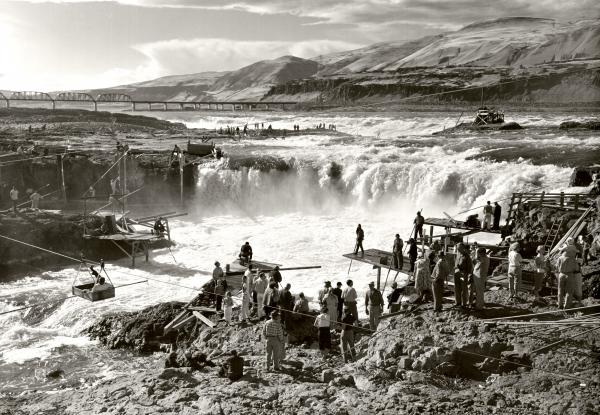
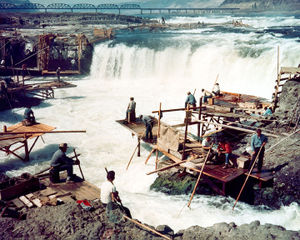
celilo3A mile across, Celilo Falls were the tenth widest waterfall in the world, the widest in the United States, and the largest along the Columbia River. Each year, millions of salmon, hundreds of sea lions, and thousands of Indians from several tribes would converge on the stair step falls, making it one of the single greatest fishing sites in the world. It was home to native settlements for over eleven thousand years. It was such a trading center that the fur trader Alexander Ross described it in 1849 as the great emporium or mart of the Columbia. When the salmon were running, the falls would be festooned with hundreds of fishermen perched on a ramshackle network of scaffolds that seemed to hover over the rushing torrent. Dip nets went down and twisting flopping salmon were hauled up. Remarkable footage can be seen in this video.

It all ended at 10:00am on March 10, 1957 when the flood gates of The Dalles Dam were shut, a lake rose behind them, and the falls were submerged in silence.

Generations later, there are memories:

celilo1“The first thing everybody remembers or recalls is the roar of the water. You know, you could hear that roar of the water miles away before you even got by the place and all of a sudden you come upon it.” – Ed Edmo

“There was a beautiful mist and the sound of the water. The sound was like a pulse. It was a beautiful sight to see. It just was. There was people everywhere. It was a few tourists but mostly it was just Indians and they were pulling those fish out and hauling them up to the warehouse.”   – Barbara Walker

“The smell of salmon was everywhere. Salmon was everywhere. Those are things I’ll never know. You can talk to elders but we’ll never know it as they did.” – Gretchen Halfmoon

“My dad was working on the railroad and he took me out of school and brought me in the car over here and I remember watching the water come up like a bad dream.” – Ed Edmo

celilo2“I couldn’t go to watch the falls being flooded because my grandma didn’t want me to see. All I seen was tears. I think my tears were just like a flood.” – Linda Meanus, granddaughter of Celilo village chief Tommy Thompson

Posted in On this date... | Tagged , , , , , , , , , | 2 Comments

On this date… March 3, 1832… Georgia

The Supreme Court ruling granting tribal sovereignty was issued on this date. It still stands today.

worcesterIt all started with Samuel Worcester (left) and Elizur Butler, missionaries to the Cherokee. While the Supreme Court debated, they sat in a Georgia jail, sentenced to four years hard labor. Their crime: living on Cherokee lands without a permit, a rule created by Georgia specifically to rid themselves of such missionaries. Worcester had spent the last seven years among the Cherokee, translating the Bible, working with them to create the Cherokee Phoenix newspaper (still published today) and printing press (the Cherokees had a higher literacy rate than the Georgia settlers), and using the courts to fight for Cherokee sovereignty.

In the end, Worcester and Butler offered themselves as bait. They declined their pardons so they could take their case to the US Supreme Court.

The ruling came in Worcester v. Georgia, 31 US (6 Pet.) 515:

“The Cherokee nation, then, is a distinct community, occupying its own territory, with boundaries accurately described, in which the laws of Georgia can have no force, and which the citizens of Georgia have no right to enter but with the assent of the Cherokees themselves, or in conformity with treaties and with the acts of Congress.”

Worcester and Butler remained in jail a few more months, until Georgia was good and ready to let them go.

Posted in On this date... | Tagged , , , , , , , , | Leave a comment

On this date… February 23, 1945… Iwo Jima, Japan

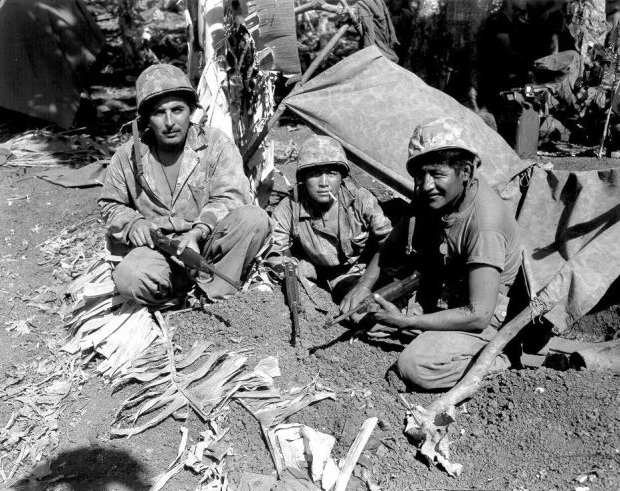
Iwo Jima1On this date, the US flag was raised over Iwo Jima. Young Navajo men, once punished for speaking their language in the boarding schools, sent over eight-hundred messages during the battle. Here is a sample of the code:

Ba-ah-ne-di-tinin, key, the letter K.

Tkin, ice, the letter I.

Tacheene, red soil, battalion.

Da-he-tih-hi, hummingbird, fighter plane.

The full code is available at this Department of Defense website.

Iwo Jima2The Japanese had broken dozens of codes, but they never could understand this one. Major Howard Connor, 5th Marine Division signal officer, said afterward, “Were it not for the Navajos, the Marines would have never taken Iwo Jima.”

Navajo was not the only Native American language used by the US military. Choctaw was used during World War I and Comanche was used by the US Army in World War II.

Iwo Jima3More information about the Navajo code breakers can be found here.

Posted in On this date... | Tagged , , , | Leave a comment