In November, the House of Representatives approved the Keystone XL Pipeline. The Rosebud Sioux, whose land the pipeline would run through, responded by declaring, “We are a sovereign nation…. We will close our reservation borders to Keystone XL. Authorizing Keystone XL is an act of war against our people.” In reality, this is merely one battle in a war that nobody is winning. I will summarize our four options for fighting climate change and explain why we are losing on all four fronts.
 Let’s begin with a few facts:
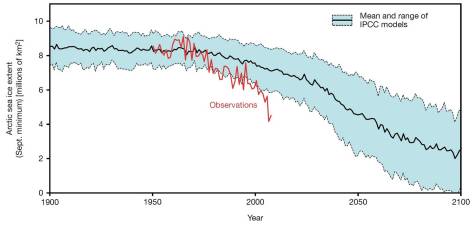
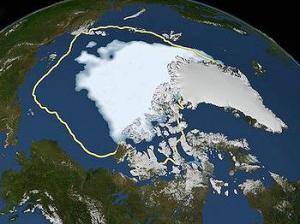
- CO2 emissions are already causing changes in our climate and environment, most prominently in the Arctic (and often faster than scientists had predicted—see the graph of Arctic sea ice cover in red compared to the model predictions in blue).
- We are quickly approaching a threshold. At present rates, we will have emitted enough CO2 to cause dramatic impacts worldwide by about 2030.
- We are still moving in the wrong direction. While CO2 emissions in the US and Europe world have leveled off (but not really decreased), they are going up in China and elsewhere. Worldwide, CO2 emissions are increasing.
There are only two ways to deal with greenhouse gas emissions:
- Reduce (or stop) emitting them; or
- Keep emitting them but prevent them from causing climate impacts.
To be successful, these things would need to be done on a large scale immediately. At the moment, none of these options are likely or feasible, at least not at the scale needed.
Let’s start with Option #1: reducing CO2 emissions.
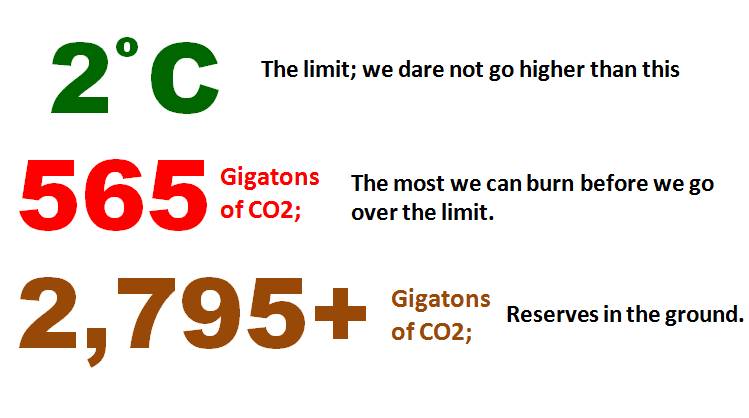
In 2012, Bill McKibben neatly summarized the entire climate change problem in three numbers:
- 2 degrees Celsius (3.6 degrees Fahrenheit). This is the maximum increase in the earth’s average temperature that we can possibly allow without catastrophic impacts. It sounds funny—what’ the big deal about a 74 degree day verses a 77.6 degree day? But it’s more than that. 3.6 degrees is just an average—changes at the poles are much larger. It’s also about melting ice, changing ocean currents, and changing weather patterns. Nearly every nation (including the US and other oil producing nations) has agreed to this 2.0 Celsius target. Currently we have a 0.8 degrees Celsius increase and are already seeing dramatic impacts on ice in the Arctic, Antarctic, and Greenland that will lead to sea level rise that will displace a significant percentage of the world’s people in the coming decades. We expect to see another 0.8 Celsius rise based on CO2 already released into the atmosphere, so we’re likely to get to a 1.6 Celsius increase shortly.
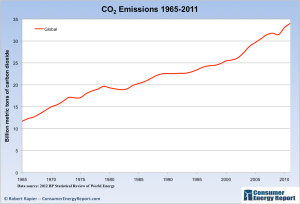 565 Gigatons. This is the amount of CO2 we can further release but still stay below the 2.0 Celsius threshold. We currently release about 35 gigatons a year and that number increases each year (most of it from fossil fuels). That means we are set to pass the 565 limit in 10-15 years.
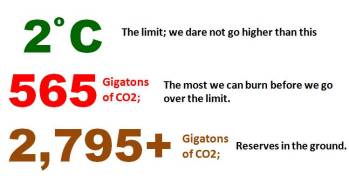 2,795 Gigatons. This is the amount of CO2 contained in current coal, oil, and gas reserves that companies are planning to produce. There are two bad things about this number: 1) it is higher than 565, meaning that to protect the planet we cannot use all the coal, oil, and gas that we have found; most of it must stay in the ground; and 2) this number has grown a lot since McKibben wrote this article, thanks to the fracking boom.
 Last week there was considerable media attention regarding a new study which quantified exactly just how much coal, oil, and gas reserves need to be left in the ground. It broke it down by reserves within each country, assuming we would use the cheapest oil first and the most expensive oil last. The expensive stuff would stay in the ground. This also tends to be the oil that is the most CO2 intensive to extract (because C02 = oil = production costs), such as Canadian tar sands. This study thus provides a goal for Paris 2015, the UN climate conference planned for this December to hammer out a binding international agreement to reduce emissions.
There are two ways to drastically reduce CO2 emissions:
A. By force, because governments require it;
B. Voluntary, because economic incentives cause a sudden shift to a cheaper, cleaner alternative.
Option #1-A appears unlikely. Whether the government is a democracy or a dictatorship, they are subject to the influence of large companies. Asking these companies to keep the majority of their profits, worth trillions of dollars, in the ground, is a “tough ask”. All these oil reserves are assets that are currently reflected in stock prices and in the price we pay at the pump. Furthermore, our own government experts and the market do not believe it will happen; they believe Paris 2015 will be a failure. At least one politician agrees.
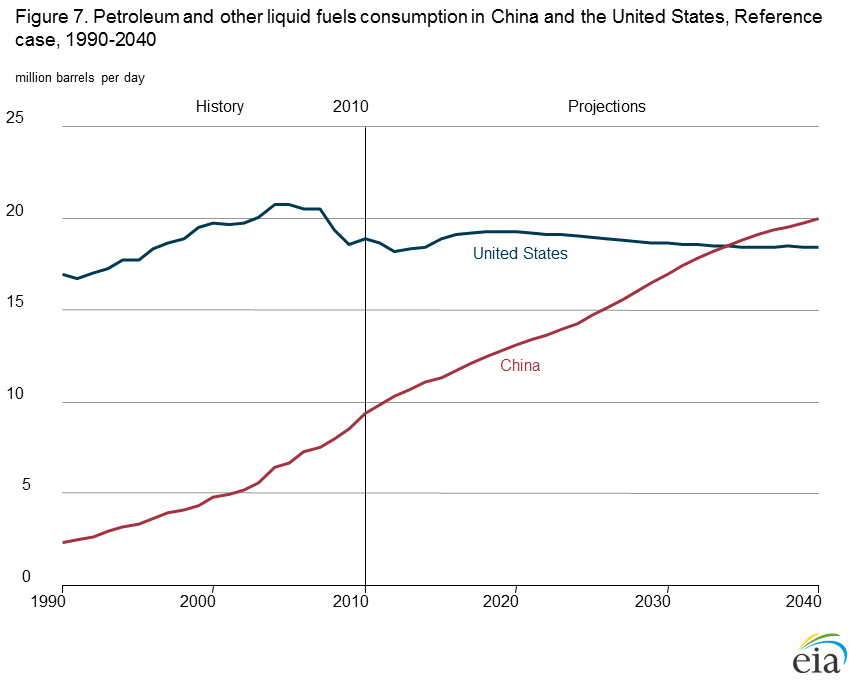
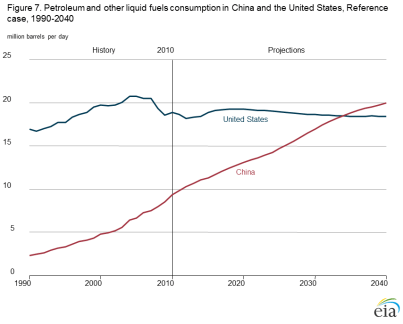 The US Energy Information Administration, which analyzes energy markets and makes projections for the future, forecasts increased fossil fuel use thru 2040 (as far ahead as they make predictions). While US oil consumption is predicted to remain level, worldwide use (largely driven by China and other parts of Asia) are expected to increase substantially. These predictions, of course, are completely at odds with all the politicians’ stated CO2 reduction goals. In short, their own expert government agencies, as well as the market as reflected by prices at the pump, do not believe them.
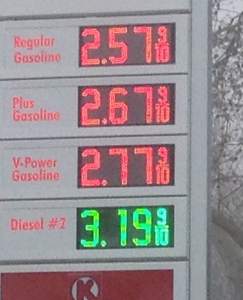 The current decline in oil prices is the market adjusting to increased supply (a function of all the newly accessible reserves due to fracking) and decreased demand (due to conservation measures like the Toyota Prius). It’s the
market saying to consumers, wait, we can make this cheaper, come back to the dark side, don’t leave us. For nations with large reserves, like Saudi Arabia, maintaining a cheap supply is predictable long-term profit-maximization for a non-renewable resource. Keep the price low while it’s abundant and make it expensive at the end. The fact that we’re paying $2.39 at the pump tells us that we are not near the end, that “peak oil” (when we are about to run out) is suddenly decades away, and that the market expects all those known reserves to indeed be produced and used (thus blasting thru the 2.0 Celsius ceiling). Cheap gas is the result of the market forces in the world expecting that we will use lots of oil in the coming several decades. The market does not expect governments to require tens of trillions of dollars of assets to be left in the ground, and the market is usually a better predictor of the future than politicians’ promises. Don’t get me wrong; political advocacy is still important and there are gains to be made, especially in the realm of promoting solar energy (e.g. allowing rooftop solar in California to sell back to the grid at a fair market price rather than pennies on the dollar) and other renewables to offset coal-generated electricity. Just don’t expect any government to do all that is needed to meet the required CO2 goals.
[An aside on the Keystone Pipeline: It is intended to move Canadian tar sands oil to refineries on the Gulf Coast. Note that a lot of it already moves in pipelines to Chicago. Clearly, tar sands oil is near the top of the list of oil that should stay in the ground. At present, the price of oil (around $50/bbl) is below the break-even point for some tar sands operations. If the Keystone Pipeline existed today, it would probably be empty, or at least have fewer companies reserving pipeline space for their product. It’s a bit complicated; this article has some of the details. However, rest assured the price will rebound and increase in time. If the Keystone Pipeline still does not exist in the future, that oil will find its way to market some other way. In the past few years, several rail terminals have been constructed in Canada to move tar sands by rail. In the meantime, the US is poised to lift its long-time ban on exporting crude, turning the US into a major oil exporter as well as consumer.]
This gets us to Option #1-B, a sudden shift to a cheaper, cleaner alternative fuel that essentially drives oil out of business. Obviously, such a miracle energy source does not exist now. Secondly, the bar just got higher because the price of oil is now so much lower. Oil is so plentiful that it’s hard to compete with. Furthermore, it’s difficult to conceive of a government policy that shifts economic incentives for an industry that just survived a 50% drop in its product’s price.
Thus, based on what we know and see today, there appears to be little hope for reducing CO2 emissions in any way close to the levels needed to avoid blasting thru the 2.0 Celsius ceiling.
We now move on to Option #2: continuing emitting CO2 but prevent it from impacting our climate. Again, there are two ways to do this:
A. Sequestering CO2 that is already released;
B. Manipulating the atmosphere to counteract global warming with something that provides global cooling (“geo-engineering”).
These are complicated topics but the quick answer is that we do not have the technology for either of these options at present, although there is some on-going research.
In summary, we have struck out on four counts.
Option 1: Reduce CO2 emissions.
A. By force (government action) – The political will is highly unlikely.
B. Voluntary (switch to cheaper, cleaner alternative) – Technology does not exist.
Option 2: Controlling the effects of CO2 emissions.
A. Carbon sequestration – Technology does not exist.
B. Geo-engineering – Technology does not exist.
 It would be wise if climate activists, which should include all of us, support all four options. There is no time for rejecting any possible solution.

 “It’s disgusting. An entire people with multiple histories of struggle, multiple ethnic groups with unique lifestyles, languages, cultural symbols and social systems are used to sell chicken-schnitzels.







 Memories of the People