Throughout the history of the west, white settlers encroached upon Native American lands, creating conflict. More often than not, there was minimal violence. Instead, the Natives went to the federal authorities, with whom they already had a treaty, and asked for the Powers That Be in Washington, D.C. to enforce the terms of the treaty and to remove the white pioneers from their land. And more often than not, forced to choose between red and white, the feds did nothing except explain to the Natives how the treaty needed to be renegotiated yet again to make room for the white settlers.
Echoes of these priorities are continuing today in Nevada.
Enter two Western Shoshone sisters, Mary and Carrie Dann, and one white rancher, Cliven Bundy.
We begin in 1863. The state of Nevada did not yet exist, but the Western Shoshone and the US federal government did. The federal government sought a right-of-way thru Western Shoshone lands in order to move gold from California east and pioneers west. Together, the feds and the Shoshone signed the Treaty of Ruby Valley, which allowed for free passage along established routes, along with military posts, rest stops, mail, telegraph, and rail lines, and even gold prospecting and white agricultural settlements. You can read the text of the treaty here (http://www.nativeweb.org/pages/legal/shoshone/ruby_valley.html). The treaty did not, however, surrender any lands from the Western Shoshone to the federal government. Furthermore, it laid out the boundaries of their land—most of Nevada—and stated the Shoshone lands would be excluded from any state or territory of the US.
 What happened over time is predictable. So many whites established homesteads, farms, ranches, and mines that the Shoshone lands were overrun. The primary land grabber was the federal government, which currently owns 87% of Nevada. They have conducted nearly a thousand nuclear bomb tests on Shoshone land. In 1973, the Bureau of Land Management (BLM) demanded that the Dann sisters pay for grazing permits for their cattle. Asserting it was Shoshone land under the Treaty of Ruby Valley, they refused. In 2007, using helicopters and trucks, the BLM conducted a raid and forcibly captured and removed seven hundred of the Dann’s cattle and horses. Footage of that can be seen in a short Oxfam documentary about them here (https://www.youtube.com/watch?v=JJ2N9-n-ka0).
In response to these conflicts, the Shoshone sought relief via the courtroom. The legal battles have continued thru the centuries and have been waged in the US Supreme Court, the US Congress, and the United Nations. In 1979, Congress gave the Shoshone $26 million for 25 million acres ($1.05 per acre), which the Shoshone refused to accept, saying they never intended to sell their land. Because the funds were transferred to the Bureau of Indian Affairs, the Supreme Court ruled that the tribe had been paid and no longer had title to the land. In 2004 an act of Congress upped the settlement amount to $145 million, which the tribe still refuses to touch. They are the not the only tribe with “settlement” funds sitting in a BIA vault. The Oglala Lakota of Pine Ridge, arguably the poorest place in the US, also refuse to touch over one billion dollars, on principle, because “the Black Hills are not for sale.” Referring to the impact on the tribe’s culture and way of life, a Shoshone chief explained it this way, “I did not sign any agreement for money. The actions of the federal government are unconstitutional, immoral, genocidal, and against international law.”
Cliven Bundy’s story begins in 1877, when his family homesteaded and created the ranch he now lives on—on Shoshone land. By then Nevada was a state. It occupied most of the Shoshone lands, in violation of the federal treaty. It was also (and still is) largely controlled by the federal government. It was not until 1993 that the BLM asked Bundy to pay grazing fees since most of his cattle were not on his ranch, but on BLM land. The bigger issue was that the BLM, also managing the land for habitat and the threatened desert tortoise, wanted to reduce his herd size. To do this, the BLM offered to purchase Bundy’s grazing rights—to pay him for decreasing his privilege of grazing his cattle on public land. Like the Shoshone, Bundy said his “rights” were not for sale and refused payment. He also refused to reduce his herd size and refused to pay grazing fees for the cattle that were allowed to remain. In response, the BLM revoked all his grazing rights and have been seeking to remove his cattle ever since.
To this day, Bundy argues that the land belongs to the state of Nevada and that his rights to the land precede the existence of the BLM or the involvement of the federal government. Moreover, it is within his rights, he argues, to refuse their “management” and to refuse to pay them for it. In 1998, Bundy lost a federal court case and was ordered to remove his cattle. He refused. In 2013, a federal judge again ordered Bundy to remove his cattle from federal land. Again he refused.
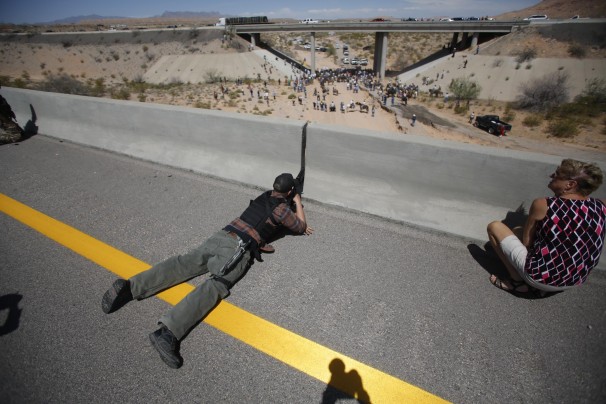
Earlier this month, when the BLM arrived with helicopters and trucks to enforce the court order and round up his cattle, Bundy managed to call in right-wing militia activists from around the West to create a tense stand-off, complete with high-powered rifles trained on BLM employees. In the end, the BLM backed off “in the interest of public safety” and Bundy’s cattle remain. 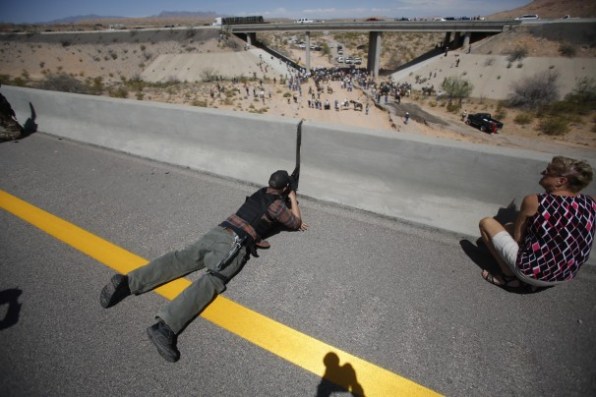
So there are similarities between the Dann sisters and Bundy. Both were (or are) ranchers in Nevada claiming grazing rights to large sections of Nevada managed by BLM. Both refused to pay their grazing fees or to remove their livestock, and both cited events from the 1800s as the basis for their rights. Both fought their cases in federal court and lost. And both refused to remove their livestock. In both cases, the BLM arrived to round-up and confiscate their cattle.
There are, of course, two obvious differences. First, the basis for their historic claims are not the same. The cases actually overlap, such that the rights of the Shoshone (based on the treaty in 1863) precede those of Bundy’s pioneering homesteaders (which are based on the creation of the state of Nevada a year later). If the treaty was enforced, both ranches could be protected under Shoshone authority (assuming the Shoshone approved of Bundy as a guest on their land). The second difference between the two cases is that Bundy chose armed resistance and, for now, has gotten away with it.
We can speculate why the Shoshone did not attempt armed resistance and what might have happened if they did. The issue of race cannot be ignored here—it is the third obvious difference. The Shoshone likely calculated the negative consequences of armed confrontation and assumed they would not rate high in calculations of “public safety”. The Bundy faction, on the other hand, deliberately put their women on the front lines, correctly assuming they would force the BLM to fall back. As in the past, the feds looked the other way in the face of pioneer aggression. Looking across the centuries and the sagebrush, it seems that fighting a range war against the feds has always been a privilege of white settlers while Native Americans are left wanting.





 Memories of the People