On this date… January 24, 1599… New Mexico

On this date in 1599, Acoma Pueblo, the sky city, fell.

Rising above the desert plain, perched atop smooth sandstone cliffs that reflect brilliant orange in the morning sun, Acoma had been there since the 1100s.  It was the oldest continuously inhabited place in the United States.  A nearly impregnable natural fortress, it was America’s Masada.

Image

When Governor Juan de Oñate swept thru New Mexico in 1598, Acoma persisted untouched.  When he sent his nephew to demand their obedience and vassalage, they threw his body from the cliffs.

A year later, Oñate planned his revenge.  Acoma must be made an example of, or all the pueblos may be emboldened.  A priest explained:  “peace was the principal end for which war was ordained.”

It took three days, but in the end the mesa was breached.  Viewed from afar, Acoma was a lit city on a hill, burning for all to see.  For the only time in history, invaders rose from below, took the stairs, burned the town, and killed and captured everyone.

The trial was held in Kewa Pueblo, renamed Santo Domingo.  It also took three days.  All of Acoma was found guilty.

–          Children under twelve were be given to the priests.

–          All between the ages of twelve and twenty-five were sent to serve twenty years in servitude.

–          The elderly were sent to the Great Plains.

Oñate had a final touch.

–          “The males who are over twenty-five years of age, I sentence to have one foot cut off and to twenty years of personal servitude.”

The sentence was applied to at least twenty-four men.

Fifteen years later, Oñate was banished, losing all his wealth acquired in New Mexico.  Acoma persisted.  In fact, it still persists.  It is still the oldest continuously inhabited place in the United States.

Posted in On this date... | Tagged , , , | Leave a comment

On this date… January 9-10, 1879… Nebraska

dullknife6On this date in 1879, in weather even colder than today’s, the long saga of Dull Knife’s (aka Morning Star) band of Cheyenne reached a climax. Three years earlier, in the aftermath of the Battle of the Greasy Grass (Custer’s Last Stand), the group was attacked at night in their winter camp, sending families with small children fleeing into forty-below weather. Many died and they were forced to slice open their horses to create a warm place to keep their babies from freezing.

dullknife2In late 1878, they found themselves imprisoned on a reservation in Oklahoma, dying of malaria at an alarming rate. One night they all fled. In what became known as “Cheyenne Autumn”, they outmaneuvered thousands of US Army troops and pioneer vigilantes in a desperate attempt to return home. Almost there, Dull Knife’s band of 150 men, women, and children ended up surrendering at Fort Robinson, Nebraska. On January 2, Captain Henry W. Wessels Jr., the commanding officer, informed Dull Knife that they must return to Indian Territory. The order had come down from the Secretary of the Interior. Dull Knife was unequivocal in response: “I will never go back. You may kill me here; but you cannot make me go back.” On January 3, Wessels cut off their food. Dull Knife informed Captain Wessels: “You can starve us if you like, but you cannot make us go south.”

On January 7 Wessels caught off their water. Huddled in the dark barracks, they drank from the ice forming on the inside of the windows of the barracks that was their prison.

dullknife1Dull Knife spoke again with Wessels: “We will not go. The only way to get us there is to come in here with clubs and knock us on the head, and drag us out and take us down there dead. We have nothing to defend ourselves with, and if you want to you can come here with clubs and kill us like dogs.”

By January 9, Day Seven without food, the Cheyenne spoke with each other: “We might as well be killed outside as starve here in this house. We have been without food and fire for seven days; we may as well die here as be taken back south and die there. It is true that we must die, but we will not die shut up here like dogs; we will die on the prairie; we will die fighting. Now, dress up and put on your best clothing. We will all die together.”

dullknife3It had warmed to zero degrees outside. As best they could in the dark and cold, they painted their faces for battle. They assemble five rifles and eleven pistols, which had been taken apart and smuggled in under the women’s clothing and as pieces of children’s toys. Outside, the soldiers paced back and forth in the snow.

That night, after the winter sun had disappeared behind the white hills and mid-winter’s full moon illuminated the snow in the Fort Robinson yard, shots rang out from each barrack window. The Cheyenne poured through the broken glass, running for the creek, breaking through the ice, drinking the water, struggling up the snow-covered hill, women carrying babies, men firing back.

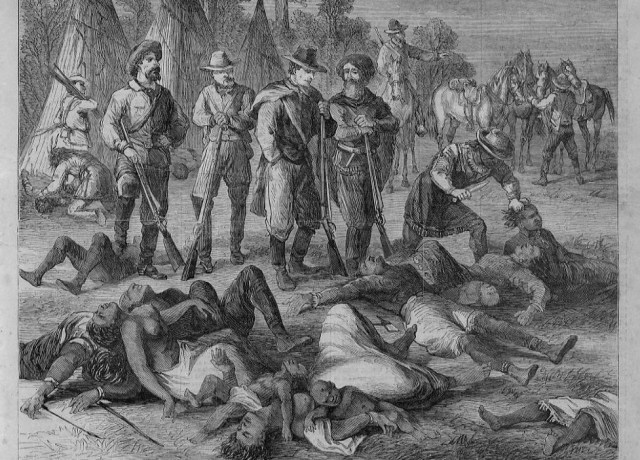
dullknife4The soldiers came, guns blazing. Women and children were struck down as the report of rifles echoed off the distant bluffs in the crystalline night. They saw Old Sitting Man, sitting in the snow next to the barracks. He had broken his leg jumping out the window. A soldier placed a muzzle against his head and fired. Other soldiers raced past bodies and up the hill after the starving freezing Cheyenne. The moon on the snow was like daylight. They found five women and three babies huddled under a group of pines. They shot them all. The next morning they found more Cheyenne hiding in rock crevices under the bluffs. They blasted away until there was a single survivor. Fifteen men, women, and children were found hiding in a buffalo wallow. They unleashed their weapons until all but two and a half were dead. A wounded girl was captured and spoke for all, “No, we will not go back; we will die rather. You have killed most of us, why do you not go ahead now and finish the work?”

dullknife5Of the one hundred-fifty Cheyenne in the Fort Robinson break-out, sixty-four were killed. Most of the rest escaped to Pine Ridge or other reservations within their homeland. Only seven were sent back to Indian Territory.

Posted in On this date... | Tagged , , , | 3 Comments

The Hopi Artifacts and the Paris Auction

This article includes a link to the NY Times detailed article of how the Annenberg Foundation secretly bid and won back most of the artifacts in order to return them to the Hopi and Apache.

http://www.npr.org/blogs/codeswitch/2013/12/21/255544805/what-part-of-sacred-don-t-you-understand?ft=1&f=1001

Posted in news | Tagged , , , , | Leave a comment

On this date… December 15, 1970… New Mexico

On this date in 1970, the Taos Pueblo won back Blue Lake through an act of Congress and sixty-four years of struggle.

At 11,332 feet above sea level, the lake reflects the deep dark blue of the bold sky.  The firs form the walls of the foyer, while the smooth green grass slope of the mountain forms the base of the altar.  Higher up, the brilliant white streaks of snow converge at the summit.  The brightest white, the deepest blue, the most vibrant green.  A cauliflower tower of cumulus, with a dark gray purple belly, rises beyond the altar.  The choir is formed by the sweet warble of the yellow-rumped warbler, the rolling waving flute of the hermit thrush, the steady tempo of the red-breasted nuthatch, and the trill of the junco.

“Blue Lake is the most important of all our shrines because it is part of our life, it is our Indian church, we go there for good reason, like any other people would go to their denomination and like a shrine in Italy where the capital of the Roman Catholics worship is different: people go visit and give their humble words to God in any language that they speak. It is the same principle at the Blue Lake, we go over there and talk to our Great Spirit in our own language and talk to Nature and what is going to grow, and ask God Almighty, like anyone else would do.”

–          Severino Martinez, Taos Pueblo

Image

Posted in On this date... | Tagged , , | Leave a comment

What really happened: The account of the first Thanksgiving

Here is the original account of the first Thanksgiving. It’s only three short paragraphs.

But first, a little context.  It’s 1621. The Pilgrims arrived the previous December, finally settling in the abandoned Native village of Patuxet.  A year or two earlier, the village – and many like it along the New England coast – had been wiped out by an unknown contagion undoubtedly acquired from other European traders.  The disease hit so hard that the people of Patuxet could not even bury their dead.  After clearing out the skeletons, the Pilgrims moved into their homes and replanted their corn fields.  They had the help of Tisquantum (Squanto), a native of Patuxet, who had recently returned home after years in Europe, having been kidnapped, sold into slavery in Spain, and lived in London.

Despite Tisquantum’s assistance, life in a new North American settlement typically meant starvation for half the colonists in their first year.  That’s what happened in Jamestown in 1607. The Pilgrims were no exception.  At the same time, they were desperate to establish trade relationships with local people.

This is where Massasoit, the Great Sachem of the Wampanoag comes in. Massasoit, his own people also decimated by disease, was keen on establishing a monopoly with European traders as well as a mutual defense pact to protect his people from the Narragansett, who remained powerful and untouched by the plague.

Thru deft negotiations, the alliance between the Wampanoag and the Pilgrims was sealed on March 22.  The pact held thru spring, summer, and fall, but the settlers still lived in fear of the natives’ superior numbers. Thus, the harvest feast that fall was a diplomatic affair, involving shows of force on both sides. The Pilgrims demonstrated the firepower of their weapons; the Wampanoag highlighted their strength in numbers. Here is the account of William Bradford.  It’s not clear the Indians were initially invited, but it is clear they provided much of the meat.

“We set the last spring some twenty acres of Indian corn, and sowed some six acres of barley and peas, and according to the manner of the Indians, we manured our ground with herrings or rather shads, which we have in great abundance, and take with great ease at our doors.  Our corn did prove well, and God be praised, we had a good increase of Indian corn.

“Our harvest being gotten in, our governor sent four men on fowling, that so we might after have a special manner rejoice together after we had gathered the fruit of our labors; they four in one day killed as much fowl, as with a little help beside, served the company almost a week, at which time amongst other recreations, we exercised our arms, many of the Indians coming amongst us, and among the rest their greatest King Massasoit, with some ninety men, whom for three days we entertained and feasted, and they went out and killed five deer, which they brought to the plantation and bestowed on our governor, and upon the captain, and others.  And although it be not always so plentiful as it was at this time with us, yet by the goodness of God, we are so far from want that we often wish you partakers of our plenty.

“We have found the Indians very faithful in their covenant of peace with us; very loving and ready to pleasure us; we often go to them, and they come to us; some of us have been fifty miles by land in the country with them.”

The pact held for five decades. If Thanksgiving should be remembered for anything, it’s the diplomatic skills of Massasoit.

Image

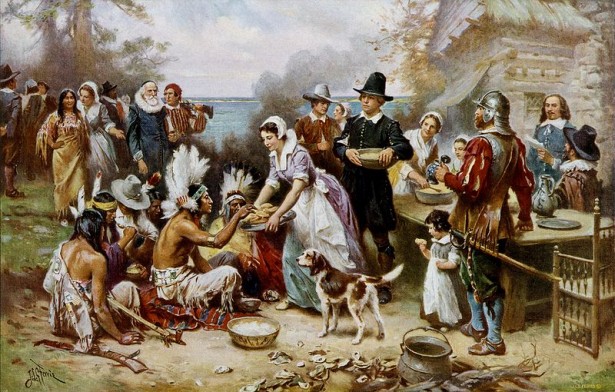
This stylized painting undoubtedly includes numerous historical inaccuracies, most notably the overall symbolism that the Pilgrims were providing the Wampanoag with a meal as if they were children at snack time.  I’m not quite sure where the guy on the right (presumably Miles Standish) picked up that conquistador helmet.

pequot1

The term “Thanksgiving” was not used until after the brutal massacre of Pequot men, women, and children at Mystic River in 1637. Thus, Thanksgiving is also associated with this act of genocide. The Puritans sold the survivors into slavery and sought to forever ban the name “Pequot”. 

In 1970, a Frank James, Wampanoag, was invited to speak at a Thanksgiving ceremony.  After seeing a copy of his speech beforehand, they would not let him read it.  Here is the speech he did not give.

Posted in On this date... | Tagged , , , , , | 4 Comments

Colonial Bros and Nava-hos: Why did these frats think this was okay?

Last week, several fraternities and sororities at Cal Poly San Luis Obispo hosted a party with the theme “Colonial Bros and Nava-hos”.   As word of the party leaked out afterwards, the campus president, faculty, and many students denounced it.

Other students, however, rejected their criticism and dismissed the controversy as unwarranted.  Their defenses included:  “I don’t think it was meant to be racist.”  “There are a lot more offensive themes out there.” “People are too sensitive.” “I don’t think they were purposefully targeting these groups.” “This makes the Greek community look bad for no reason.” And “The fact that this is even an issue is a joke.”

Obviously, associating any people group with prostitution is insulting.  In the case of the Navajo (whose actual name for themselves is the Diné; Navajo is a Spanish nickname), it is akin to rubbing salt in old wounds.

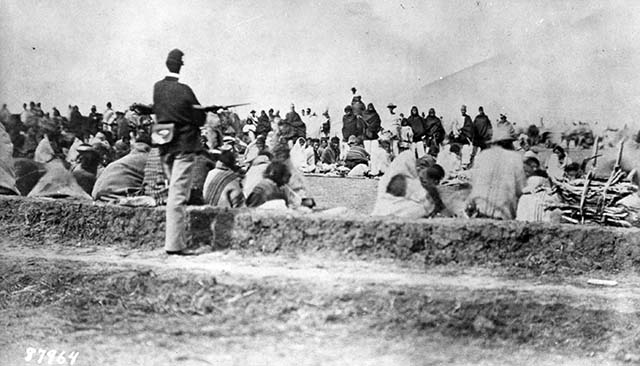
Like all Native American groups, the Diné have a long history of suffering at the hands of US policies and prejudices.  In 1863, while the Diné were still living traditional lives, gold was suspected on their homeland.  Quickly they became the target of a massive US Army operation.  Colonel Kit Carson used a scorched earth policy, burning their homes and maize fields and shooting their livestock, to drive the Diné off their land.  Eight-thousand Diné were marched, on foot, 400 miles to Bosque Redondo, their reservation/concentration camp.  The US Army ordered its troops to “kill or capture all Navajo men you can find in the old Navajo country without proper passports.”  A year later, a defiant Navajo leader, known by the whites as Manuelito, snuck into the squalid camp, which was guarded and overseen by US troops, to investigate the conditions.  What he found was shocking.  Imprisoned in the bleakest of landscapes and divorced from their traditional ways of living, his people moved listlessly among their hovels.  The trees had all been chopped down to build the soldiers’ fort.  The Diné walked miles to dig mesquite from the desert for firewood.  The acres of corn failed in the poor soil.  The water was alkaline and difficult to drink.  Dysentery and other illnesses were rampant.  The people were dependent upon military rations, which were in short supply and sometimes moldy or infested with rat droppings.  The manager of the fort was selling government issued cattle and grain on the side for personal profit.  Diné children picked thru manure piles in corrals, looking for undigested kernels of corn.  Teen girls prostituted themselves to the soldiers for meal tickets.  Some died during botched abortions.  Syphilis was detected in fully half of the army soldiers.  Nearly one third of the Diné died here in the span of five years.

Image

So for the frats to equate the Diné with prostitution is a bit like a German frat equating Jews with overcrowded train cars or large ovens.  It’s probably safe to assume the frat boys have some vague awareness of general oppression and injustice against Indians in the distant past, but they probably had no knowledge of the details and certainly assumed all such persecution was a thing of the past.

Here they would be wrong.  Through the 1950s, many (most?) Diné children were removed from their parents and sent to boarding schools where they were stripped of their traditional clothes, hair styles, and names and re-molded into white culture.  They were forbidden to speak their language.  Thousands died of tuberculosis in the schools.  Through the 1970s, a disproportionate number of Diné children were removed from their homes by child welfare authorities, keen to protect them from poverty, and sent to be raised by white families.  The US’s nuclear arsenal was built with uranium mined on Navajo land.  To this day, un-remediated mine waste spreads cancer among them.  If these conditions existed elsewhere, it would require an emergency response.  In fact, an emergency response was mounted when it was discovered the uranium-tainted cement was used to build schools in Grand Junction, Colorado.  Most Navajo homes have not even been tested.  Persistent poverty on the reservation leads to high rates of teen pregnancy and some of the highest rates of cervical cancer in the nation.

The Diné are acutely aware of all this.  Native American students, faculty, and those studying their history are likely aware of most of this.  The Cal Poly frat boys probably are not.

But does that fully explain their actions?  I cannot imagine them having a themed party mocking gays, Jews, Asians, African Americans, or a wide range of other groups.  Why do they think they get a free pass with the Diné?

I’m guessing they are not cruel enough, and have little motive, to deliberately make fun of past Diné suffering.  They are probably clueless in that regard.  I’m also guessing they are not deliberately making fun of promiscuous Navajo women that they know.  They probably don’t know any.  Furthermore, they probably assume there are none at Cal Poly SLO, and assume that no one will care if they equate their name with prostitution.  They might even believe that the Diné no longer exist.  Thus, they are deliberately targeting the Diné specifically because they think they can get away with it.  For them, the Diné are expendable.  As for rubbing salt in old wounds, they don’t know about that and they don’t want to know.  As for the student that said, “The fact that this is even an issue is a joke”, the truth is the fact that he thinks this is a joke is an issue.  The Diné do exist.

Posted in my own thoughts | Tagged , , , | 1 Comment

On this date… November 19, 1863… Pennsylvania

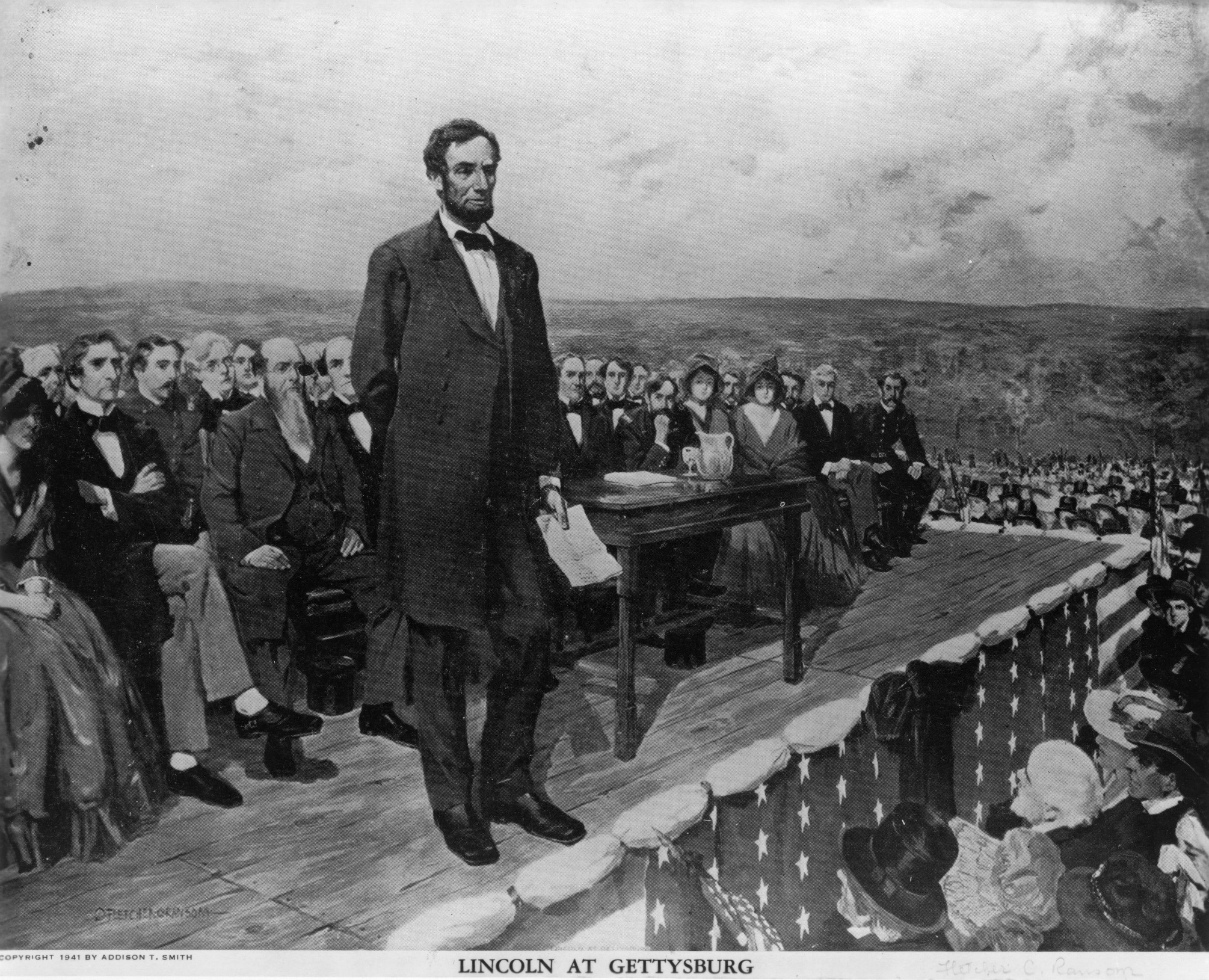
The airwaves today are filled with gushing remembrances of Abraham Lincoln’s brief eloquent eulogy at the Gettysburg Battlefield site on November 19, 1863.  In that speech, Lincoln stated that the nation was “dedicated to the proposition that all men are created equal.”  While he does not mention the abolition of slavery specifically, he goes on to describe a “new birth of freedom” for the nation.

Lincoln’s nation, however, did not include Native Americans.  By 1863, the policy of Indian “removal” had evolved into government-sponsored genocide, with widespread public calls for the “extermination” of Indians.  While Lincoln was speaking, Minnesota and California were offering bounties for dead Indians.  A scalp was worth $200 in the former, but only 25 cents in the latter.

Slavery was not over either. While Lincoln was speaking (and for many years afterwards), a brisk trade in Navajo children filled wealthy New Mexico homes with domestic servants.  Union troops were baffled by the practice, but the eyes of justice turned the other way.

1863 was also the year that the Navajo were subject to a scorched earth policy, their homes and fields burnt and their livestock shot.  The Sand Creek Massacre, where Cheyenne women and children were butchered (because “nits make lice”) took place a year later, in November 1864.

So the Gettysburg Address swirls in one reality, a landmark speech that defines a nation.  In another reality, a woman ran up a hill with children in her train, while gunshots rang out and her field of maize was set ablaze.

Imageor

Posted in On this date... | Tagged , , | Leave a comment

Redskins

redskins2

[I will keep adding to this list as I find more quotes.]

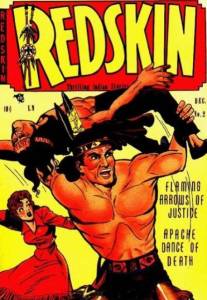
From the 1500’s thru the 1800’s, the most common derogatory term for Native Americans was “savages”.  In the 1830’s, large scale ethnic cleansing (called “Indian Removal”) become official government policy.  By the 1850’s, many settlers and local governments, especially in the Plains and Western states, advocated outright genocide.  During this period the term “redskins” appeared and was often used.  Here are all the examples I have found, in chronological order:

“Now that general hostilities against the Indians have commenced we hope that the Government will render such aid as will enable the citizens of the north to carry on a war of extermination until the last Redskin of these tribes has been killed.  Extermination is no longer a question of time– the time has arrived, the work has commenced, and let the first man that says treaty or peace be regarded as a traitor.” – Yreka Herald, August 7, 1853

“[Certain white men] who live in the vicinity of the [Indian] villages, and who are in the constant habit of committing the grossest outrages upon the squaws.  In a few instances these outrages have been avenged by the Indians, by shooting the aggressors or killing their stock.  These acts of retribution are called Indian outbreaks, and are made the pretext for fresh outrages upon the poor redskins.”  – Sacramento Union, October 1, 1858

“Those men from Eel River [involved in the Indian Island massacre near Eureka, California], becoming exasperated, followed the Indians, and determined to clean out every thing that wore a red skin.  Sheriff Van Ness thinks that the number of Indians (including men, women, and children) who have been thus slaughtered amounts, probably to about eighty.”  – letter to the editor, San Francisco Bulletin, February 28, 1860

“Seventeen of the Indians were killed and scalped by the volunteers, who, being from the immediate vicinity of the former massacre, are highly exasperated at the red-skins…  They are determined to drive off or exterminate the Indians, it is said.”  – Marysville Appeal (California), August 9, 1862

“The State reward for dead Indians has been increased to $200 for every red-skin sent to Purgatory. This sum is more than the dead bodies of all the Indians east of the Red River are worth.” – The Daily Republican (Winona, Minnesota), September 24, 1863

“A couple of shots from my soldiers with their trusty rifles caused the redskins to disperse instantly, and gave me a safe passage through this celebrated Gibraltar of the Navajoes.” – Albert Pheiffer, report to Major General Kit Carson, January, 1864

“We feel convinced that there is but one course to be pursued towards these treacherous red skins. We have long since thought they should be collected together and removed to some remote district of country, away from settlements, or to an island in the sea…” – editorial in the Mendocino Herald, April 22, 1864

“General Sherman remarked, in conversation the other day, that the quickest way to compel the Indians to settle down to civilized life was to send ten regiments of soldiers to the plains, with orders to shoot buffaloes until they became too scarce to support the redskins.”Army Navy Journal, 1869

“Reports are coming in from various points in Arizona that the old pioneers of the Territory, tempted by the reward of $250 for Indian scalps made by several counties in Arizona, have started out on the hunt for redskins, with a view to obtaining their scalps…. It is believed that several New Mexican cities and counties will adopt this plan of exterminating the savages.”  – Atchison Daily Champion (Kansas), 1885

“With [Sitting Bull’s] fall the nobility of the Redskin is extinguished, and what few are left are a pack of whining curs who lick the hand that smites them. The Whites, by law of conquest, by justice of civilization, are masters of the American continent, and the best safety of the frontier settlements will be secured by the total annihilation of the few remaining Indians. Why not annihilation? Their glory has fled, their spirit broken, their manhood effaced; better that they die than live the miserable wretches that they are.”  – L. Frank Baum (author of The Wonderful Wizard of Oz), editorial in the Aberdeen (South Dakota) Saturday Pioneer, December 20, 1890 (5 days after the assassination of Sitting Bull and 9 days before the massacre at Wounded Knee) Image

The first positive use of the term seems to come from Robert Louis Stevenson in 1893, when he lamented the loss of “redwoods and redskins, the two noblest indigenous living things.”  This, of course, is a prime example of “noble savage” stereotyping, a kind of conqueror’s guilt, that was prevalent in the wake of many massacres of Native Americans.

I have found one earlier use of the term, from 1786, though this seems to be an outlier. An unnamed Native “chief” was seeking French and other Native support to drive American pioneers out of Vincennes, a French outpost and mixed Native/White community on the Wabash River in what is now Indiana. He asked “other Redskins” for help to “destroy all the men wearing hats who are occupying this island.” This quote comes from a letter written between two white officials.

See my blog post for twelve things even more offensive than the Redsk*ins mascot.

See this blog post for a thorough academic review of the use of Native mascots in sports.

Posted in my own thoughts | Tagged , | 10 Comments

On this date… November 2, 1542… California

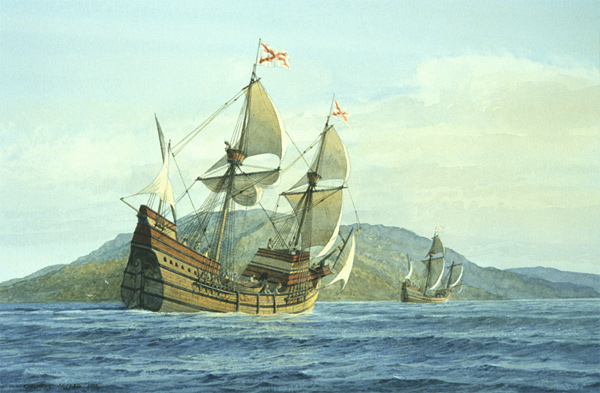
On this date in 1542, a party erupted on the deck of the San Salvador anchored off Santa Barbara, California.

The captain of the ship was raised on the Cuban genocide, came of age in the conquest of Mexico, and grew wealthy as a slave master in Guatemala.  He was the right-hand man of Pedro de Alvarado, the red devil of Central America.  He made the boats that laid siege to Tenochitlán, caulking them with the boiled human fat of Aztec bodies.  He was Juan Rodrígues Cabrillo, and with three ships, he fought the wind and current that sweeps the coast of California clean.

Image

On this date he was confronted with the spirit of the people.

Underneath the warm hills of Santa Barbara, where the blue sea meets the white sand, the people of Cicacut, loaded with sardines and acorns and nuts and seeds from a good year, were in a gracious mood.  Large canoes were filled with party-goers, adorned with beads, bone, shell, stone, and feathers.  Musicians, armed with pipes and rattling reeds, were brought forth.  They were all rowed to Cabrillo’s flagship, anchored offshore, for a party on the deck that lasted several days.  The Spanish sailors broke out the bagpipes and tambourines.  In the end, the sailors were worn-out hosts and it was only with the threat of violence that they sent the guests back to shore.

Kelsey, Harry. 1986. Juan Rodrigues Cabrillo.

Posted in On this date... | Tagged , , | Leave a comment

On this date… October 18, 1540… Alabama

The bloodiest battle between Europeans and Native Americans took place on this date in 1540 in Alabama.  De Soto’s army had been rampaging through the southeast, stripping villages of their entire winter stores of food, kidnapping political leaders, chopping off limbs, and taking young women for sex (but not before baptizing them).

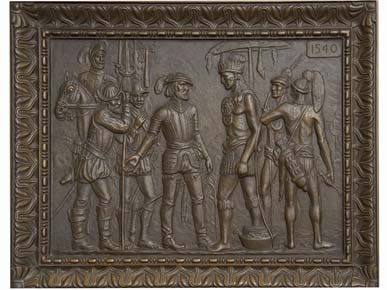
Then De Soto ran into Tuskaloosa. According to one of De Soto’s men, “Full of dignity, he was tall of person, muscular, lean, and symmetrical. He was the suzerain of many territories, and of numerous people, being equally feared by his vassals and the neighboring nations.  He wore a mantle of feathers down to his feet, very imposing.”    desoto tuskaloosa

De Soto meets Tuskaloosa, as depicted on the bronze panel doors at the Alabama Department of Archives and History.

A servant was always next to him, shading him with a parasol.  He was seated on cushions on a balcony above a town square when De Soto entered.  As De Soto’s man recalled, “And although the Governor entered the plaza and alighted from his horse and went up to him, he did not rise, but remained passive in perfect composure and as if he had been a king.”

On October 18 Tuskaloosa led De Soto’s army to his town of Mabila, where he had promised the Spaniards slaves and women.  Upon arrival, the Spaniards were greeted with a celebration of dancers– all men.  The town was walled, with fresh fortifications and guard towers.  All trees and bushes within bowshot of the walls had been recently cleared.  In the shadows were weapons, lots of them.

What began with a shout and the slash of a knife ended with the burning of the town.  The Battle of Mabila raged for hours.  The Indian death toll was estimated at several hundreds to perhaps thousands.  The fate of Tuskaloosa is unknown.

OLYMPUS DIGITAL CAMERA

The Spaniards won the battle but lost the war.  They lost dozens of men and horses and most of their gear.  It was the beginning of the end for them, and it would be nearly 150 years before Europeans ventured this way again.

Posted in On this date... | Tagged , , | Leave a comment