
Search Previous Posts
-
Enter your email address to subscribe to this blog and receive notifications of new posts by email.
-
-
For WordPress users:
- Follow Memories of the People on WordPress.com
Follow on Facebook
-
Recent Posts
- Migrating to Substack
- The many voices that called for Native genocide: A collection of quotes from the United States
- The Whiteness of Audubon’s Snowy Egret
- Book Review: Rebecca Nagle’s ‘By the Fire We Carry’ burns bright
- Women Leaders Are An Indigenous Tradition; Is It Time for a Woman US President?
Categories
- COVID-19 (7)
- land acknowledgments (9)
- my own thoughts (80)
- news (162)
- Occupied Lands (1)
- On this date… (44)
- reblogs (12)
- Standing Rock (28)
- Uncategorized (14)
Archives
- December 2024 (2)
- November 2024 (2)
- October 2024 (3)
- July 2024 (2)
- June 2024 (2)
- May 2024 (1)
- April 2024 (2)
- February 2024 (1)
- January 2024 (1)
- September 2023 (2)
- June 2023 (1)
- April 2023 (3)
- March 2023 (1)
- January 2023 (1)
- November 2022 (2)
- August 2022 (2)
- July 2022 (1)
- June 2022 (1)
- May 2022 (1)
- April 2022 (1)
- February 2022 (1)
- November 2021 (1)
- October 2021 (1)
- September 2021 (2)
- August 2021 (1)
- July 2021 (1)
- June 2021 (2)
- May 2021 (1)
- April 2021 (1)
- January 2021 (3)
- December 2020 (1)
- November 2020 (4)
- October 2020 (2)
- September 2020 (2)
- August 2020 (1)
- July 2020 (3)
- June 2020 (3)
- May 2020 (2)
- April 2020 (4)
- March 2020 (3)
- February 2020 (1)
- January 2020 (1)
- December 2019 (1)
- November 2019 (2)
- October 2019 (1)
- September 2019 (1)
- August 2019 (2)
- June 2019 (4)
- May 2019 (1)
- April 2019 (2)
- March 2019 (1)
- February 2019 (2)
- January 2019 (4)
- December 2018 (2)
- November 2018 (1)
- October 2018 (1)
- September 2018 (2)
- August 2018 (2)
- July 2018 (3)
- June 2018 (3)
- May 2018 (1)
- March 2018 (4)
- February 2018 (3)
- January 2018 (4)
- December 2017 (1)
- November 2017 (5)
- October 2017 (3)
- September 2017 (2)
- August 2017 (2)
- July 2017 (3)
- June 2017 (4)
- May 2017 (1)
- April 2017 (1)
- March 2017 (3)
- February 2017 (1)
- January 2017 (4)
- December 2016 (4)
- November 2016 (9)
- October 2016 (4)
- September 2016 (2)
- August 2016 (1)
- July 2016 (2)
- June 2016 (3)
- May 2016 (3)
- April 2016 (2)
- March 2016 (5)
- February 2016 (4)
- January 2016 (6)
- November 2015 (4)
- October 2015 (3)
- September 2015 (4)
- August 2015 (1)
- July 2015 (6)
- June 2015 (3)
- May 2015 (3)
- April 2015 (6)
- March 2015 (4)
- February 2015 (3)
- January 2015 (3)
- December 2014 (2)
- November 2014 (6)
- October 2014 (3)
- September 2014 (2)
- August 2014 (2)
- July 2014 (3)
- June 2014 (2)
- May 2014 (2)
- April 2014 (4)
- March 2014 (2)
- February 2014 (6)
- January 2014 (3)
- December 2013 (2)
- November 2013 (5)
- October 2013 (5)
- September 2013 (8)
- August 2013 (8)
On this date… October 12, 1492… Bahamas
On a small white sand island in the Bahamas, Cristoforo Colombo came ashore.
Since the first task of the conqueror is always to re-name the conquered, Colombo wrote, “I reached the Indian sea where I discovered many islands thickly peopled, of which I took possession without resistance in the name of our most illustrious Monarch, by public proclamation and with unfurled banners. To the first of these islands, which is called by the Indians Guanahani, I gave the name of the blessed Saviour (San Salvador).”
Colombo was warmly greeted by the people living there. That night, in his diary, he pondered what good slaves they would make: “I could conquer the whole of them with fifty men, and govern them as I please.”
Within a few decades, the natives of the Dominican Republic, Haiti, Cuba, and the Bahamas would be virtually extinct.
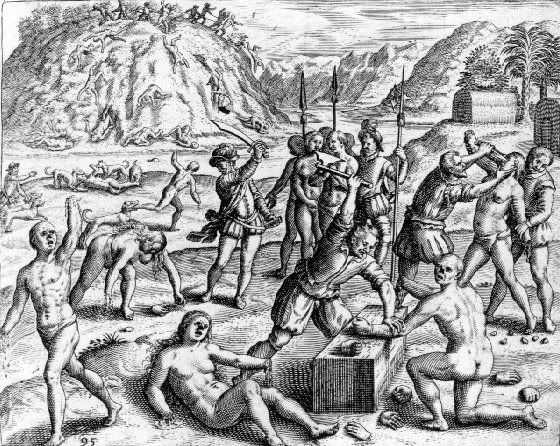
For a full account of the Spanish genocide of Native Americans in the Caribbean and Central America, see A Short Account of the Destruction of the Indies by Bartolomé de las Casas, a contemporary of Columbus. Various translations can be found on-line. Warning: it is very disturbing reading; this drawing is one of the least gruesome; imagine the Holocaust x10 (in terms of both quantity and degree of torture).
Posted in On this date...
Tagged Bartolomé de las Casas, Christopher Columbus, Native American history
1 Comment
Re-post: On this date, Oct 5, 1877
Chief Joseph says, “I will fight no more.”
Posted in reblogs
Leave a comment
On this date… October 4, 1597… Georgia
The Guale began their uprising against the Spanish priests on the Sea Islands. They began by killing the friar of Tolomato. Over his body, the cacique’s son gave this speech:
“Now the friar is dead. This would not have happened if he had allowed us to live according to our pre-Christian manner. Let us return to our ancient customs.
They take away from us our women, allowing us but one, and that, in perpetuity, forbidding us to exchange them for others. They prohibit us from having our dances, banquets, feasts, celebrations, games and wars, in order that, being deprived of these, we might lose our ancient valor and skill, which we have inherited from our ancestors. They persecute our old men, calling them wizards. They are not satisfied with our labor and hinder us from performing it on certain days. Even when we are willing to do all they tell us, they remain unsatisfied. All they do, is to reprimand us, treat us in an injurious manner, oppress us, preach to us and call us bad Christians. They deprive us of every vestige of happiness which our ancestors obtained for us…
If we kill them all now, we will throw off this intolerable yoke without delay.”
Within days, five friars were dead and Christian Indians were forced to evacuate to St. Augustine under the protection of Spain.
The Spanish responded. Between October 24 and November 6, they burned the Guale towns of Ospo, Zapala, Tolomato, Asao, and Talaxe. They burned all the houses and all the food stockpiled for the winter.
Geiger, Maynard 1937. The Franciscan Conquest of Florida. 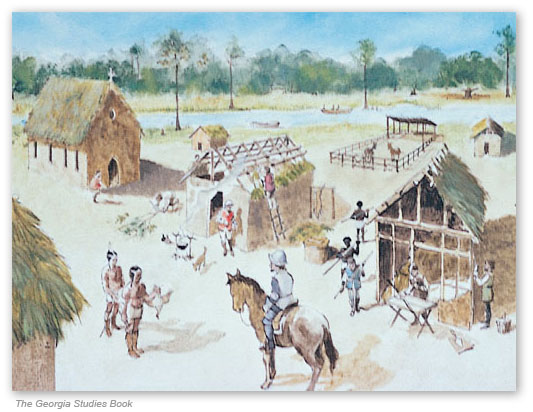
On this date… September 29, 1872… Texas
For the first time, Colonel Ranald Mackenzie attacked the Comanche successfully in the heart of Comancheria, on the Staked Plains, on the North Fork of the Red River.
Their leader, Mowway, was on his way to a peace conference. Joining an entourage of fifty-two Indians from various tribes, they headed to Washington for a meeting with President Ulysses Grant. Grant’s idea was to awe the chiefs with the splendor of white civilization. In addition to a meeting with the president and other officials, they would also be wined and dined at the fashionable Washington House hotel on Pennsylvania Avenue. They would be professionally photographed in all their native regalia (see the photo below). They would tour the Capitol Building with its new dome, the White House, and the national mint where money was printed. The route home would include stops in Philadelphia and New York City, where they would attend a circus and a Broadway musical.

The Kotsoteka and Quahada Comanches, with over three hundred lodges, had chosen the plains over the reservation. For hundreds of miles around, there are few white settlers. Satisfied with enough buffalo meat and other provisions, they were preparing for the winter. Women were drying slices of meat in the late summer sun. Children were gathering the last of the blackberries. Recent raids had netted plenty of horses and mules, some taken brazenly from Fort Sill itself. The sky was blue and life was good.
On this date, Mowway had just arrived in St. Louis and was attending a meeting of chiefs and other government officials at the Everett House hotel.
Half a world away, Mackenzie and his men charged the camp. Comanche children looked up upon hearing hoofs and seeing dust in the distance. In three minutes, those hoofs were racing between the tepees, women were running, children were crying, the men were running for their horses. In ten minutes, bullets and arrows, gunshots, yells, screams, and moans filled the air. In one hour, the tepees and all the Comanches’ food and clothes for the winter were burning. Except for the choicest buffalo robes—these the soldiers kept for themselves. One hundred sixteen women and children were taken captive. They would be held, imprisoned, until the tribes returned stolen mules and horses and four white captive children.
Almost two weeks later and completely unaware of the destruction of his home, Mowway and the chiefs finally met with President Grant. Grant spoke to them briefly about the need for them to become civilized and then left the room. He took no questions and entertained no discussion.
Zesch, S. 2005. The Captured: A True Story of Abduction by Indians on the Texas Frontier
On this date… September 25, 1714… New York
Three years and three days after the start of the Tuscarora War, on this date, the Five Nations of the Iroquois Confederacy negotiated the safe passage of the surviving refugees from North Carolina to New York. The Iroquois informed the governor of New York:
“We acquaint you that the Tuscarore Indians are come to shelter themselves among the five nations they were of us and went from us long ago and are now returned and promise to live peaceably among us and since there is peace now every where we have received them, do give a Belt of Wampum, we desire you to look upon the Tuscarores that are come to live among us as our Children who shall obey our commands & live peaceably and orderly.”
The Tuscarora were then accepted as the Sixth Nation of the Confederacy.
On this date… September 22, 1711… North Carolina
On this date, the Tuscarora rose up and attacked the English settlement of Bath and other homesteads along the Neuse, Roanoke, and Trent Rivers. They had suffered greatly from English slave raids, land grabs, and diseases. In the uprising, hundreds of settlers were killed.
This ignited the Tuscarora War and led to the ultimate defeat of the Tuscarora.

This drawing shows Christopher von Graffenreid, founder of a Swiss- German colony in North Carolina, and his slave being held captive by the Tuscaroras during the conflict. http://www.turtletrack.org/Issues03/Co02082003/CO_02082003_Thisdate.htm
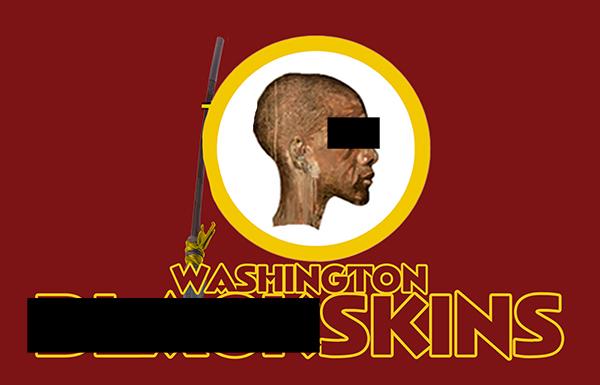
Re-post: Redskins and Blackskins
Interesting commentary from an African American.
Selective Memories from Syria to Fort Pitt
President Obama is right to voice outrage at the use of chemical weapons in Syria. While the concept of rules in warfare is a bit ironic, maintaining an international consensus against the use of these weapons, which kill civilians so indiscriminately, is a good thing. However, for the rest of the world, this sudden outrage is both amusing and frustrating, exposing the US government’s selective memory over time. For Native Americans, the use of chemical weapons brings memories of past uses of biological weapons.
In the bubble of the US media, one would think this is the first use of chemical weapons since the notorious trenches of World War I. For the rest of the world, however, their memories are different.
They remember that the previous most recent use of chemical weapons was just four years ago (in 2009), in Gaza, by Israel against the Palestinians. In that incident, Israel used white phosphorus, ostensibly to create smokescreens. However, there were extensive reports of white phosphorus landing among heavily populated areas, burning through flesh on contact, sometimes to the bone. A United Nations office was hit and burned. As in Syria, a UN investigation and report followed. As in Syria, it was denounced by the perpetrator. The US stood by Israel, criticized the UN report, and the whole issue quickly fell out favor in the local media. Most Americans are probably not aware of it. Likewise, few Americans realize that US forces admitted targeting personnel with white phosphorus in Fallujah, Iraq in 2004.
It has been reported that the Syria attack is the largest use of chemical weapons since 1988, when Saddam Hussein used them in Halabja, a Kurdish minority town. Chemical weapons were widely used in the Iran-Iraq War. The Halabja incident, however, was the single largest, and stood out because it targeted an ethnic minority within Iraq by Iraqi government forces. As many as 5,000 people were killed, making it the largest chemical weapons attack in history. While George W. Bush widely used this example in his arguments against Hussein (saying he used weapons of mass destruction “against his own people”), the rest of the world remembers that, at the time, Iraq was a US ally and the US said little in the aftermath of this event. US diplomats were instructed to spread the blame to Iran as well. A UN resolution, seven weeks after the incident, condemned both countries for their use of chemical weapons and made no specific mention of Halabja.
The rest of the world also remembers the widespread use of napalm by the US during the Vietnam War. Although it was designed as a defoliant, images of burned children fleeing their flaming villages are now iconic. Most Americans have seen this. But what the US media scarcely covers is the ongoing legacy of napalm residue in the water supply of some villages and their ongoing impacts to public health. These sites are now known for some of the most grotesque fetal deformities ever documented. And, just to be complete, the rest of the world remains quite cognizant that the US is the only country to have ever used that other weapon of mass destruction, an atom bomb, against a civilian population.
For Native Americans, all of this recalls biological warfare, primarily the deliberate spread of smallpox. To this day, there exists only one well-documented instance of Europeans deliberately attempting to infect Native Americans with smallpox. The incident occurred in 1763 at Fort Pitt, Pennsylvania. English General Jeffrey Amherst recommended it: “Could it not be contrived to send the smallpox among the disaffected tribes of Indians? We must on this occasion use every stratagem in our power to reduce them.” (He now has a town and a prestigious college named after him.) Colonel Henry Bouquet agreed to implement the plan: “I will try to inoculate the bastards with some blankets that may fall into their hands.” But, unbeknownst to them, Captain Simeon Ecuyer had already done it on his own: “We gave them two Blankets and an Handkerchief out of the Small Pox Hospital.”
In addition to this incident, there are many more stories from tribes who have similar suspicions. Elizabeth Fenn has documented the use of smallpox as a potential weapon during the Revolutionary War. During this time period the vaccination had not yet been developed. But individuals could be “inoculated” by deliberately injecting the smallpox virus into open wounds or thru other methods. They would then come down with a mild version of smallpox (with only a 2% mortality rate), but would gain lifelong immunity just the same as any survivor of the disease. More interestingly, during their period of mild infection, they were just as contagious as any victim of the disease and could pass on the full regular version of the virus (with a 30% mortality rate among Europeans, and up to 90% among Native Americans). Furthermore, they had twelve days before they would show any symptoms. For the military general, these mildly infected inoculated people were weapons. They could be sent among enemies, be they French, American colonists, or Native Americans, and spread the contagion with little notice. Furthermore, it would be very difficult to prove.
Thus, Barack Obama is far from the first president to address this issue. In the midst of the Revolutionary War in 1775, General George Washington wrote to John Hancock, “The information I received that the enemy intended Spreading the Small pox amongst us, I coud not Suppose them Capable of – I now must give Some Credit to it, as it has made its appearance in Severall of those who Last Came out of Boston.”
History shows that the use of these weapons of mass destruction, be they chemical or biological, have most often been used not in international wars, but in close quarters, in domestic civil wars, typically characterized by ethnic conflict. Such is the case in Syria, and that was the case in Gaza, Iraq, Vietnam, and colonial America. Often, the perpetrators were a powerful ethnic minority and the victims were an ethnic majority. Native Americans can easily sympathize with the victims and applaud Obama’s outrage regarding Syria. What to do about it is an open question and one for the whole world, because the rest of the world knows that the US has limited moral high ground on this issue.

Posted in my own thoughts
Tagged chemical warfare, chemical weapons, native americans, smallpox, syria
1 Comment
The Rutherford Trace and the Destruction of Nikwasi
reblog from This Day in North Carolina History
Posted in reblogs
Leave a comment
 Memories of the People