On this date… September 8, 1598… New Mexico

On this date, Pueblo leaders were summoned to San Juan Pueblo to pledge their allegiance to King Phillip of Spain, represented by Governor Juan de Oñate, and to God, represented by Fray Alonso Martinez.

They gathered under the shade of cottonwood trees on a warm September afternoon for a version of the Requerimiento.  The Pueblo leaders were asked to care of priests assigned to them, lest they and their towns be put to the sword and destroyed by fire and their wives and children sold into slavery.  This instruction was repeated three times.

An official scribe of New Spain provided legal documentation:

They, of their own free will, as has been set forth, wished to have Don Philip, our lord, as their king, and to render obedience and vassalage to him voluntarily, without compulsion from anyone.

Before the year was over, this ceremony was repeated throughout all the pueblos of New Mexico.

Image

San Juan Pueblo in 1906

Posted in On this date... | Tagged , , | Leave a comment

On this date… September 5, 1877… Nebraska

On this date, Crazy Horse was literally stabbed in the back and killed while in custody at a guard house at Fort Robinson.

He was a man of mystery.  We do not know what he looked like.  We do not know the name of the man who murdered him.  We do not know where he is buried.

Uncompromising and brave, he had been a living legend among his people.  Black Elk’s father had told him that Crazy Horse dreamed and went into the world where there is nothing but the spirits of all things. That is the real world that is behind this one, and everything we see here is something like a shadow from that world. He was on his horse in that world, and the horse and himself on it and the trees and the grass and the stones and everything were made of spirit…

He joins a list of freedom fighters killed while in custody:  Túpac Katari, Che Guevara, Stephen Biko, Victor Jara, Jesus.

Image

Posted in On this date... | Tagged , | Leave a comment

On this date… August 27, 1874… South Dakota

The Chicago newspaper declared:  “GOLD!  The Glittering Treasure Found at Last…  A Belt of Gold Territory Thirty Miles Wide.”  The article was leaking the news from an illegal US Army expedition into the Great Sioux Reservation.

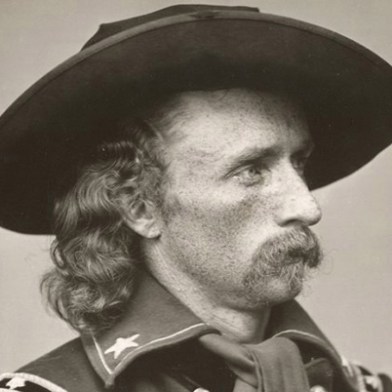
The reservation, delineated by treaty just six years earlier, included Paha Sapa, the Black Hills, the sacred heart of the Sioux world.  The treaty stated that the hills shall be “set apart for the absolute and undisturbed use and occupation of the Indians and no unauthorized person shall ever be permitted to pass over, settle upon, or reside in.”  Nevertheless, without permission from the Sioux, General George Custer led an expedition of ten companies of cavalry and infantry, 110 wagons, two engineers, four biologists, two experienced gold prospectors, a photographer, and three newspaper correspondents.  It was not a quiet, or secret, affair.  The intent, it seemed, was to flood the Indian’s land with trespassers.  The expedition was ordered from the top, from President Ulysses Grant.  To this day, the Sioux call Custer’s route the “Thieves’ Road”.

The newspaper article continued, “The expedition has solved the mystery of the Black Hills, and will carry back the news that there is gold here, in quantities as rich as were ever dreamed of.”
Image

A New York article was more brazen and prophetic:  “A dispatch from Bismarck, Dakota, speaking of Gen. Custer’s expedition, says the explorers are well satisfied with the prospect, and are ready to conduct an expedition to the new Eldorado as soon as the Indian title is extinguished.”

Image

This set in motion a politically contrived war, Custer’s Last Stand, and the eventual internment of most of the Sioux and Cheyenne.  It led to the creation of Pine Ridge Reservation (one of the poorest parts of the country today), the Homestake Gold Mine (which produced 10% of the world’s gold), and the Hearst family fortune (from the gold).  It also led to the largest civil judgment against the US government, for the illegal seizure of the land.  Today, however, the Sioux refuse compensation because they say the Black Hills never were for sale.

Gray, J.S.  1988.  Centennial Campaign:  The Sioux War of 1876.  

Posted in On this date... | Tagged , , , | Leave a comment

On this date… August 20, 1705… Florida

Not much remained of the original inhabitants of Florida by 1705.  The villages and towns of the Apalachee, Timucua, Ais, Jeaga, Calusa, Tocobaga, and Matecumbe had all been devastated by the Yamasee, who worked as slavers for the British.  All the way down to Key West, Florida had been depopulated.  Many of its people were taken to Charleston, South Carolina and shipped as slaves to British plantations in the Caribbean.  Between 1670 and 1715, as many as 50,000 Indians were exported from Charleston, more than double the number of African slaves brought in.

An Englishman recounted,  “They have drove the Floridians to the Islands of the Cape, have brought them in and sold many Hundreds of them, and Dayly now Continue that Trade so that in some few years they’le Reduce these Barbarians to a farr less number.  There is not one Indian Town betwixt Charles Town and Mowila Bay [Mobile, Alabama]…”

A few remaining Indian villages sought protection around the Spanish settlement at St. Augustine.  Already, their ways of living and homeland had been turned upside down.  Today we would call them “IDP’s”, internally displaced persons.  On this date, they came under siege.  The men of Chiluque left their village to protect two neighboring villages.  While they were away, their own village came under attack.  Racing home, they discovered their homes had been ransacked and eighty women and children were missing.  The track was easy to follow and they gave chase.  Twenty-five miles north, in a swamp between St. Augustine and the mouth of St. John’s River, they caught them.

The battle raged, with the men of Chiluque fighting side-by-side with the Spanish against the Yamasee, who were armed by the British.  In the heat of the battle, most of the captured women and children crawled through water and grass to freedom.  It was a short-lived victory; today most of Florida’s original tribes no longer exist.

Image

Gallay, A. 2003. The Indian Slave Trade:  The Rise of the English Empire in the American South.

Hann, J.H. 1996.  A History of the Timucua Indians and Missions.

Posted in On this date... | Tagged , , | Leave a comment

On this date… August 14, 1720… Nebraska

One hundred fifty-six years before Custer, Europeans were massacred on the high plains.  Hiding in the tall grass, the Pawnee, armed by the French, surprised a Spanish/Pueblo encampment at dawn.  They killed 35 Spaniards, which was most of them, including their captain Pedro de Villasur.  They also killed 11 Pueblo allies, though most of the Pueblo escaped.  The victory secured the northern Plains for French traders and sent the Spanish reeling back to Santa Fe.

Because of the Pawnee, and at other times the Apache and Comanche, the Spanish Empire never advanced on to the Great Plains.

Image

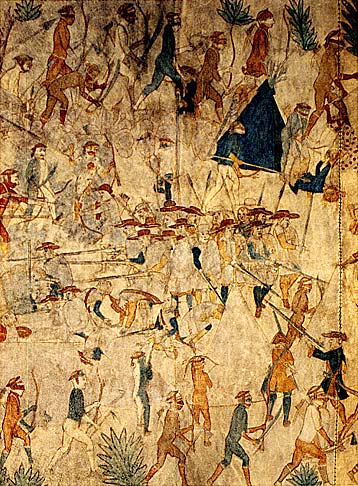
The Spanish are surrounded by the French and Pawnee in this painting on a buffalo hide. 

http://www.nebraskastudies.org/0300/frameset_reset.html?http://www.nebraskastudies.org/0300/stories/0301_0114.html

Posted in On this date... | Leave a comment

On this date… August 12, 1676… Rhode Island

Metacomet, known as King Phillip, sachem of the Wampanoag, was killed, decapitated, quartered, his body cut into pieces and hung from trees, his head put on a spike in Plymouth (where the Pilgrims kept it there for twenty years), and his right hand given to his killer, John Alderman, a Christian “praying Indian” who fought with the English colonists. His wife and daughter were sold into slavery and shipped to Bermuda.

King PhilipMetacomet, known as King Philip 

Thus ended King Philip’s War, the bloodiest war on US soil in terms of the percentage of towns attacked and number of people killed. The war was as short as it was fierce. In less than a year, over half of the English settlements were attacked, while the Wampanoag and Narragansett were nearly wiped out. Nevertheless, both tribes remain today.

Posted in On this date... | 1 Comment

Dumping oil waste at Wind River, Wyoming

Dumping oil waste at Wind River, Wyoming

This was on NPR yesterday; I didn’t see it yet at other Native news sources.

“It looks like the protections for tribal citizens here are weaker than those for citizens in Wyoming that surround them.” – Duke professor examining the case

Posted in news | Leave a comment

What if people told European history like they told Native American history?

Reblog from An Indigenous  History of North America

What if people told European history like they told Native American history?.

Posted in reblogs | Leave a comment

On this date… August 10, 1680… New Mexico

After eighty years of living like serfs under Spanish domination, the Pueblo revolted.  Across a broad territory, they rose up on a single day, killed hundreds of Spanish priests and leaders, and sent the remaining two-thousand fleeing down the Rio Grande to today’s Ciudad Juarez.

Spanish sympathizers were killed immediately.  Churches were burned.  Kachina dances were revived.  And, most significantly, all that they harvested, whether it was maize or beans or cotton or squash or watermelons or cantaloupes, was theirs.

New Mexico was swept clean of Europeans for most of the next twelve years.  It was probably the largest indigenous revolt, in terms of duration, geographic scope, and degree of societal transformation, in the history of North America. Image

Hopi mural of the Pueblo Revolt 

A Tiwa man explained it the Spaniards:  “For a long time, because the Spaniards punished sorcerers and idolaters, the nations of the Tewas, Taos, Picurís, Pecos, and Jémez had been plotting to rebel and kill the Spaniards and the religious, and that they had been planning constantly to carry it out, down to the present occasion….  He declared that the resentment which all the Indians have in their hearts has been so strong… and that he has heard this resentment spoken of since he was of an age to understand.”

Sando, J.S. 1992.  Pueblo Nations.

Kessell, J.L. 1979.  Kiva, Cross, and Crown.

http://adamjamesjones.wordpress.com/2012/05/23/the-pueblo-revolt-of-1680-an-american-braveheart/

http://www.americanjourneys.org/aj-009b/summary/

http://www.pbs.org/weta/thewest/resources/archives/one/pueblo.htm

Posted in On this date... | Tagged , , , , | Leave a comment

Acoma Pueblo, New Mexico

Acoma Pueblo, New Mexico

the oldest continuously inhabited place in the nation

Posted in Uncategorized | Tagged | Leave a comment