Erasure, white fragility, and the verbal monuments of bird names: Should we hold people in the past accountable to present-day mores?

When addressing historic wrongs, and especially memorials that honor people that perpetrated historic wrongs, a common challenge is: Should we be holding these people accountable according to modern values and mores?

There are two big problems with this question.

  1. Almost always the wrong, let’s say slavery of Blacks and ethnic cleansing of Native Americans, was actually hotly debated and contested at the time.
  2. (and this is the key) Blacks and Native Americans have always been opposed to slavery and ethnic cleansing.

The question of “social mores” and society’s standards refers, implicitly, only to white society’s standards. By raising the question of whether or not (white) morals have changed, people of color are removed from the equation, shunted to the back of the room, and put in a position of debating the issue in a white-centric framework. It’s a fine introspective question for white society, but it erases people of color, both from the past and in the present.

Case study: Bird names for birds

By way of example, let’s look at the recent movement in the birding and ornithological community to rename birds that have been named after people. These honorific bird names are described as “verbal statues”, usually to white men in the mid-1800s. Some were slaveholders, others were Indian killers, and most were either associated with these men or comfortable naming birds – or rivers, mountains, forests, and towns – after them.

One example is a striking black and yellow oriole of the southwest deserts, known for singing its melodious song from the tallest yucca around. In 1837 in Mexico, ornithologist Charles Bonaparte first described the species for Euro-American scientists, giving it the Latin scientific name Icterus parisorum. The name honors the Paris brothers, businessmen who paid to transport specimens from Mexico to France. In 1854, Couch “re-discovered” it and named it after Winfield Scott, Commanding General of the US Army. Today it is known as Scott’s Oriole.

Scott, not a naturalist in any way, was honored precisely for his role in the US-Mexican War, which allowed the US to take over much of the oriole’s range. His resume also included his prosecution of the Black Hawk War and ethnic cleansing of Native Americans from the Midwest, and overseeing the arrest, detainment, and expulsion of the Cherokee during the Trail of Tears.

There are many more examples of honorific bird names memorializing those with checkered pasts. We can also examine the dismissive treatment of women in the few birds named after them, or the two species with Native names, albeit misplaced and over-written. More on that can be found here.

…and the American Ornithological Society

In 2020, in the racial reckoning in the aftermath of the George Floyd killing, the AOS’S North American Classification Committee (NACC), which is responsible for official bird names, modified their naming guidelines to be “responsive… to changing societal mores” (Winker). Under Part D, Special Considerations, they added, “The NACC recognizes that some eponyms refer to individuals or cultures who held beliefs or engaged in actions that would be considered offensive or unethical by present-day standards. These situations create a need for criteria to evaluate whether a long-established eponym is sufficiently harmful by association to warrant its change…. The NACC recognizes that many individuals for whom birds are named were products of their times and cultures, and that this creates a gradient of disconnection between their actions and beliefs and our present-day mores.” [italics added by me]

Thus, last year, they were willing to change McCown’s Longspur to Thick-billed Longspur. McCown had been a Confederate soldier. Others that participated in massacres or ethnic cleansing of Native Americans remain unaddressed at present. Like Scott’s Oriole, Abert’s Towhee, Clark’s Nutcracker, and others.

The entire argument, that social mores have changed, frames the issue from a Eurocentric position. To coin a phrase from Isabel Wilkerson in her book “Caste”, focusing on social mores, and by implication white social mores, is an example of white “expectation of centrality”, where the white historical perspective is the only one on the table. The AOS’s reasoning is also an exhibition of white fragility, a face-saving attempt to say that the land has shifted under them, and that in its beneficence they will consider new names. It was not that the AOS itself was in need of reform.

Society hasn’t changed

To be clear, not that much has changed. Then, as now, Blacks and Native Americans have always opposed slavery and ethnic cleansing. Within white society, both slavery and ethnic cleansing were hotly contested at the time. A war was fought over the former. The Indian Removal Act of 1830 and the resulting ethnic cleansings remain one of the most contentious and debated pieces of legislature in the history of the US Congress—and the Supreme Court. The removal of the Cherokee passed by a single vote after US Representative Davy Crockett (National Republican-TN) was voted out of office for defending Native rights. The streets of Washington DC were filled with polemical pamphlets, the social media of the day. Had the naming of Scott’s Oriole been fully vetted, it would surely have met white opposition.

The biggest change that has occurred is probably within the AOS’s membership, which now includes many more women and people of color than in the past. Their change in policy is welcome, and long overdue, but it is not due to tectonic social shifts underneath them; it is due to their membership becoming more diverse. The white story, and white history and white social mores, are no longer central.

Posted in my own thoughts | Tagged , , , , , , , , , , , , , , , , , , | 2 Comments

The backstory on Hannah Duston’s scalps

To scalp someone is to remove the skin from the top of the skull and the hair with it. The end product is a flap of skin with a hair piece attached. The size of the scalp taken can vary from a square inch to the entire scalp. Scalping can be done in a variety of ways, but is usually done from behind the victim, pulling the head up, and slicing along the hairline of the forehead. Scalping may be done to a living person or a dead person. When done to a living person, scalping does not necessarily result in death.

A Hannah Duston statue augmented by fake blood in 2020.

Much like religion, written language, and agriculture, scalping seems to have arisen independently among different human populations on different continents. The first recorded mention of scalping in history comes from ancient Greek historian Herodotus. Natives along the East Coast claim they learned it from the English. Between Natives and whites, it’s not clear who took more scalps from who, but both scored in the thousands.

For Natives, scalps were a trophy. For Europeans, with a long history of employing mercenaries, they served as proof for payment.

Today, ten scalps, including those of women and children, can be seen in the hands of the statue of Hannah Duston. She was a frontier mother who was kidnapped by the Abenaki. One night in 1697, she and two fellow captives killed their presumed captors, two men, two women, and six children. About to escape, she was cognizant of the bounty: “fifty pounds per head for every Indian man, and twenty five pound [four to eight months of a soldier’s salary] per head for any Indian woman or Child… the Scalps… to be produced and delivered to the Commissioner.”

In New England, the colonists began with bounties for wolves, evidenced by producing a head or scalp. In the 1630s, they offered cloth in exchange for Pequot body parts. They killed that which they could not domesticate, and they paid someone to do it.

The bounty had actually expired by the time Duston returned with her scalps, but she petitioned, successfully, for the reward. It was a key moment in the history of European colonial scalp bounties. In the words of Ball (2013), “In a single generation, accelerated by the colonial wars, bounties had moved from a tool born of exigency to a demand by the populace.”

By 1700, most New England colonies were offering scalp bounties.

Like Pocahontas, her story was forgotten but revived in the 1800s. It was repeated by Nathaniel Hawthorne and Henry David Thoreau. She appeared in history books and children’s books. They left out the part about the women and children, or the possibility that the people she killed were not her original captors, but were bringing her back to her settlement to ransom her.

In the words of Ball, “Demand for territory in this ’empire of land’ was ‘inherently eliminatory,’ presuming the removal of indigenous peoples in favor of English settlers. Colonial rewards for Indian scalps fused the ‘logic of elimination’ with targeted violence. Scalp bounties simultaneously constructed racialized enemies and produced whiteness as the unifying principle for people of the British (and later American) empire.”

Between 1861 and 1910, six monuments were dedicated to her. It was a story the white people wanted to memorialize at that time. Her granite likeness, the one that stands today holding the scalps, was the first statue funded by the state of New Hampshire. In her other hand is a hatchet.

Today, there are calls to de-memorialize these monuments to white colonization, white supremacy, and ethnic cleansing.

Citation: Ball, M.H.R.S. 2013. Grim commerce: Scalps, bounties, and the transformation of trophy-taking in the early American Northeast, 1450-1770. Ph.D. thesis, University of Colorado.

Posted in news | Tagged , , , , , , , , , , , , , , , | Leave a comment

Decolonizing bird names: Effort reveals fault lines among birders

The American Ornithological Society, National Audubon Society, and American Birding Association are leading the process for change. Townsend, with three species named in his honor, collected Native skulls for his friend Samuel Morton, author of Crania Americana. He delighted in the 1838 smallpox epidemic of the northern Plains (in which President Andrew Jackson withheld the vaccine), as it gave him greater opportunity to rob graves.

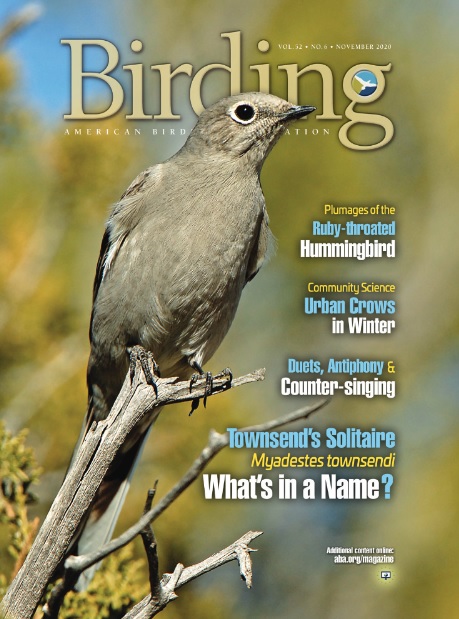
A revolution is about to sweep the world of birders and ornithologists. After decades of intransigence, the most prominent organizations and authors – including prominent field guide authors David Sibley and Kenn Kaufmann – are endorsing “bird names for birds”, a widespread effort to rename eponymous or honorific species names with more descriptive names, focusing on their physical or ecological attributes. For example, Bachman’s Sparrow could revert to Pinewoods Sparrow, Townsend’s Solitaire might become Juniper Solitaire, and Kittlitz’s Murrelet would probably be re-named Glacier Murrelet.

Over a hundred, or about 10%, of bird species in North America are named after people, almost always European colonizers, many with checkered pasts.

We are used to this.

We live in a world dominated by memorials and honorifics to white supremacy. The US capitol is the District of Columbia. It’s nearly impossible to avoid seeing Andrew Jackson’s face every day on a $20 bill. My own town (Port Townsend) was named by Vancouver after a friend in Europe. My county is Jefferson, who owned a slave plantation and plotted to get Natives in debt to steal their land. My state is Washington, who considered Natives “merciless Indian savages”. Our streets are Sheridan, Kearney, Jackson, etc. The whole place is a celebration of white conquest. I cannot walk 100 yards and NOT see something – a street, a plant, a mountain – named to honor a white supremacist. And yes, even the birds.

Decolonizing names, especially names for nature, is a way to reclaim sovereignty.

The effort has grown out of the national reckoning on racial equality in the aftermath of the George Floyd killing. Movements to change names are underway with regard to parks, mountains, streets, other wildlife, and even rock-climbing routes. Current names generally go back to the eighteenth and nineteenth centuries during white American expansion across North America and recall an era of conquest, when species and landforms were “discovered” – and some named after the individual who documented them, or after their friends and colleagues.

Bird Names for Birds, a small group of interested birders, was instrumental in reaching out to the larger organizations to participate in the congress. In their words, “Eponyms (a person after whom a discovery, invention, place, etc., is named or thought to be named) and honorific common bird names (a name given to something in honor of a person) are problematic because they perpetuate colonialism and the racism associated with it. The names that these birds currently have—for example, Bachman’s Sparrow—represent and remember people (mainly white men) who often have objectively horrible pasts and do not uphold the morals and standards the bird community should memorialize.” They describe such names as “verbal statues” that should be removed. The Bird Names for Birds website includes bios of various people memorialized with bird names.

Some of the names are obviously problematic. Bachman was a pro-slavery white supremacist and used his scientific background to argue that position. Audubon was similar, and deliberately made up bird species to sell his books. Townsend robbed Native graves– and his diaries show he knew it was wrong. But it’s the entire practice that is being challenged. Naming species and landforms after people was largely an act of conquest, possession, bravado, and control.

The ornithological world remains dominated by white men. Name changes over social justice concerns began only last year when McCown’s Longpsur was changed to Thick-billed Longspur, after widespread outcry because McCown was a Confederate general and involved in the ethnic cleansing of Native Americans (though the former reason was mentioned far more often than the latter). A proposal in 2018 for that name change was rejected by a 7 to 1 vote. 

The last time a bird name was changed for similar reasons was in 2000, when Oldsquaw was changed to Long-tailed Duck, the name it already had in Europe. At that time, the American Ornithologists’ Union, the precursor to the AOS, asserted that the name change was not for reasons of “political correctness” but merely to conform with usage in Europe.

MacGillivray’s Warbler was named by John James Audubon after his friend, William MacGillivray, a Scottish ornithologist who never came to America. Audubon also coined its Latin specific, tolmiei, to honor William Fraser Tolmie, a Scottish employee of Hudson’s Bay Company based at Fort Nisqually during the period of Native removal. Scientific, or Latin names, are subject to international rules and processes are not the focus of this process

In deference to white fragility, proponents of the changes are emphasizing the positive aspects of new names—that they would be more meaningful and descriptive of the bird—rather than focusing on past racial injustices.

Many suggested using Native names for species, though most stated this could be challenging because 1) names from Native languages may have been lost, or 2) most bird species’ ranges span multiple historic aboriginal territories and languages, creating a conundrum over which indigenous word to use. (The exception to this is Hawaii, where indigenous names are already in widespread use.) I’m not convinced this is a problem. Many species are named after California—California Quail, California Condor, California Gull—none of these are restricted in range to just California. Noteworthy, consultation with tribes was never mentioned; it was basically dismissed as too difficult. Among mammals, moose, raccoon, and skunk are all derived from Algonquian languages.

For now, the effort will be limited to primary eponymous English bird names. The effort will not include secondary names (e.g., American Crow, named after the continent, which was named after Amerigo Vespucci). Other problematic names, such as Flesh-footed Shearwater for a bird with pink feet, will not necessarily be addressed.

Reaction

Responses, as well as the entire rollout, have broken down – sharply – along demographic lines.

The Congress for English Bird Names was held on April 16, 2021. The AOS committee that hosted the webinar was primarily people of color, which is fairly striking because the organization is disproportionately white. The speakers at the webinar – the authors and representatives of the various organizations – were entirely white and mostly men. Some endorsed the name changes whole-heartedly, even though they’d only come to that position recently. Others, especially the database managers, were more begrudging in their support.

The video was posted a week later. I posted a blog on it, for birding audiences, on April 24, linking the video and summarizing the discussion. It was shared widely across dozens of Facebook birding groups and clubs and other social media dedicated to birders.

The online response among birders, who are primarily white liberal environmentalists, has been mixed and sometimes heated. Support for the name changes has been tepid. On my personal Facebook page, which includes dozens of left-wing politically active birders, my blog post received only four likes.

The opposition has been almost entirely white males. Their comments are generally along the lines of “oh for fuck’s sake”, “what a colossal waste of time”, “dishonorable and embarrassing”, “the mindless insanity of the cancel culture”, “virtue signaling on steroids” and “No racial reckoning is needed. We have done nothing wrong.” Comments at the Oklahoma Ornithological Society Facebook page were nearly ninety percent negative. Some used an argument of “unity” and “compassion” to justify keeping the names as they are.

White women, when in opposition, mostly took a softer approach, noting that “a few bad apples spoil the whole thing.”

Strong statements of support were primarily limited to people of color and people under 30 years old.

Posted in news | Tagged , , , , , , , , , , , , , , | Leave a comment

Marjorie Taylor Greene’s 14th District: Where the Trail of Tears began

Marjorie Taylor Greene’s 14th District in the northwest corner of Georgia lies in the center of the lands the Cherokee Nation was forced to vacate at gunpoint during the horrific ethnic cleansing known as the Trail of Tears.

My great-great-great grand uncle, Richard Fox Taylor, led one of the detachments on the Trail of Tears. He became a signer of the new Cherokee Constitution in 1839 in Indian Territory (Oklahoma), and served as Assistant Chief in 1851. My great-great grandfather, Thomas Jefferson Parks, drove one of the wagons as a teenager.

Greene is the infamous Q-Anon follower who now sits in the House of Representatives where she faces calls for her expulsion over her behavior, death threats, and endorsement of outlandish conspiracy theories. Greene has berated fellow legislators in the halls, called for the death of Nancy Pelosi, and stated that the Sandy Hook school shooting and aspects of the 9-11 terrorist attacks were staged. Fellow Republicans have called her “bat-shit crazy” and a “more aggressive” version of Trump, and decried her blatant racism.

Greene won the 14th District easily. The area, known for its “diehard Christian conservatives”, is disproportionately white, poor, and uneducated.  It wasn’t always that way.

It sits in the center of the final remaining piece of Cherokee lands before removal. By the 1830s, the Cherokees were building a functioning nation-state, complete with a constitution, a bicameral legislature, a newspaper, and a museum. They were more literate (90% literacy in their own language and syllabary) and had more wealth than the white pioneers who would displace them.

Between 1721 and 1819, the Cherokee made 35 land cessions in treaties with the British and the Americans. Their borders had shrunk to primarily northern Georgia (outlined in yellow) at the time of removal in 1838. Georgia’s 14th District (outlined in red) lies entirely within the last remaining Cherokee homeland.

Regardless of their degree of “civilization”, the State of Georgia was doing everything in its power to force the Cherokees out. Most notoriously, they passed a law preventing Cherokees from testifying in court. This left them vulnerable to all kinds of depredations by white pioneers, including theft, rape, and murder with impunity. There are accounts of grandmothers raped along roads in daylight.

Thanks to two white missionaries, Samuel Worcester and Elizur Butler, the Supreme Court was forced to rule on the issue in 1832. (My great-great-great grandfather, James Allen Thompson, was one of seven other ministers arrested with these two.) In Worcester v Georgia, the Supreme Court ruled, “The Cherokee nation, then, is a distinct community, occupying its own territory, with boundaries accurately described, in which the laws of Georgia can have no force…” This remains the basis for tribal sovereignty over states to this day.

In response, Georgia held a lottery and awarded Cherokee land, divided into 160-acre parcels, to its white settlers. In a policy that can only be described as socialism and affirmative action for whites, each new title-holder was required to pay only a nominal fee of $18.

But they all had to wait six years until Andrew Jackson became president, ignored the Supreme Court ruling, and ordered General Winfield Scott and the US Army to remove the Cherokee by force. Beginning in May, 1838, the Cherokee were rounded up at gunpoint and marched to stockades. In the chaos, children were separated from parents, spouses from each other. Often by nightfall Cherokee homes were looted of clothing, bedding, and furniture by white pioneers.

Cherokee removal, or ethnic cleansing, proceeded through the winter of 1838-9. They were divided into seventeen detachments of about a thousand people each. Four thousand died in the stockades, along the route or shortly after arrival in Indian Territory (Oklahoma), where no services awaited them. I had dozens of relatives on several different detachments, as well as some who removed early and others who stayed behind (because they had a white spouse). The white Reverend Daniel Butrick recorded my ancestor Richard Fox Taylor’s detachment’s journey in a diary. Besides the rain, mud, cold, and difficulty finding suitable camp sites, among the most difficult challenges along the route was the lack of sleep due to the incessant noise made by drunk white settlers who would enter their camps in the night to harangue them.

The fact that Greene could get elected from this land is exhibit A (out of thousands of examples) of the straight line between white pioneers and white supremacy today. Trump’s greatest support came from the same locations where ethnic cleansing was most dramatic, where Natives were massacred, where Native land was immediately given to white settlers, and, in many instances, where descendants of those white settlers still live on the same parcels to this day. This is the legacy of settler colonialism. White supremacy is the justification, then and now; it will remain until white Americans reconcile with the people they displaced and enslaved.

Posted in news | Tagged , , , , , , , , , , , | 5 Comments

The rise and fall and rise of the buffalo

The story of the American buffalo (Bison bison; formally known as American bison) is steeped in legend, mythology, and controversy. Recent research has shed light on the full history, affirming portions of most stories.

The first rise: evolution with Native Americans

The species evolved with humans and spread thru human land management practices. Early Native Americans arrived in North America at least 20,000 years ago (a date that keeps being pushed back further), but didn’t move onto the Great Plains until about 13,000 years ago. Buffalo as we know them today did not yet exist. The Great Plains were still emerging from the Ice Age. The Dakotas were still covered with forest or even glacial ice.

Early Natives (generally associated with the Clovis and Folsom cultures) “especially targeted several species of mammoth and a species of giant, long-horned bison (Bison antiquus). Other now-extinct animals known to have been hunted, at least on occasion, by Paleo-Indians include varieties of caribou, musk ox, camels, horses, four-horned antelope, sloths, tapirs, dire wolves, peccary, and giant armadillos” (Cunfer and Waiser, eds, 2016. Bison and People of the North American Great Plains: A Deep Environmental History. Texas A&M University Press, p.4). This hunting was done with atlatls, a device that enabled a spear to be thrown at speeds up to 100 mph. Much of this hunting collapsed 3,000 years later as most of these species went extinct, almost certainly due to a combination of over-hunting and climatic shifts at the end of the Ice Age. This followed a similar pattern of large mammal extinction coincident with the arrival of humans in Europe, Asia, Australia, and even Madagascar.

Figure 3.6 in Cunfer and Waiser (2016). Paleovegetation maps of the Great Plains region. Buffalo are grassland specialists. Note: 6,000 BP = 4,000 BCE.

Deer, elk, moose, and caribou remained. And buffalo. Bison bison, a smaller, faster version of Bison antiquus, evolved from that species to quickly fill the void left by the extinct herbivorous megafauna on the Great Plains. There were fluctuations in both human and bison occupation of the Plains due to climatic shifts, but in general, they increased together. Early Natives, by burning young woodlands on the eastern half of the Plains, deliberately expanded buffalo habitat. They created tallgrass prairie; it would not have existed without Native land management. Long-term fire management opened up parklands suitable for buffalo and other big game across the East, ranging from small prairies to the Shenandoah Valley. Buffalo expanded. They crossed the Mississippi River around AD 1000 and spread to the US southeast by the 1500s and into New England by the 1600s. In short, like corn, buffalo were cultivated and expanded in harmony with Native nations. Consistent with most Native legends, there were a gift from the earth.

The fall

That harmony began to dissipate with the arrival of Europeans. In the East, cattle displaced buffalo. In the West, Natives quickly adopted and mastered use of the horse, which led to a major “technological” innovation in hunting. Up through the 1600s, buffalo were hunted by teams of people herding them off bluffs or down arroyos where they could be ambushed with spears. Horses allowed for small parties, even individuals, to hunt. By 1750, every tribe on the Great Plains was fully mounted.

While most buffalo were hunted for subsistence and some trade among Native nations, a small but growing market for buffalo products—first pemmican and later hides—emerged among white traders. In later years, buffalo products were often exchanged for European products such as guns or pots. The Comanche Empire built their wealth on the buffalo trade, practically turning Spanish New Mexico into a vassal state in the late 1700s.

As with deer and beaver in the East, this market hunting led to unsustainable take. By the late 1700s, the commercial take exceeded the subsistence take, the southern Plains bison were over-hunted by about 40,000 animals per year, and whites had scarcely started hunting them yet. That said, there were still so many millions of buffalo that the decline was within normal variation caused by droughts or harsh winters.

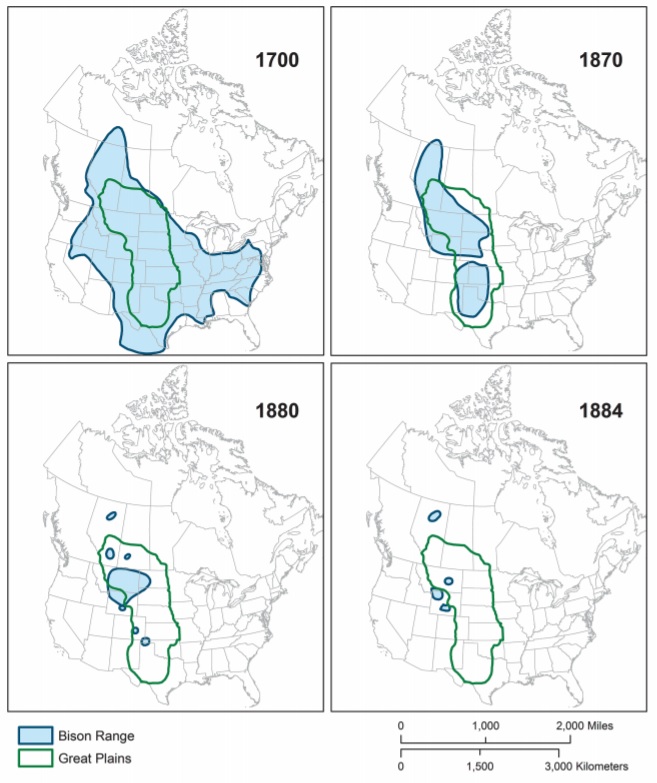
Figure 1.1 in Cunfer and Waiser (2016). The contracting range of American bison, adapted from Hornaday’s 1889 map.

Then things got worse. In the early 1800s, market hunting by Natives increased, fueled by Hudson’s Bay Company in the north and a market in New Orleans that exported 100,000 buffalo robes each year. In 1840, a peace treaty between the Comanche and Kiowa nations in the south and various northern tribes opened the door to more hunting. At the same time, large Native horse herds competed with buffalo for winter forage, leading to increased mortality. As early as the 1840s, Kiowa and Lakota winter robes reported fewer buffalo. By 1850, the total buffalo population fell below 20 million; they had declined a third, but were still plentiful.

Then things got much worse. After the Gold Rush in California, white pioneer trails destroyed forage in riparian corridors, critical for buffalo during winter. A massive drought from 1856 thru 1864 reduced the carrying capacity of the southern Plains about 50%. Buffalo populations, which had been falling at a rate of 40,000/year, now fell 400,000/year. By 1870, the total population fell below 10 million.

Then the “white hunt” began. Fueled by a commercial interest in buffalo leather and a military campaign to ethnically cleanse the Great Plains of Native Americans, white hunters began to take a million buffalo each year. In 1873, while “Home on the Range” was written, white hunters killed 1.5 million buffalo; Natives killed less than 10% of that number. Ten years later, the southern bison herd was extinct. In the north, only remnants remained. 

In 1878, when the Comanches were imprisoned in a concentration camp at Fort Sill, Oklahoma, a small group was allowed off the reservation to conduct a traditional buffalo hunt. They returned stunned and dejected, finding only bones on the Plains.

In 1886, believing buffaloes were on the brink of extinction, the National Museum sent taxidermist William Hornaday to Montana to collect a few final specimens for their collection. On the evening of October 16, they shot a huge bull, but left it for the night, planning to return in the morning. When they arrived the next day, they reported, “To our great dismay the noble red men had visited the bull which we had killed the day before. All that remained was the head painted red on one side yellow on the other with a red & yellow rag tied to one horn, eleven notches cut in the other…. All around were moccasin tracks.” A ceremony had taken place.

The Crow chief Plenty-Coups, in telling his life story to a biographer, refused to speak about the years after the disappearance of the buffalo. “After this,” he said, “nothing happened.”

The second rise

In 1889, less than a thousand buffalo remained. White society then sought to protect them. Bison preserves were established at Yellowstone National Park in Wyoming and at the National Bison Range in Montana.

Today there are about half a million buffalo, nearly all confined to preserves. Less than 10% are free ranging, and even those have limits imposed by cattle ranching concerns. Most bison today are managed like cattle by private ranchers. The only semi-wild herds are managed by the federal government, non-profits, or Native tribes. The largest wild herd is at Yellowstone National Park, with 4,000 buffalo.

A buffalo cow and calf at the Cherokee Nation bison farm.

From Montana to Oklahoma and beyond, Native communities are playing a critical role in bison restoration and continue to push for buffalo restoration to open lands. Among the leaders are the Fort Peck Indian Reservation (Assiniboine, Nakota, Lakota, and Dakota) and the Blackfeet, who hosted the Buffalo Treaty among 13 Native nations across the US and Canada in 2014 to promote buffalo conservation and restoration. Both to restore the species and their own cultures, it is their dream to see wild buffalo across thousands of acres of the high plains.

Posted in my own thoughts, news | Tagged , , , , , , , , , , , , , | 2 Comments

Cherokee Nation juggles tribal sovereignty with Trumpers in a red state

In light of its newly recognized reservation, Cherokee Nation, and all of Oklahoma’s 38 tribal nations, finds themselves in the crosshairs between tribal sovereignty and Trumpism, between protecting the environment and Big Oil.

In the July 2020 McGirt decision, the US Supreme Court affirmed that much of eastern Oklahoma was reservation land, under the jurisdiction of the Creek, Cherokee, Choctaw, Chickasaw, and Seminole. While many were thinking about jurisdiction over criminals on various parcels within reservation lands, the Washington Post noticed the elephant in the room:  Big Oil. Their headline said it all:  “Now that half of Oklahoma is officially Indian land, oil industry could face new costs and environmental hurdles: The landmark Supreme Court decision give the five tribes a say over oil and gas wells, refineries, and pipelines—including those running to the Cushing hub of the Keystone XL, legal experts say.”  Cushing, the “center of the oil universe” lies just outside the reservation area. At the very least, the oil industry would now need federal as well as state permits for new wells and pipelines.

The map above shows all tribal lands in Oklahoma, with the McGirt decision affirming the area outlined in bold black. The lower map shows injection wells (purple) and earthquakes caused by fracking (orange). In response to the McGirt decision, the Trump Administration recently stripped all Oklahoma tribes of jurisdiction over environmental issues.

Oklahoma, controlled by a large Republican majority with support from the oil industry, reacted quickly. There were (and still are) calls for the Senate to immediately terminate the treaty and abolish the reservations. The former mayor of Tulsa and prominent oil executive said “It’s going to be total chaos.”  He asked the tribes to give up their rights.

Chaos did ensue when the state quickly got several tribes to sign an Agreement-in-Principle that would shift most civil jurisdiction from the Tribes to the state, thereby freeing the oil industry from any tribal requirements. The Five Tribes faced immediate internal backlash and quickly backed away from the agreement.

In response, Oklahoma Governor Kevin Stitt asked the US Environmental Protection Agency (EPA) to grant Oklahoma jurisdiction over environmental regulations on reservations. He was relying on an old 2005 law, created when Senator James Inhofe (R) attached a midnight rider to an appropriations bill, that allows the EPA to grant Oklahoma control over environmental issues on the lands of all of Oklahoma’s 38 tribes.

In late September 2020, Attorney General William Barr paid a visit to Tahlequah, ostensibly to discuss criminal law enforcement. We don’t know what was discussed during the closed-door meeting with Cherokee leaders. We do know that, the next day, Principal Chief Chuck Hoskin Jr. made a statement in support of tribal sovereignty. And we also know that, that same day, the EPA chief announced that the Inhofe rider was granted. The Trump Administration had stripped all 38 of Oklahoma’s tribes of their sovereignty over environmental issues and given it to the state of Oklahoma. Principal Chief Hoskin condemned the move.

So that’s where we are. The Biden Administration can reverse this. But even then, would the Cherokee or other tribal nations pick up the baton? 

Cushing, Oklahoma, west of Tulsa, is the center of the oil supply system in the central US. Several pipelines run through tribal lands.

Across much of Indian County, Native reservations and communities are blue islands amidst a red prairie. Not so in Oklahoma where, at most, Native areas are purple islands in a state that went 2/3 for Trump in the 2020 election. In the Cherokee Nation even the most Native counties, Cherokee and Adair, went 65% and 80% for Trump respectively. The majority of people in these counties are not tribal citizens; there is no data regarding how Cherokees within these counties voted.

The irony is that Cherokee Nation provides public services with the efficiency of a modern democratic-socialist European state. Its $608 million budget in 2019 allocated 56% to healthcare, 37% to education and other community services; only 7% went to administration. (Most of their revenues come from federal grants treaty obligations, but 35% are from taxes and fees.)

Principal Chief Hoskin, as well as the previous Principal Chief Bill John Baker, are officially non-partisan but generally associated with Democrats. This puts Hoskin in a tight spot. He seems to be defending Cherokee sovereignty on principle, but it’s not clear he would be able to do anything with it, constrained by his own constituents. He also faces challenges by Republican-dominated Oklahoma, which is increasingly attacking tribal sovereignty.

Even with a Biden reversal of the Inhofe Rider and re-establishment of tribal sovereignty, will the Cherokee work with the Standing Rock Sioux and other tribal governments to forestall the Keystone XL pipeline and implement environmental regulations in a state that has almost none? Will they push for a conversion to alternative fuels, such as renewable diesel? Will they regulate well injection and fracking? The Supreme Court just affirmed the rights of tribes to regulate corporations doing business on tribal lands. Will they demand that industry clean up pollution from releases? Will they require compensatory restoration to make the environment whole?

The state of Oklahoma, in addition to lax regulation on industry, is also reticent to tax Big Oil in a meaningful way. Instead, they seek “revenue sharing” from tribal casinos, essentially taxing the tribes for the revenues that the state refuses to seek from the oil industry. The tribes are now in a position to challenge that, but will they?

Posted in news | Tagged , , , , , , , , , , , , , , , , , , , | Leave a comment

Not always but mostly: Native Americans living in harmony with nature

It’s often said that Native Americans have always lived in harmony with nature, understanding how to live sustainably with Mother Earth. This is partially a myth, but one that we embrace, because it is very much our goal today to restore our connection to Mother Earth.

The Noble Savage

This notion of harmony, that indigenous peoples are so in tune with their land that they are essentially part of it, in sync with the natural resources, and in a respectful relationship with all the other creatures, is flattering. But all indigenous peoples around the world are closely tied to the land; they have to be. Why is it that Native Americans have this reputation but subsistence farmers in rural Africa do not? Surely both are dependent on the land and both have cultures and religions that emphasize our bond to the natural world.

View Post

In the US, I posit that this stereotype, based on some truth, is part of the “noble savage” caricature, a kind of de-humanizing othering that evolved in the aftermath of ethnic cleansing and genocide, as if Natives were too good to be true, or at least too pure to coexist with modern Western civilization, and thus sadly had to disappear, for the sake of white expansion – like the condor or the passenger pigeon or some other species on the edge of extinction. So they name football teams after us in honor of us, or at least honoring the sacrifice of these noble people, who had to be sacrificed for the sake of modern civilization. Like a run-down zoo, they put us on reservations but only portray us “in our natural state”, with Plains headdresses and tepees.  

Manifest Destiny painting
In this famous painting illustrating ethnic cleansing (blessed with the name Manifest Destiny), Native Americans flee with wildlife, as if they were more animal than human. Even today, Native matters are handled by the US Department of the Interior, not the Department of State.

Over-exploitation

The truth is that Native Americans have been and remain normal people, quite capable of mistakes and not always living in harmony with nature. The first humans in North America unquestionably played a role (along with a changing climate) in the mass extinction of large megafauna—overhunting mammoths, mastodons, giant buffalo, giant sloths, giant armadillos, and dozens of other species to extinction. This happened in the first few thousand years after humans arrived in Europe, Asia, and Australasia. The pattern was identical in North and South America.

Native Americans did live largely in harmony with the remaining game in North America thru the 1600s, probably because human populations were modest and were able to avoid over-exploiting the land. We managed landscapes thru controlled burns, promoting the development of grasslands to promote certain game species, and learned to fish and farm in sustainable ways. This is no different from other indigenous peoples around the world who lived in harmony with nature most of the time. They had to; it was all there was.

In North American, much of that changed when Europeans arrived and wanted beaver skins and deer skins and buffalo hides for commercial markets. But it wasn’t them that killed all those animals—it was Native hunters and a basic human desire to seek gains from trade. Acting as low wage workers in an international capitalist system, Natives borrowed guns and ammunition on loan, hunted and brought back the hides, and traded them for European goods, such as pots and pans, axes, and Stroud cloth manufactured in England to Native American specifications.

Sometimes, as with the Comanche, the Natives developed powerful empires that grew more powerful than the European ones and stopped their expansion, and even ended up flipping the tables, selling impoverished Europeans guns and horses. But most of the time, the Native hunters fell into so much debt that their tribal governments ended up ceding land to Europeans to settle those debts.

For Thomas Jefferson, putting Native hunters in debt was a deliberate policy. He wrote, “… we shall push our trading uses and be glad to see the good and influential individuals among them run in debt. We observe that when these debts get beyond what the individuals can pay, they become willing to lop them off by a cession of lands….”

But regardless of economic success or failure, market hunting by Natives helped drive animals to the point of local extinction—first with beaver in New England in the 1600s, with deer across the East in the 1700s, and then with buffalo on the Plains in the 1800s (where white hunters eventually finished them off with a horrific flurry in the final decades).

Restoration

Nevertheless, the stereotype is based on truth. Especially relative to ambient white culture, Native American communities are connected to the land in profound cultural and spiritual ways and are striving to retain and restore that connection. For many, reconnecting with tribal ways, invariably with a strong connection to nature, is a major pathway out of historical trauma.  

Yurok biologists release a condor
Yurok biologists release a California Condor in preparation for future releases on the north coast of California..

Today, Native American governments and people are largely at the forefront of efforts to restore ecosystems, stop climate change, and embrace Mother Earth. Here are just a few examples from the West Coast.

The tribes in Washington co-manage the state’s fisheries with federal and state counterparts. The Swinomish are rebuilding oyster reefs and restoring wetlands. The Yurok are working with state and federal governments to restore condors to the north coast of California, while the Cahuilla are doing the same for bighorn sheep in the south. The Karuk are spearheading a plan for controlled burns in California to reduce mega-fires. The Salish and Kootenai are doing the same in Montana.

Tribes across the land are leading fights against new oil pipelines, and are leaders in climate adaptation planning.

We can embrace Mother Earth, and we should, but we should also recognize the past—that the noble savage stereotype is a way of “othering” indigenous peoples as abnormal. Native Americans are people. We’ve committed basic human sins of over-exploitation in the past, but we are now among the world’s leaders in finding a better way and restoring our connection to the land.

Note: the condors released by the Yurok are now flying free. You can follow their progress here.

Posted in my own thoughts | Tagged , , , , , , , , , , | Leave a comment

Patuxet (Plymouth) 400 years on: Massasoit the statesman masterfully played the Plymouth Colony

While the Pilgrims moved into the abandoned village of Patuxet and planted their fields, the Great Sachem Massasoit called together a council to hammer out policy toward the wayward colonists. Hammered by plague and pestilence, his Wampanoag Confederacy was vulnerable. Inland, the Narragansett remained untouched by the epidemic, with their jealous eyes on the lucrative European trade along the coast.

Massasoit considered the Pilgrims the solution to his problem. Reversing decades of policy, he opted this time to let them stay. Half-starved and malnourished, the dirty men from the sea posed no threat. Fifty-two Pilgrims of one hundred and two died during the winter. They tried to bury them secretly but the Wampanoag were watching. The real danger was the Narragansett. To counter them, Massasoit wanted the military support of the Pilgrims’ guns.

For the negotiations he needed a translator, but Massasoit did not trust Tisquantum (Squanto); he lived in London too long and his loyalty was suspect. There was one other, the Abenaki man from the north, Samoset. He knew a little English from the fisherman off Monhegan, enough to monitor Squanto during negotiations.

The actual treaty negotiations were probably outdoors and involved dozens of Wampanoag as well. The English colony at Patuxet was the first that Natives allowed in the New England region.

Massasoit plan was to convey power and show a façade of his beleaguered forces. On the first day, he sent Samoset alone and unarmed to greet the Pilgrims in English, “Welcome Englishmen!” He dropped the names of all the English fishermen he knew and mentioned, in passing, the military strength of the Wampanoag.

A few days later, Samoset returned with five men for a full reconnaissance.

Finally, several days after that, Samoset came again with Tisquantum, fluent in English, to engage them in conversation. An hour later, Massasoit and an escort of sixty men (nearly all he had) appeared on a nearby hilltop, faces painted for war. The Pilgrims would have wondered how many more would appear the next time.

The plan worked and Massasoit got what he came for. Edward Winslow, dressed in a full suit of armor, came forward, asked for peace, and kissed Massasoit’s hand. Today our halls are not adorned with a painting of this.

The critical terms were recorded in the treaty under Article Four: “If any did unjustly war against him, we would aid him; if any did war against us, he should aid us.”

The initial months were tense. The first Thanksgiving meal, later that fall, occurred in this context. In the coming years, Massasoit manipulated the colony into various skirmishes to address threats to the Wampanoag from other tribes. The pact held for five decades.

Posted in my own thoughts | Tagged , , , , , , | Leave a comment

Patuxet (Plymouth) 400 years on: Prisoner, slave, guide, ambassador — Meet the real Squanto, Tisquantum

When we last left the Pilgrims and other settlers (see previous blog post), they had arrived at the abandoned village of Patuxet, but stayed huddled onboard the Mayflower, freezing and dying thru the winter. Finally, in March 1621, the weather warmed enough that they moved ashore, cleared the homes and corn fields of the skeletons left behind by a plague a few years earlier, and began to turn the village into Plymouth.

In reality, Tisquantum dressed in English clothes and was very much at home in Plymouth, causing Massasoit and other Natives to wonder where his loyalties lay.

It was in this context that Squanto came to them, speaking perfect London English.

He had grown up in Patuxet. Seven years earlier, in 1614, an English trading vessel (captained by a colleague of John Smith) lured him aboard, along with about two dozen other Patuxet and Nauset. He told them his name was Tisquantum, “Anger of the Gods”; they shortened it to Squanto.

They were taken to Spain to be sold into slavery. In Málaga, Tisquantum was rescued by concerned friars and made his way to London. Five years later, he arranged passage for himself on an English vessel bound for the fishing grounds off Newfoundland. Once there, Tisquantum talked the captain, Thomas Dermer, into heading south to Cape Cod Bay.

Finally, after five years in exile, he was on a vessel bound for his home. When the vessel dropped anchor off Patuxet in June 1619, no one was there to greet them. The alewives were shimmering in the creek mouth and yet no one was there to catch them. No one was standing on the beach, waving, pointing, and calling. No movement was seen among the homes.

Ashore, Tisquantum found corpses and skeletons in many of the homes, even in the abandoned corn fields. Surrounded by only English, he was the last Patuxet.

In the spring of 1621, when the Pilgrims finally left the Mayflower and came ashore, Tisquantum was there to meet them—but not right away. Massasoit, great sachem of the Wampanoag, held all the cards. He used Tisquantum as a translator and an ambassador, but only under close supervision. Eventually, Tisquantum moved into Plymouth, teaching the English how to plant their crops and serving as their only translator for dozens of diplomatic meetings with the Natives.

Massasoit’s oversight of Tisquantum, and diplomatic maneuvers with the Pilgrims, will be covered in a coming blog post.

Posted in my own thoughts | Tagged , , , , , , , | Leave a comment

Patuxet (Plymouth) 400 years on: “Bones and skulls” — An epidemic made the Pilgrims’ settlement possible

In the late fall of 1620, the 102 men, women, and child passengers aboard for the Mayflower found themselves behind schedule and seriously off course. They were supposed to be in Virginia Colony (the colony that famously kidnapped Pocahontas), which was founded thirteen years earlier. That wasn’t the oldest European settlement on the eastern seaboard—those honors go to St. Augustine, Florida, which was founded – with a thriving slave market – in 1565. Many other short-lived Spanish settlements date back to the early 1500s. In the west, Santa Fe was ten years old.

The indigenous people of New England were already familiar with Spanish, French, Portuguese, and English fishermen who had been fishing the Grand Banks for a hundred years, many of whom had ventured south to what would become Massachusetts. The Europeans knew the coastline was heavily populated; they saw the villages and cornfields in the daytime and lights of fires reflecting on the water at night. Along the shore, there was no suitable village site unoccupied. They didn’t come to settle; just to fish and trade.

But, unbeknownst to the Pilgrims, that changed in 1617. An epidemic wiped out the majority of Natives for two hundred miles along the coast. Many villages were abandoned.

When the Pilgrims arrived on November 21, 1620, they made their initial landing at today’s Provincetown, at the tip of Cape Cod. Delayed by mishaps along the way, they were low on supplies and winter was setting in. To survive, they raided Nauset gravesites where corn had been buried with the departed, and took maize from a village cache while the local residents were away. After several peaceable and one not-so-peaceable interaction with the Nauset, the Pilgrims concluded they needed to find another place to settle.

The new U.S. Postal Service stamp commemorating the 400th anniversary of the Mayflower landing off the coast of New England. They spent a cold winter huddled on the vessel off the village of Patuxet.

On December 16, they arrived at the village of Patuxet. It was abandoned. They renamed it Plymouth. Here’s what they found:

The place where we now live is called Patuxet, and that about four years ago all the inhabitants died of an extraordinary plague, and there is neither man, woman, nor child remaining, as indeed we have found none…  great mortality which fell in all these parts about three years before ye coming of ye English, wherein thousands of them dyed, they not being able to bury one another; their skulls and bones were found in many places lying still above ground where their houses and dwellings had been; a very sad spectacle to behold. – Edward Winslow

[They] were sore afflicted with the plague, so that the country was in a manner left void of inhabitants. –Ferdinando Gorges

and the bones and skulls upon several places of their habitations made such a spectacle after my coming into these parts, that, as I traveled in the Forest near the Massachusetts, it seemed to me a new found Golgotha. – Thomas Morton

… the bodies all over were exceeding yellow, describing it by a yellow garment they
showed me, both before they died and afterwards
– Daniel Gookin

The Indians in those parts had newly, even about a year or two before, been visited with such a prodigious pestilence, as carried away not a tenth, but nine parts of ten (yea, ’tis said, nineteen of twenty) among them: so that the woods were almost cleared of those pernicious creatures, to make room for a better growth. Our first planters found the land almost covered with their unburied carcasses. – Reverend Cotton Mather

The Pilgrims essentially built Plymouth over the footprint of Patuxet and took over their abandoned corn fields. Without this epidemic, it is unlikely the Pilgrims would have been able to settle anywhere in the region. 

Almost four centuries later, scholars still debate the disease which may have emanated from a French fishing vessel that visited Cape Cod. The list of possibilities includes plague, yellow fever, influenza, smallpox, chickenpox, typhus, typhoid fever, trichinosis, cerebrospinal meningitis, Hepatitis B, Hepatitis D, and leptospirosis complicated by Weil syndrome. With a 90-95% mortality rate (based on the Cotton Mather report), it is probably the most severe plague ever reported in the Americas, though its geographic extent was limited to just the coastline. Inland, the Narragansett were largely untouched by the plague.

The Wampanoag, Massachusett, Abeneki, Penobscot, and Nauset were devastated. The indigenous population of New England fell eighty-six percent between 1616 and 1639.

The passengers of the Mayflower suffered as well. Only fifty-three (slightly more than half) survived the first winter, which they spent huddled onboard the Mayflower at anchor near shore.

This set the stage for the arrival of Tisquantum (Squanto) and an alliance between two groups of people struggling to survive: the Wampanoag (under Great Sachem Massasoit) and Plymouth Colony.

These will be covered in coming blog posts (hyperlinks above).

Posted in news | Tagged , , , , , , , , , , , , , | Leave a comment