Headline from 1606: Spanish Conquistador Juan de Oñate recalled to Mexico City

Onate1

Sante Fe, NM:  In a stunning turn of events, Governor of the Northern Territories Juan de Oñate was recalled to Mexico City today by Spanish authorities for excessive violence and brutality against both Natives and colonists. Given the recent history of Spanish conquistadors – everything from DeSoto’s constant demand for young girls to Cortez caulking his canoes with the boiled fat of victims – Oñate put in some effort to be censored.

Former-governor Oñate’s family made their fortune in the slave mines of Zacatecas. After invading Pueblo land in 1598, Oñate called in all the Pueblo leaders, asking them to pledge allegiance to God and King Phillip of Spain or “be put to the sword and destroyed by fire” and their wives and children sold into slavery. He documented that they all, “of their own free will, wished to have Don Philip, our lord, as their king, and to render obedience and vassalage to him voluntarily, without compulsion from anyone.”

In his first year in office, 1599, Oñate famously captured Acoma Pueblo. After three days, the Spanish took over the city, killing hundreds in the process. At trial, the entire town was found guilty. All survivors from age 12 to 25 were sentenced to 20 years of slavery. The elders were sent to the Great Plains. The children were given to the priests and nuns. For at least 25 of the men, their right foot was cut off as part of their servitude.

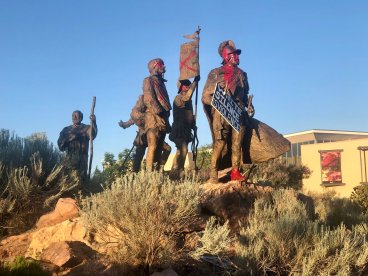
Onate3That’s how an imaginary newspaper might have reported the departure of Governor Oñate. After a hearing in Mexico City, he was found guilty, banished from New Mexico for life, and returned to Spain.

In 1997, a statue honoring Oñate north of Santa Fe was vandalized; its right foot was cut off.

Onate2

The shooter, the son of a local sheriff and former Republican candidate for Albuquerque City Council. On the police scanner, the cops called the militia “armed friendlies”.

Now, in 2020, after protests in Albuquerque left one man shot and in critical condition, city managers are removing the statue “temporarily”, declaring it a “public health hazard”.

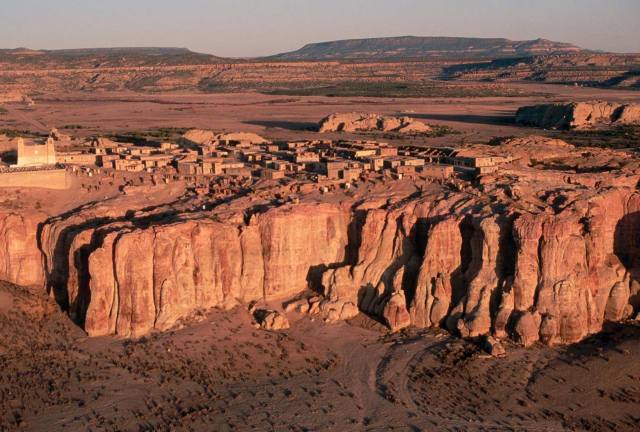
The Pueblo still live at Acoma today; it is the oldest continuously inhabited town in the United States.

Onate4

Acoma Pueblo, or Sky City, a fortress town on a mesa.


Posted in news | Tagged , , , , , , | Leave a comment

Abolishing the police: Minneapolis looks to alternatives

In the wake of the killing of George Floyd and associated riots, the people of Minneapolis are turning to a 2017 report, Enough is Enough: A 150 year Performance Review of the Minneapolis Police Department (MPD150).

The Past

The report begins with history. Starting in London in 1829, police forces are relatively recent creations. In the US, they began as vigilante militia slave patrols. During the genocide of California’s Natives in the 1850s, these patrols were reimbursed by the new state government for scalps and expenses incurred. The Minneapolis Police Department (MPD) was established in 1867, just five years after the mass hanging of 38 Dakota men in Mankato. Early municipal police forces in the US in the late 1800s made ample use of the Thirteenth Amendment, hauling people off the streets and forcing them into slavery on behalf of the city.

Police jobs were given out as political favors, with early mayors sometimes replacing entire police forces with political appointees with each new term. Departments quickly became armed wings of corrupt political parties. By the early 1900s, well-connected businesses were using city police to break up unions. In Minneapolis the mayor deputized a right-wing militia, the Citizen’s Alliance, to work with police in breaking strikes and combatting unions. They were basically the private army of the powerful used to suppress the poor, paid for with public funds. By the 1920s, the Great Migration had caused Minneapolis’s black population to swell, while KKK members joined the MPD.

There have been several hundred riots in the history of the United States. Before World War II, most were initiated by poor whites demanding better conditions, or by angry whites attacking immigrants. Since Harlem 1964, most have been initiated by urban Blacks in the aftermath of police brutality. Riots are now regular and predictable. City planners, mayors, and police departments expect and anticipate them. They are the acceptable price the powers pay rather than reform.

Minneapolis’s first riot against police brutality wasn’t until 1967; the National Guard was called in. Many more have followed, especially since the 1990s. Since then, the MPD150 observes, “the pattern established by the 1967 riot – policy brutality leads to community outrage, leads to protests, leads to promises of reform, leads to a lack of meaningful change – would become a constant feature of policing in Minneapolis for the next fifty years.” A series of investigations in the 1970s found the MPD to be racist, homophobic, and in the words of its own police chief, “damn brutal”. In 1999, Minnesota repealed a residency requirement for MPD officers, allowing them to come from outside the city. That bill was authored by a recent Hennepin County Sheriff.

The report concludes:

“the history of policing in Minneapolis and across the country has taught us that it doesn’t matter who the chief is, or even who runs the city: the police can’t be controlled. The Minneapolis Police Department was built on violence, corruption, and white supremacy. Every attempt ever made to reform it or hold it accountable has been soundly defeated. The culture of silence and complicity in the department, along with the formidable political power wielded by the police union, will continue to preserve the status quo…. It’s time for us to face the reality – if we want to build a city where every community can thrive, it will have to be a city without the Minneapolis Police Department.”

The Present

The problems in Minneapolis are not unique; they plague most urban police departments around the nation. The police are outsiders, literally. In Minneapolis, 95% of police officers live in distant suburbs, are from a different ethnic group, and communicate and socialize in different ways. They often view the people they are there to serve with disdain.

Minn map

Where Democrats and Republicans live in the Minneapolis-St.Paul area. The police come primarily from the red areas, but work in the blue. Source: FiveThirtyEight.

To use a village metaphor, it’s as if a traditional Iroquois town hired a group of Shawnees to be their police force. Problems are inevitable.

Armed to the teeth, these officers spend the vast majority of their time responding to minor traffic violations, traffic accidents, mental health crises, and domestic disputes. This is at once inefficient, inappropriate, ineffective, and dangerous. Like sweeping up leaves with a chainsaw, armed police are the wrong tool for most of their jobs. As outside mercenaries from another culture, they are even poor at solving crimes; many locals don’t trust them and won’t confide in them.

Robb Davis, former mayor of Davis, California and former executive director of Mennonite Central Committee, observed,

“We need to see policing for what it has become in too many places: an institution that views itself as separate from the community but, somehow, charged with ‘saving the community from itself’; an institution that refuses to be morally judged for its tactics, arguing that as ‘technical experts’ it should be left alone; and an institution that has created structures via political processes to protect its worst actors from legal action.

Any institution that has been given a ‘monopoly to use force’ must be tightly reviewed and controlled. What we see today in policing is what we see in practically every institution that operates without control: an entity bent on its own survival, resistant to change, and self-destructive in its behavior.”

The Future

The MPD150 report envisions an alternative structure where, instead of armed police from a different ethnic group, well-trained mental health professionals, social workers, and others are called to deal with mental health crises, threats of domestic violence, and other situations that police are poorly trained to address.

Returning to the Native village comparison, in traditional communities from North America to Africa, people knew each other and relied on each other. Laws were enforced by all. In most eastern North American communities, village chiefs or elders were the arbiters of conflicts, but women chose the chiefs and had final power of clemency. Modern cities can replicate these principles, setting up local neighborhood networks to promote community and reduce anonymity, to create local structures for investigating crimes and implementing restorative justice.

The current MPD budget of nearly $200 million per year could be put to use for these endeavors, as well as to alleviate poverty. The report lists a number of small local NGOs that are already doing this work – including emergency dispatch of mental health workers—though with meager funds.

This has been done before, most drastically in Northern Ireland in 2001. Police departments have been dismantled many times in the US (most famously New York City in 1857 and Boston in 1919). In the past decade, Jennings, Missouri and Camden, New Jersey concluded that, due to institutional racism and corruption, their police departments were unredeemable. They fired all their officers and started over.

Today in Minneapolis, alternatives to armed outside police forces are already happening. Local neighborhood groups are forming, neighbors are talking, traditional village-type networks are solidifying. The looting and arson was largely quelled by protesters guarding sites. The American Indian Movement (AIM), founded in Minneapolis, is playing a leading role in this. MPD150 notes, “In 1968, community patrols emerged in Black and Native communities to keep people safe, deescalate conflict, and prevent police violence. These programs were enormously successful, and their legacies continue today.”

Now we have an opportunity. The arc of history, or, in this case, the long train of riots, has brought us to a new point, a possible tipping point. The recent uprising over the murder of George Floyd is a little different from the past. First, the police were fired immediately and quickly faced serious charges. Second, the protests were decidedly multiracial. Third, the general public has shown widespread empathy for the Black community, with a stunning 54% supporting the burning of the 3rd Precinct (compared to 38% support for Colin Kaepernick taking the knee four years ago). Finally, even some Republican politicians have called for a time of listening and reform. The door has opened a crack.

Minneapolis City Council member Steve Fletcher posted this on Twitter:

“It became clear by day two that people were marching for much more than that – the response to George Floyd’s death needed to be much more than any prosecution could offer. What people in the streets have won is a permanent, generational change to the mainstream view of policing.

I don’t know yet, though several of us on the council are working on finding out, what it would take to disband the MPD and start fresh with a community-oriented, non-violent public safety and outreach capacity. Our city needs a public safety capacity that doesn’t fear our residents. That doesn’t need a gun at a community meeting. That considers itself part of our community. That doesn’t resort quickly to pepper spray when people are understandably angry. That doesn’t murder black men.

We can totally reimagine what public safety means, what skills we’re recruiting for, what tools we do and don’t need. We can invest in cultural competency and mental health training, de-escalation and conflict resolution…. We can resolve confusion over a $20 grocery transaction without drawing a weapon, or pulling out handcuffs. The whole world is watching, and we can declare policing as we know it a thing of the past, and create a compassionate, non-violent future. It will be hard. But so is managing a dysfunctional relationship with an unaccountable armed force in our city.”


Posted in news | Tagged , , , , , , , , , , , , , | Leave a comment

How Andrew Jackson used the smallpox vaccine against Native Americans: A cautionary tale of politics and disease

In 1832, smallpox raged along the Mississippi River. After years of bitter debate, the Indian Removal Act had just been signed by President Andrew Jackson. A sharply divided white nation prepared for widespread Indian removal to west of the river; that is, ethnic cleansing on a mass scale. Overcoming the objections of southerners who loathed the Indians, northern white liberals passed the Indian Vaccination Act, allocating a paltry $12,000 out of a total $1 million-dollar Indian budget to vaccinate tribes along the “frontier”.

It was a progressive move, one of the first efforts of the federal government for Native public health. Nevertheless, officials made it clear that helping Indians was an act of charity and not a responsibility. The commissioner for Indian affairs, Elbert Herring, blamed foreigners and the victims for the epidemic. They got it, he said, from French and British fur traders, or had brought the disease on themselves by drinking whiskey from a keg wrapped in an infected cloth.

Lewis Cass

cass

Cass missed the 1837 epidemic. By then, he was in Paris with his family. Andrew Jackson had appointed him ambassador to France. Today, Cass is honored with a statue in the US Capitol and his name adorns several schools and towns, as well as counties in eight states.

When it came to the Jackson Administration’s implementation of the act, Trump’s more competent doppelganger took a familiar political approach. Rather than appoint a doctor or even the Indian Bureau to oversee the vaccination program, he selected the Department of War (now known as the Department of Defense). The Secretary of War was Lewis Cass, an ardent Jackson supporter and sycophant who had fought in the Battle of the Thames that killed Tecumseh and later, as the Governor of Michigan, was instrumental in removing Natives from large portions of the Midwest. He had recently described the Plains Indians as beyond the pale of civilization.

As described in Pearson (2003), Cass “selected the tribes for vaccination, authorized the hiring of all vaccination personnel, delegated limited authority to the commissioner of Indian affairs, and set the parameters that limited or denied vaccinations to Indian nations.” For efficiency, he used the US Army to administer vaccines, unless he selected civilian physicians as an act of political patronage.

His corruption didn’t stop there. In his home state of Michigan, where many of the vaccinations took place, the program had a dual purpose – a full scale reconnaissance of the region’s potential for mineral exploitation was also performed. The report back to Washington said more about metals and ores than it did about public health.

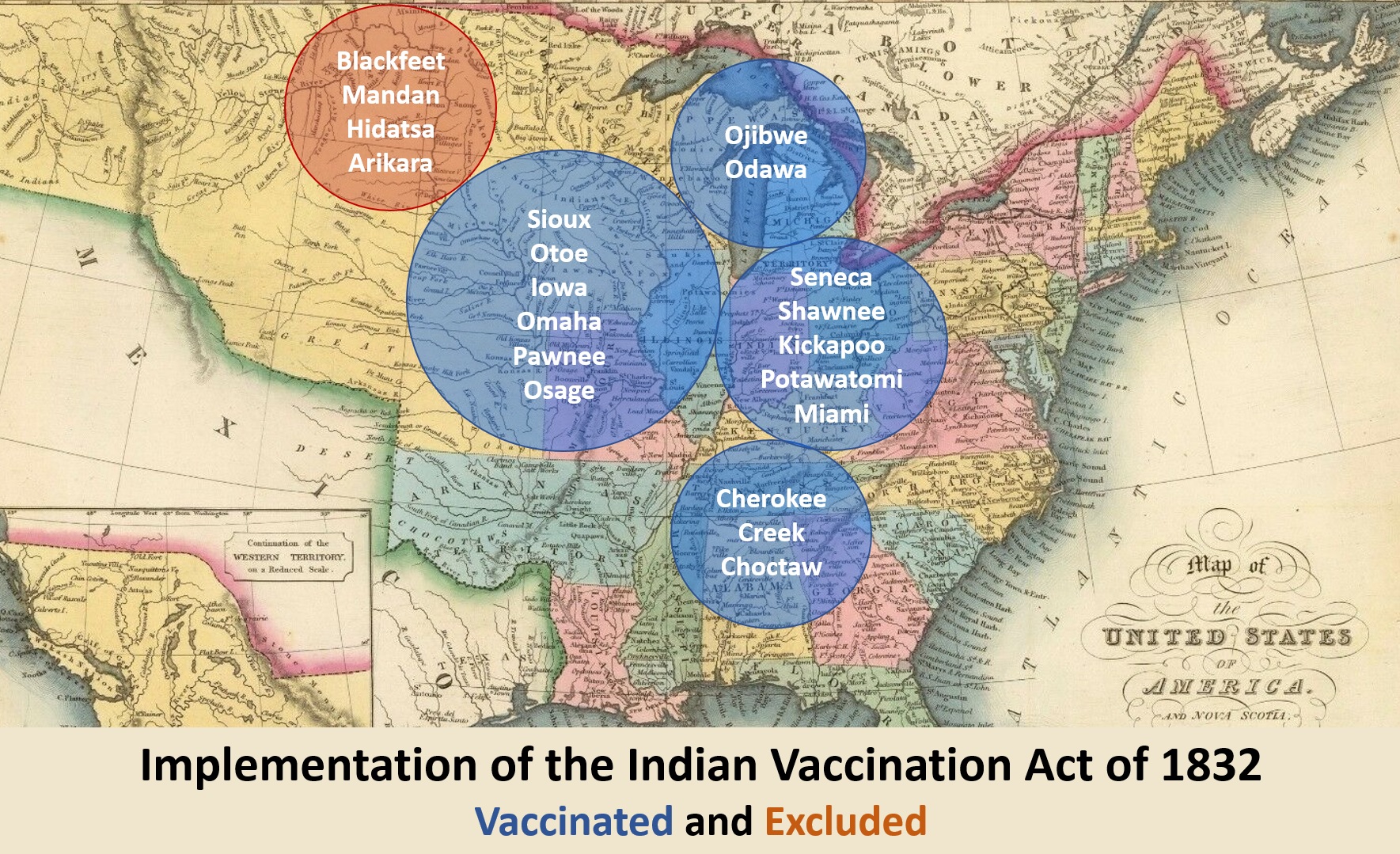
As for the tribes, Cass limited the vaccine to only those who had signed treaties favorable to the United States (i.e. giving up territory), or, such as with the Sioux, were considered important trading partners. Even though a plurality of the funds were supposed to be allocated to the “Upper Missouri River”, Cass’s instructions stated, “Under any circumstances, no effort will be made to send a Surgeon higher up the Missouri than the Mandans, and I think not higher than the Aricaras.”  This excluded the Blackfeet (the dominant tribe of the northwest Plains at that time), Cree, and Assiniboine. At the time, tensions due to trade disputes with the Arikara were strained to the breaking point.

smallpox vaccine map

The 1837 Great Plains smallpox epidemic

What happened next is well-known. In May 1837, the steamer St. Peter, owned and operated by the American Fur Company, traveled up the Missouri River. When it was discovered several passengers were sick with smallpox, the captain refused to stop. No shutdown; no quarantine. That night, at a company fort north of present-day Bismarck, many in the company attended a local Mandan gathering.

Within weeks, the local Indian agents were asking their superiors in Washington for shipments of vaccine. One agent warned I would not be surprised if it wiped the Mandan and Rickaree [Arikara]Tribes of Indians clean from the face of the earth. Within a year, most of the local Mandan, Hidatsa, and Arikara were dead. Upriver, over ten thousand Blackfeet died, altering the balance of power on the northern Plains.

The next year, as word of the tragedy became known, an investigation in Washington led to finger pointing and excuses about telegrams never received. Cass was not exonerated because the investigation never even made it to his level.

The politics of disease

Pearson concludes, “Vaccinations were used to enable Indian removal and to facilitate reservations and the consolidation and reduction of reservations. Westward expansion of the United States was also expedited by the act, since Indian nations viewed as friendly or economically important to the United States were protected by the federal smallpox vaccination program, but Indian nations viewed as transgressor nations were not.”

TrumpJackson

Trump hung Andrew Jackson’s portrait in the Oval Office.

All President Trump, a modern buffoon of an Andrew Jackson wanna-be, needed to do for the current pandemic was to establish a federal unified command guided by subject matter experts, serve them thru the provision of resources and the removal of bureaucratic obstacles, and unify the public with a common call to work together. Instead, he has assumed the spotlight as a completely unqualified leader of the emergency response, thrown federal coordination into confusion such that states are left forming their own multi-state task forces, and gaslit stay-at-home orders with tweets supporting white supremacists protesting public health recommendations, a ludicrous phenomenon unknown in other societies.

With regard to Native Americans, the Trump Administration delayed and bungled support for tribes, even while the Navajo Nation suffers a higher infection rate than any other nation on the planet. When it comes to politicizing public health, the United States has not come that far in 180 years.

For more on smallpox and Native Americans, see this:

The strange truth about smallpox and Native Americans

Source: Pearson, J. Diane. 2003. Lewis Cass and the Politics of Disease: The Indian Vaccination Act of 1832. Wicazo Sa Review 18 (2): 9-35.

UPDATE ON MAY 22, 2020:

No sooner had I posted this than this story broke.  A former deputy chief of staff to Donald Trump retired and formed a company named after himself: Zach Fuentes LLC. Eleven days later he was awarded $3 million federal contract to supply respirator masks to Navajo Nation hospitals. Many of those masks have proven to be faulty, “unsuitable for medical use”. The Navajo Nation remains in desperate need for PPE.

Posted in COVID-19, my own thoughts, news | Tagged , , , , , , , , , , , , | 4 Comments

Navajo Nation now has one of the highest COVID rates in the world: May 3 update

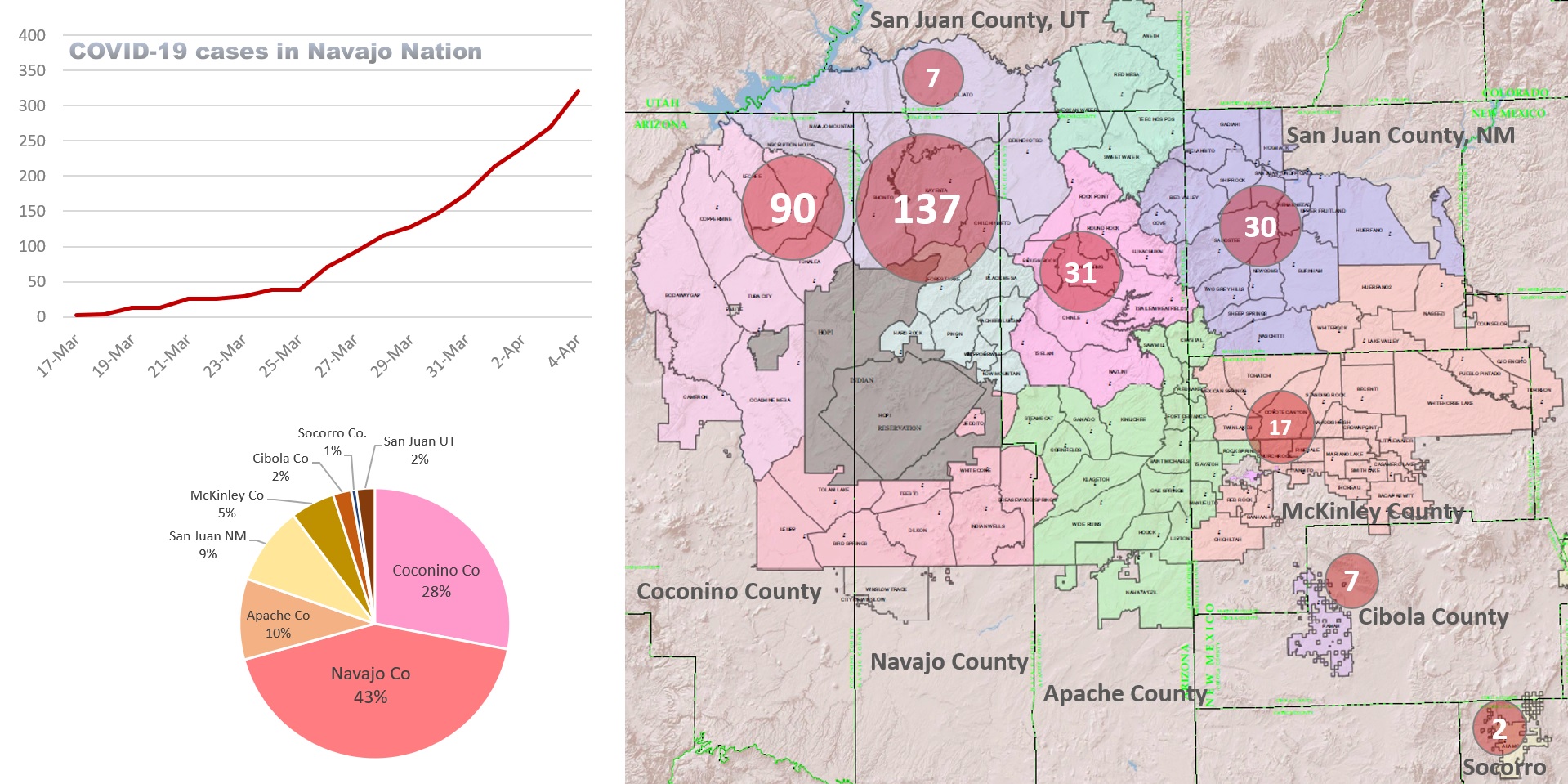
COVID-19 cases in Navajo Nation continue to rise at high rates across in all regions. Both confirmed cases and deaths grew on average 6% per day over the last week, implying doubling of cases and deaths every 12 days.

CLICK TO ENLARGE

Navajo 5-3-20.jpg

Given the population of Navajo Nation is 357,000, the rate of infection is now over 6,000 per million, which exceeds all nations in the world except for the small city states of San Marino, Andorra, and the Vatican. In the United States, New York and states near New York City, as well as the District of Columbia, have higher rates. New York’s infection rate is over 16,000 per million.  The rate of growth in all those other nations and states is zero to 3% per day. In New York, it is now 1% per day.

Current deaths in Navajo Nation are 3% of current confirmed cases. However, given many of those cases have yet to resolve, the actual case fatality rate may be as high as 5%. In New York, current deaths are over 7% of current confirmed cases.

Data for nations and states comes from this website. Data for Navajo Nation comes from the Navajo Nation government website, which also includes other news and information. 

The Navajo Nation still awaits federal government support from the Coronavirus Aid, Relief, and Economic Security (CARES) Act, which passed Congress on March 27. $8 billion was allocated for tribes, but not a penny has been released, as the Treasury Department is still figuring out how to divide it among 500+ federally-recognized tribes. Suggestion: Release the first $2 billion now for immediate response, divided based upon number of confirmed cases. Release the next $2 billion for prevention, divided based upon total population at reservations or counties. Get it moving now. Figure out the rest later.


Posted in COVID-19 | Tagged , , , | 1 Comment

Navajo Nation COVID outbreak still spiraling: Apr 10 update

Navajo Nation has been hit with some of the highest per capita rates of infection anywhere in the world. The current number of cases are increasing 12% daily, doubling every 6 days. Detailed information and emergency orders can be found at the Navajo Nation government website.

CLICK TO ENLARGE

Navajo 4-10-20.jpg


Posted in COVID-19, news | Tagged , , | 5 Comments

White noise in the time of coronavirus: The chaotic California Fish & Game Commission telemeeting

When the California Fish & Game Commission attempted to hold a telemeeting on April 9, it quickly devolved into chaos and was cancelled within minutes. It was an illustration of white rage, white privilege, and white noise making other voices impossible to hear. In the debate over safe spaces, this was a perfect illustration of an invaded and colonized space.

Five hundred callers, mostly from rural counties, swarmed the lines and began shouting down the commissioners. They shouted:

Make fishing great again.

Take a stand; join the Klan.

Fascists!

One quoted the Old Testament and referenced his grandfather while another demanded his fishing rights under the California constitution. You can hear some of it here.

The purpose of the meeting was for the Commission, an appointed independent body which sets California’s hunting and fishing regulations, to temporarily give emergency powers to the Department of Fish and Wildlife to manage fishing and hunting during the COVID-19 pandemic. Because the Department would be able to quickly close fishing sites or delay fishing seasons, it could more effectively protect public health. Furthermore, some rural counties, about to receive an onslaught of out-of-town anglers for much-celebrated trout season openings on April 25, had asked for help. They did not want outside anglers bringing the disease to their small communities.

But that’s not the message many rural anglers in California heard. Instead, a right-wing faux news source spread misinformation, that the state was going to ban all recreational fishing, as the state of Washington did on March 26. The sheriffs of Modoc and Shasta Counties spread the rumor. Republican representatives from much of the Sacramento Valley repeated it, whipping up a frenzy.

Lost in the noise of affronted whites demanding their rights were two other groups: Native tribes and mostly Asian immigrants who depend on “recreational” fishing for subsistence.

I’ll focus on the tribes. There are about 110 federally-recognized tribes in California and about 50 to 100 others, many listed by the state requiring consultation. Almost none of them have fishing rights. In the 1850s, the state of California blocked nineteen treaties between the federal government and the tribes that would have protected their interests. Today, these tribes remain subject to Commission regulations, a point of friction. If anyone has a right to be angry, it is them.

The Department no doubt reached out to all these groups prior to the meeting, seeking narrow “surgical closures” and not a statewide ban. The tribes got it.

But that didn’t stop white rage. Like the Bundy’s in Nevada, the rage seems to come exactly from where it is most tenuously justified. It comes from the same counties where systematic genocide gave these anglers the land in the first place. In the 1800s, they willingly took the state’s reimbursements for their vigilante ethnic cleansing, getting paid by the scalp. But, like white pioneers everywhere, chafed at any government intervention to protect the Natives. The apples have not fallen far from the trees. They still chafe at government regulation. They still claim as rights that which they have taken.


Posted in COVID-19, news | Tagged , , , , , , , , , , | Leave a comment

COVID-19 outbreak at Navajo Nation: Apr 4 summary

See my first update on Apr 1 for relevant background and links to Navajo Nation press releases.

Here is the summary for Apr 4. There have now been 13 deaths.

CLICK TO ENLARGE

Navajo 4-4-20.jpg

The COVID-19 epidemic in Navajo Nation was also featured on NPR today.


Posted in COVID-19, news | Tagged , , , | Leave a comment

COVID-19 outbreak at Navajo Nation: Apr 1 summary

UPDATE AS OF APRIL 1, 2020

Navajo Nation is currently experiencing one of the largest outbreaks of COVID-19 among any Native community in North America. Navajo Nation press releases document the spread, which I summarize here.

The outbreak began on March 17, in the small hamlet of Chilchinbeto, located between Chinle and Kayenta in Navajo County. The first victims had recently traveled and are thought to have acquired the disease outside the reservation, but then unknowingly brought it back home with them. Infected people are contagious for one to two days before showing symptoms. Some people may be completely asymptomatic, but are still contagious. The outbreak quickly grew to 10 cases two days later, possibly thru a church service, and Chilchinbeto was put under lockdown. By March 21, cases appeared in Coconino, Apache, and McKinley Counties, either spread from Navajo County or possibly arriving independently from elsewhere.

As of March 31, the Indian Health Service reports that nearly 1,500 people have been tested, with only 9% of those tests coming back positive. This low rate of positive tests is typical of national trends.

CLICK TO ENLARGE

Navajo 4-1-20.jpg

Seven people have died so far. New Mexico Governor Lujan Grisham reported, “we’re seeing a much higher hospital rate, a much younger hospital rate, a much quicker

Chinle gym.JPG

The gym at Chinle, were Netflix’s “Basketball or Nothing” was filmed.

go-right-to-the-vent rate for this population. And we’re seeing doubling in every day-and-a-half.” Ventilators can save lives, but experience from New York City shows that less than half of patients put on a ventilator survive. Navajo Nation may be especially vulnerable due to its high population of elders, as well as high rates of obesity and diabetes, all of which make COVID-19 more dangerous. The nearest major hospitals are several hours away, in Flagstaff and Gallup, though the early patients were transported all the way to Phoenix.

The data on confirmed cases, above, imply a doubling rate of every four days, slower than what Governor Grisham stated but still incredibly fast. Shelter in place orders are now in effect. Preliminary data from Washington and California show this can be successful in slowing the virus, making it the single most important measure. Studies have shown that if isolated family groups continue to each interact with one outside person, the benefits self-quarantine are essentially lost. Six to ten feet physical distancing from those outside a family group should be maintained at all times– and even attempted within family groups.

Because many elders live in and widely scattered homes, they need support obtaining groceries and other necessities. Extreme care should be taken while shopping and delivering food. Navajo Nation has also asked for more personal protective equipment (PPE), such as masks.


Posted in COVID-19 | Tagged , , , , | Leave a comment

Lost Bird died in the last pandemic

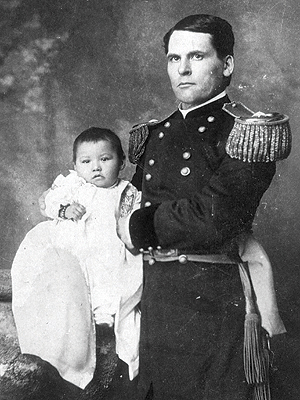
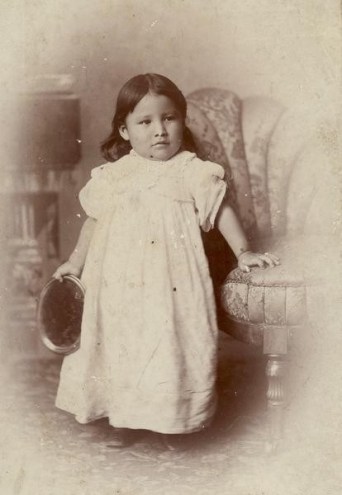
In 1920, Lost Bird, aka Zintka, aka Zintkala Nuni, died in the Spanish flu pandemic in the Bay Area of California. We still don’t know her real name.

Wounded Knee, 1890

After the massacre, Hugh McGinnis, of the same 7th Cavalry that Custer led 14 years earlier, wrote: “General Nelson A. Miles, who visited the scene of carnage, following a three day blizzard, estimated that around 300 snow shrouded forms were strewn over the countryside. He also discovered to his horror that helpless children and women with babes in their arms had been chased as far as two miles from the original scene of encounter and cut down without mercy by the troopers.”

lostbird2.jpgThe soldiers and hired civilians gathered the frozen forms, tossed them onto wagons, all stiff arms and legs, carried them to the hill where the guns had been, and tossed them into a mass grave on the snow-swept tundra.
At this point, the men heard a muffled cry coming from down the draw- a baby. The sound was coming from under the stiff form of a dead woman. The child, about four months old, was tightly wrapped and wore a little bracelet and a beaded cap with a picture of a tipi and the Black Hills.

They took the child back to Pine Ridge and give her over to the care of Annie Yellow Bird, who was nursing one already. A few days later General Leonard Colby of the Nebraska National Guard arrived. Together with Buffalo Bill’s publicity man, he bartered for the child and came away with his trophy.

The soldiers called her “The Lost Waif of Wounded Knee”. Colby called her Marguerite. Her new mother, Colby’s wife, called her Zintka, short for Zintkala Nuni, Lost Bird.

Washington, DC, 1900

Lost Bird was raised in the swirl and hustle and bustle inside the Beltway, far from the grasslands of Pine Ridge. General Colby had become the Assistant Attorney General under President Benjamin Harrison. They entertained diplomats and other important people in their large home. Susan B. Anthony visited often, a close friend of her step-mother.

lostbird1.jpgBut Lost Bird, 10-years old, was restless. She knew she did not belong. She wanted to play with the black children but was told not to—it was beneath her—but that left her wondering what level she was on. Her mother, sensitive to Zintka’s past, took her to see a traveling troupe of Sioux drummers and dancers. She would have heard them before, at her mother’s breast, and it would have been the Ghost Dance. Like a bird in a cage watching a bird out the window, she was transfixed. Her mother tugged her arm to leave, but Lost Bird wanted to stay and watch.

She proved to be too rebellious, bouncing out in and out of local boarding schools. Eventually, she was sent to Nebraska to visit General Colby, her adoptive father.

Milford, Nebraska, 1908

Now 17-years old, Lost Bird wrote to her mother, “I don’t know where I am.”

She was at the Milford Industrial Home for Girls, a place for “penitent girls who have met with misfortune.” High in a tiny room tucked underneath a gable, tied up in a straight-jacket, shivering in the cold, Zintka was pregnant and imprisoned.

General Colby had left the family after impregnating and running off with the family’s young governess that had practically grown up in their house. After his stint with the Department of Justice, he returned to Nebraska and became a wealthy man. After Lost Bird became pregnant, he deposited her at Milford with a note to keep it quiet.

Zintka’s child was stillborn.

Hollywood, 1914

Like so many young people with similar pasts, Lost Bird ended up on the streets of Hollywood. She made money the only way she could—becoming a display item in Buffalo Bill Cody’s Wild West Show. She got married. Her husband gave her syphilis. This became her underlying condition.

lostbird3.jpgHanford, California, 1920

At age 29, Lost Bird died in the Spanish flu pandemic.

Wounded Knee, 1991

Lost Bird’s journey was not over. In 1991, after 101 years, she was repatriated to Wounded Knee and re-buried near her mother in a Lakota ceremony.


Posted in my own thoughts | Tagged , , , , , , , | Leave a comment

Asymptomatic but contagious: Healthy youth may be spreading the virus

elders.jpgHere’s what they learned in the town of Vo’, Italy, when they tested everybody.  This comes from a Physicians Facebook group, posted by an Italian doctor (Daniela Molena):
A letter from Prof Romagnani Sergio who is a Professor in Florence. He is talking about a study from the University Of Padova in Vo’, a small town outside of Padova and one of the first centers in Italy with positive cases. He says:

“The results of the study in Vo’ are ready. Every inhabitant in Vo’ has been tested for COVID-19 (about 3000 persons) and it has been shown that the majority of people who were positive for the disease (50-75%) were completely asymptomatic but represent a strong way to spread the disease. In fact, in Vo’, by isolating everyone that was positive, the total number of patients decreased from 88 to 7 (at least 10 times lower) within 7-10 days. The most interesting and surprising finding was that isolating positive patients (with or without symptoms) not only were we able to protect other people from getting the disease but also from the evolution towards a serious illness since the rate of recovery in people positive but isolated was about 8 days for 60% of cases. These data gave us some very important information:

1) the percentage of infected people is high even if people are asymptomatic and represent the majority of cases among young people (and possibly other groups as well).

2) the isolation of asymptomatic people is essential to be able to control the spreading of the virus And the severity of the disease. In the view of these data is clear that some of the procedures of containment need to be revised. It is fundamental to block the diffusion of the virus to identify the major number of asymptomatic subjects that have an important part in the disease and to identify them as quickly as possible.

On the base of the data from Vo’, we have already started “a massive surveillance” in the entire Veneto region and we have started performing screening test ti all healthcare workers (doctors, nurses, police, support staff) even when asymptomatic so to isolate them as soon as possible.

The first conclusion of this experience is that our approach of testing only symptomatic patients is insufficient . Now that there are so many cases of COVID 19 it is not so important to test symptomatic patients who would be isolated anyway. But the crucial thing is to detect the asymptomatic positive patients who have higher chance of spreading the disease since no one expect they can. This is particularly important for doctors and nurses who are exposed and could be the vector of spread between personnel and patients. In many countries in fact they are deciding to avoid testing personnel if not symptomatic ma this is a very dangerous decision. The hospitals are risking becoming areas with high prevalence of positive Subjects who are not isolated and therefore not only can spread the disease to each other but also create communities with higher viral loads where the course of the disease is catastrophic.

It is therefore important to extend the test to those people who are at risk of multiple contagions and isolate them when positive even is asymptomatic. Finally it is very important that all subjects at risk wear a mask not only to protect themselves but also others.

Similar approach seems to have been adopted by South Korea.

Sergio Romagnani
Già Professore di Immunologia Clinica e Medicina Interna
Professore Emerito dell’Università di Firenze”

Posted in news | Tagged , , , , , , , , , , , , , | 1 Comment