
In 1832, smallpox raged along the Mississippi River. After years of bitter debate, the Indian Removal Act had just been signed by President Andrew Jackson. A sharply divided white nation prepared for widespread Indian removal to west of the river; that is, ethnic cleansing on a mass scale. Overcoming the objections of southerners who loathed the Indians, northern white liberals passed the Indian Vaccination Act, allocating a paltry $12,000 out of a total $1 million-dollar Indian budget to vaccinate tribes along the “frontier”.
It was a progressive move, one of the first efforts of the federal government for Native public health. Nevertheless, officials made it clear that helping Indians was an act of charity and not a responsibility. The commissioner for Indian affairs, Elbert Herring, blamed foreigners and the victims for the epidemic. They got it, he said, from French and British fur traders, or had brought the disease on themselves by drinking whiskey from a keg wrapped in an infected cloth.
Lewis Cass

Cass missed the 1837 epidemic. By then, he was in Paris with his family. Andrew Jackson had appointed him ambassador to France. Today, Cass is honored with a statue in the US Capitol and his name adorns several schools and towns, as well as counties in eight states.
When it came to the Jackson Administration’s implementation of the act, Trump’s more competent doppelganger took a familiar political approach. Rather than appoint a doctor or even the Indian Bureau to oversee the vaccination program, he selected the Department of War (now known as the Department of Defense). The Secretary of War was Lewis Cass, an ardent Jackson supporter and sycophant who had fought in the Battle of the Thames that killed Tecumseh and later, as the Governor of Michigan, was instrumental in removing Natives from large portions of the Midwest. He had recently described the Plains Indians as beyond the pale of civilization.
As described in Pearson (2003), Cass “selected the tribes for vaccination, authorized the hiring of all vaccination personnel, delegated limited authority to the commissioner of Indian affairs, and set the parameters that limited or denied vaccinations to Indian nations.” For efficiency, he used the US Army to administer vaccines, unless he selected civilian physicians as an act of political patronage.
His corruption didn’t stop there. In his home state of Michigan, where many of the vaccinations took place, the program had a dual purpose – a full scale reconnaissance of the region’s potential for mineral exploitation was also performed. The report back to Washington said more about metals and ores than it did about public health.
As for the tribes, Cass limited the vaccine to only those who had signed treaties favorable to the United States (i.e. giving up territory), or, such as with the Sioux, were considered important trading partners. Even though a plurality of the funds were supposed to be allocated to the “Upper Missouri River”, Cass’s instructions stated, “Under any circumstances, no effort will be made to send a Surgeon higher up the Missouri than the Mandans, and I think not higher than the Aricaras.” This excluded the Blackfeet (the dominant tribe of the northwest Plains at that time), Cree, and Assiniboine. At the time, tensions due to trade disputes with the Arikara were strained to the breaking point.
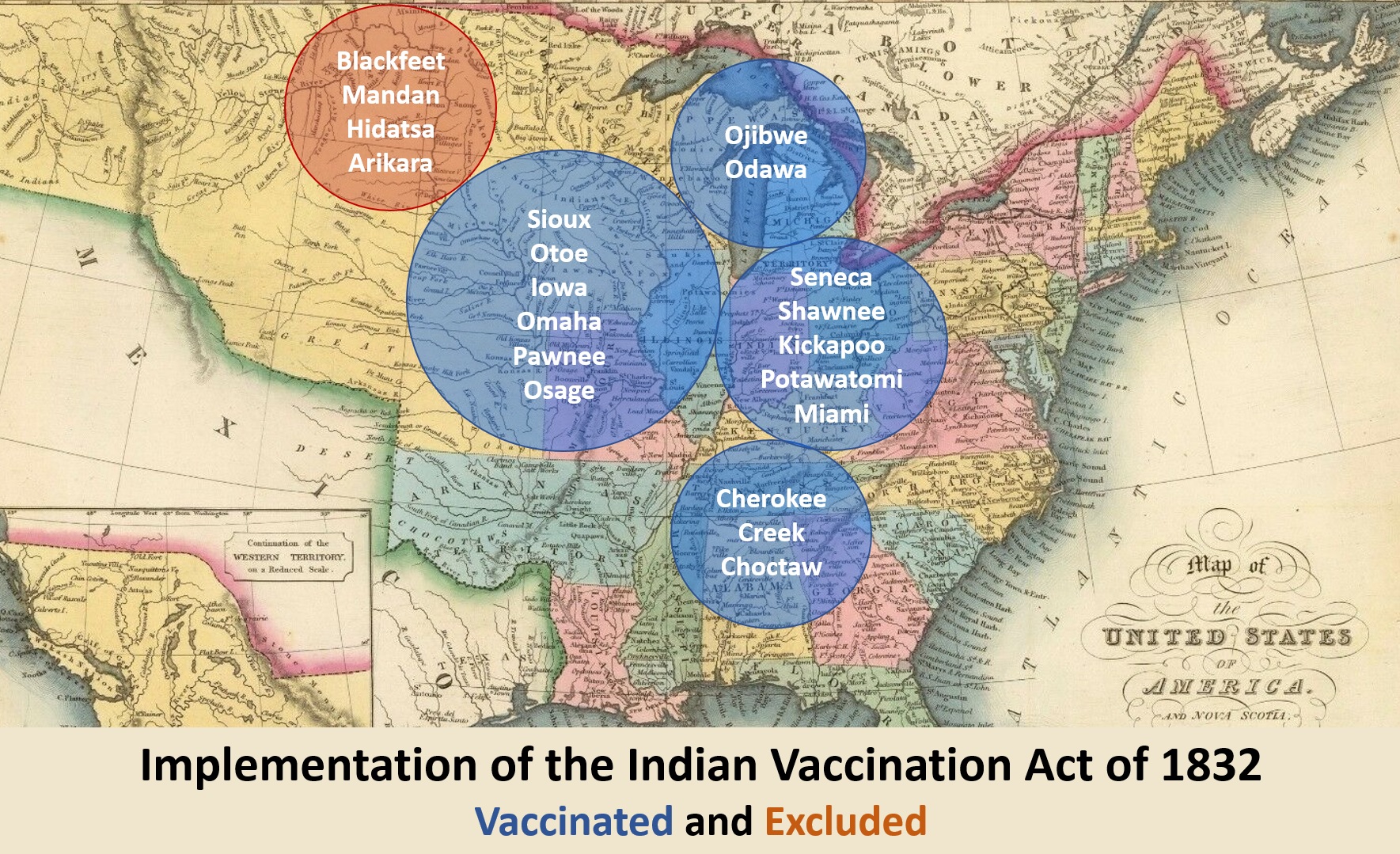
The 1837 Great Plains smallpox epidemic
What happened next is well-known. In May 1837, the steamer St. Peter, owned and operated by the American Fur Company, traveled up the Missouri River. When it was discovered several passengers were sick with smallpox, the captain refused to stop. No shutdown; no quarantine. That night, at a company fort north of present-day Bismarck, many in the company attended a local Mandan gathering.
Within weeks, the local Indian agents were asking their superiors in Washington for shipments of vaccine. One agent warned I would not be surprised if it wiped the Mandan and Rickaree [Arikara]Tribes of Indians clean from the face of the earth. Within a year, most of the local Mandan, Hidatsa, and Arikara were dead. Upriver, over ten thousand Blackfeet died, altering the balance of power on the northern Plains.
The next year, as word of the tragedy became known, an investigation in Washington led to finger pointing and excuses about telegrams never received. Cass was not exonerated because the investigation never even made it to his level.
The politics of disease
Pearson concludes, “Vaccinations were used to enable Indian removal and to facilitate reservations and the consolidation and reduction of reservations. Westward expansion of the United States was also expedited by the act, since Indian nations viewed as friendly or economically important to the United States were protected by the federal smallpox vaccination program, but Indian nations viewed as transgressor nations were not.”

Trump hung Andrew Jackson’s portrait in the Oval Office.
All President Trump, a modern buffoon of an Andrew Jackson wanna-be, needed to do for the current pandemic was to establish a federal unified command guided by subject matter experts, serve them thru the provision of resources and the removal of bureaucratic obstacles, and unify the public with a common call to work together. Instead, he has assumed the spotlight as a completely unqualified leader of the emergency response, thrown federal coordination into confusion such that states are left forming their own multi-state task forces, and gaslit stay-at-home orders with tweets supporting white supremacists protesting public health recommendations, a ludicrous phenomenon unknown in other societies.
With regard to Native Americans, the Trump Administration delayed and bungled support for tribes, even while the Navajo Nation suffers a higher infection rate than any other nation on the planet. When it comes to politicizing public health, the United States has not come that far in 180 years.
For more on smallpox and Native Americans, see this:
The strange truth about smallpox and Native Americans
Source: Pearson, J. Diane. 2003. Lewis Cass and the Politics of Disease: The Indian Vaccination Act of 1832. Wicazo Sa Review 18 (2): 9-35.
UPDATE ON MAY 22, 2020:
No sooner had I posted this than this story broke. A former deputy chief of staff to Donald Trump retired and formed a company named after himself: Zach Fuentes LLC. Eleven days later he was awarded $3 million federal contract to supply respirator masks to Navajo Nation hospitals. Many of those masks have proven to be faulty, “unsuitable for medical use”. The Navajo Nation remains in desperate need for PPE.


 Memories of the People
Thank you so much for posting all of this information most of my family have all past away and I have know knowledge on how to help myself or my children of our ancestry or roll numbers but what interesting history I have learned from your postings.
Pingback: No. 590: It’s Cinco de Mayo, with astronauts, archaeologists and a new Australian connection - Innovate Long Island
I was wondering if you knew of any documentation showing that the vaccine caused smallpox in the Indians that were vaccinated.
No, I’ve not seen anything like that. What I’ve seen seems to imply the vaccine was successful.