
With the ink barely dry on the Supreme Court ruling that eastern Oklahoma is in fact reservation land of the Creek, Cherokee, Choctaw, Chickasaw, and Seminole, the Five Tribes are under pressure to relinquish some of their new-found sovereignty.
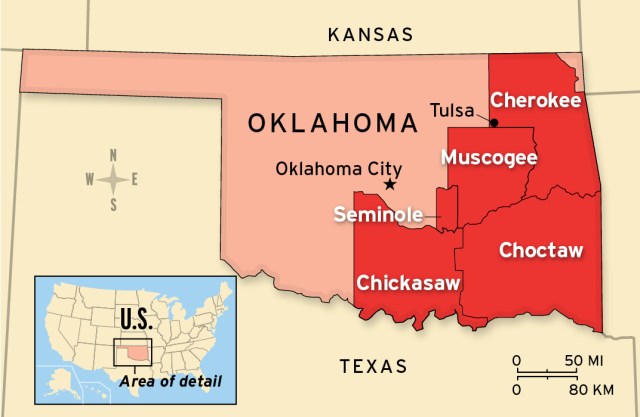
The landmark McGirt v Oklahoma ruling came on July 9, asserting that Congress never dissolved the Creek reservation in Oklahoma (and by extension the other four reservations of the “Five Civilized Tribes”). This put much of eastern Oklahoma, including most of Tulsa, in Indian Country.
Immediately lawyers and officials from Oklahoma and the Tribes met to figure it all out. Note they already have many cooperative agreements regarding law enforcement, health care, hunting and fishing, etc.
A week later, on July 16, the Five Tribes announced an Agreement-in-Principle with the Oklahoma Attorney General “to ensure collaboration among Tribal, State, and Federal authorities in the interest of effective law enforcement and administration of justice across Tribal lands.” The purpose is to draft federal legislation together defining oversite of civil and criminal law enforcement. The chief of each of the Five Tribes released a statement affirming their own sovereignty as well as cooperation with the state of Oklahoma.
While many were thinking about jurisdiction over criminals on various parcels within reservation lands, the Washington Post noticed the elephant in the room: Big Oil. Their headline says it all: “Now that half of Oklahoma is officially Indian land, oil industry could face new costs and environmental hurdles: The landmark Supreme Court decision give the five tribes a say over oil and gas wells, refineries, and pipelines—including those running to the Cushing hub of the Keystone XL, legal experts say.” Cushing, the “center of the oil universe” lies just outside the reservation area. At the very least, the oil industry will now need federal as well as state permits for new wells and pipelines.

Cushing, Oklahoma, located just west of Tulsa, is one of the largest pipeline hubs in the world.
Oklahoma is one of the most Republican states in the nation, with 65% voting for Trump in 2016 (only West Virginia and Wyoming outdid them). With little environmental regulation, Oklahoma is content to allow oil operations (e.g. fluid injection) that routinely cause earthquakes over 4.0 on the Richter Scale, and as high as 5.8. With little taxation of oil (or anybody else), Oklahoma was forced to cut public schools to four days per week for budgetary reasons, pre-Covid. They repeatedly seek more revenues from tribal casinos to make up their deficits.
In this context, Oklahoma Republican leaders and the oil industry are in panic mode. Dewey Bartlett, a prominent oil executive of Keener Oil & Gas, and a former mayor of Tulsa, said “It’s going to be total chaos.” The oil industry wants the hands-off status quo to remain. In the words of the Petroleum Alliance of Oklahoma, they want “a stable, predictable regulatory and tax environment consistent with their interests.”
The Agreement-in-Principle would shift most civil jurisdiction from the Tribes to the state, thereby freeing the oil industry from any tribal requirements.
The Five Tribes faced immediate internal backlash when they released the Agreement-in-Principle. The next day, July 17, the Creek and Seminole chiefs issued statements backing out of the Agreement, saying that collaboration “does not require congressional legislation.” Three days later, on July 20, the other three tribal governments, faced with protests at their own capitols, issued a statement backing off the Agreement so they can dialogue with “stakeholders” (presumably their constituents).
On July 23, Oklahoma Governor Stitt (R) came back playing hardball, announcing he was invoking the 2005 Inhofe rider to assert state jurisdiction on environmental issues on reservation lands. It remains to be seen if that will hold up in court. Cherokee Chief Chuck Hoskin Jr. called it a “knee-jerk reaction to curtail tribal jurisdiction.”
The pressure does not stop there. Oklahoma legislators, all Republican with deep ties to the oil industry, have already drafted federal legislation to strip the Five Tribes of their sovereignty or reservation altogether. It’s a massive threat that recalls the legacy of the oil-induced Osage murders. On July 23, an op-ed piece by a former legislator and current Tulsa County assessor said the Tribes, if they knew what was good for them, should “actively lobby Congress to disestablish swiftly the reservation status that was just recognized by the Supreme Court.” He cited the “cloud of uncertainty” in the marketplace.
There are carrots as well as sticks. In addition to the full court press by Oklahoma Republicans, Cherokee Nation announced they will host a visit by Melonia Trump “to tour our state-of-the-art Outpatient Health Center and first medical school on tribal land in the nation.” Expect a presidential offer of financial support, strings attached.
It’s easy to come up with snarky historical comments about beads and blankets and bribes to old chiefs. The legacy of Standing Rock also towers over this battle. Time will tell what how the Five Tribes respond.


 Memories of the People