
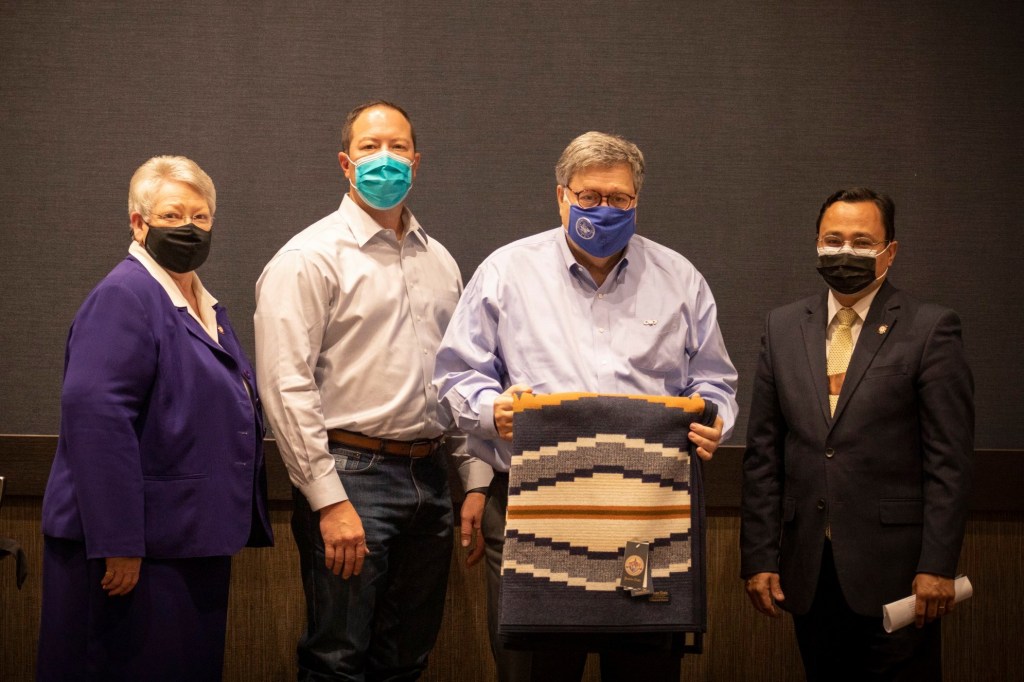
Attorney General William Barr spent most of Wednesday, September 30, at Cherokee Nation (CN). This was Day 4 after he attended the infamous Amy Coney Barrett reception at the White House, the presumed COVID super-spreader event now known as the #RoseGardenMassacre. There, Barr did not wear a mask and had close conversations with several who later tested positive (see video of Barr at the reception here).
According to the Johns Hopkins School of Public Health contact tracer training, the average incubation period for COVID is five days, but can range from two to fourteen days. People are typically contagious one to two days before they show symptoms. Trump tested positive on day five, though he had fatigue on day four (and attended a fundraiser even knowing that aide Hope Hicks had already tested positive). Barr has not tested positive, yet. It’s possible he doesn’t carry it, or is late in developing it, in which case the Cherokee will have dodged a bullet. Under public pressure, Barr began to quarantine himself on October 4.
When Barr went to CN, neither Trump nor Hicks had tested positive. Presumably due to CN requirements, he wore a mask… most of the time. CN posted several photos of his visit. In one he is the only one pictured not wearing a mask; in three others, his nose is uncovered. Social distancing was violated in most of the photos.

Long before Trump’s positive diagnosis, the reckless and deliberately anti-public health behavior of the Administration was painfully obvious. Any visitor from Trump’s inner circle would be a public health risk. This time, for the Cherokee, a very real risk. Yet, it appeared as if CN officials were unwilling to challenge him when he was maskless or when his nose was uncovered; they welcomed him with open arms.
The purpose of Barr’s visit is related to this uncomfortable dynamic between a tribal nation claiming sovereignty, but being too afraid to assert it. On July 9, the US Supreme Court affirmed the Cherokee Reservation in eastern Oklahoma, giving the Cherokee Nation (CN) limited sovereignty over much of the region, including the ability to regulate the oil industry via environmental requirements. Much of Indian Country wasn’t attuned to this – and it’s not clear how much CN wants to take on this responsibility – but Big Oil and the Republican politicians they employ were all over it.
Republicans and op-eds in Tulsa newspapers called for the abolishment of the reservation. The Governor of Oklahoma invoked an old statute asserting state control over environmental issues on tribal lands. For more of the drama from that week, see this post: Drama on the Rez: Big Oil, Oklahoma, and Trump put the Five Tribes under pressure.
Since then, the Trump Administration has come courting. On July 23, Melonia Trump announced she would visit, touring CN healthcare facilities. That visit has yet to occur.

Then, last week, Barr arrived. The Barr reception was the typical inter-government lovefest, with prerequisite niceties, compliments, and promises of cooperation (see video here). The main point, in the face if the McGirt decision, was to strengthen coordination for law enforcement, as now many criminal prosecutions will be moved from state to federal and tribal courts. Barr came bearing gifts: $7.6 million “to improve safety, serve victims of crime, support law enforcement and to support youth programs”, as well as “creating a Special Assistant U.S. Attorney program with $2 million over three years to allow the Northern and Eastern District U.S. Attorneys’ offices to each hire additional prosecutors.”
Principal Chief Chuck Hoskin Jr. put a positive spin on it. “Anytime you can have the attorney general of the United States come to the capital of the Cherokee Nation because he wants to talk about sovereignty, he wants to talk about McGirt, he wants to see the best in law enforcement in the judiciary and in law enforcement, that’s good for all of Indian Country,” Hoskin said. “It’s certainly a good thing for the Cherokee Nation.”
But Barr also made reference to forthcoming legislation. It’s not clear why any legislation is needed at this point, except to strip from CN some of the sovereignty awarded by the McGirt decision. It’s doubtful Trump and Barr want to repeal the Inhofe rider that takes jurisdiction over environmental issues away from tribes and gives it to Oklahoma.
Hoskin again: “There are legislative ideas floating around to disestablish the Five Tribes. If they’re going to disestablish the Five Tribes, I’m going to fight that tooth and nail. We expressed to the attorney general that we want the support of the Department of Justice on that, and in response, he said we are going to be very engaged on that.”
Barr said DOJ will be “very engaged”; on which side?
After the friendly opening statements, the media was dismissed and the discussions continued behind closed doors. We know nothing about what was said, promised, or threatened. Later in the day, Barr met with the tribe’s Marshal Service and toured the CN’s bison herd.

I had a vision of CN working with the Standing Rock Sioux and other tribal governments to forestall the Keystone XL pipeline and implement environmental regulations in a state that has almost none. I was imaging laws like in California, where any release of “deleterious materials” into waters of the state (or Nation) is a crime, where enforcement is robust, where the Nation can make claims for compensatory restoration to make the environment whole. Where industry is held to account.
But if Hoskin and the CN government are unwilling to challenge Washington in the face of a deadly disease, I’m concerned they’d be afraid to take a stand to protect our environment. Will CN demand the repeal of the Inhofe rider, or will they relinquish the ability to create and enforce environmental laws? Will the legacy of Barr’s visit be that he brought Covid and took sovereignty?
UPDATE ON OCT 5: Principle Chief Hoskins has just issued a statement criticizing the US EPA for invoking the Inhofe rule and giving Oklahoma authority over environmental regulations on their reservation. Despite Barr’s visit, Hoskins took a stand to protect Cherokee sovereignty over the environment. The timing of the US EPA’s actions and Hoskins’ statement suggest the topic did come up with Barr, Hoskins refused to yield, so Barr pulled the string. How can the Cherokee fight back? Well, they can withhold casino earnings from Oklahoma for starters. More likely they’ll wait and hope for a Biden Administration to reverse it.

 Memories of the People
Here’s an excellent article summarizing the latest regarding the EPA seizing tribal sovereignty over environmental issues. Note that Oklahoma’s request came Oct 1, the day after Barr’s visit. https://tyt.com/stories/4vZLCHuQrYE4uKagy0oyMA/65Oa5a0nYI4rljnOqxhUto
November 8, 2020: Cherokee Chief challenges OK governor in op-ed: https://tulsaworld.com/opinion/columnists/chuck-hoskin-jr-the-tribes-and-the-state-can-solve-any-problems-created-by-the/article_e05019a2-1e1c-11eb-99d6-d3b85c0ccdca.html?fbclid=IwAR29vwmzTfozZqQue1XFP8Rhgbwarm-SIEZm7_jHQT-eVJ1-lzF7IsNVeu8