
Historical records about Indian boarding schools – forced re-education and labor camps – are abundant. Superintendents had to write reports to superiors every year, and these were passed on to the Secretary of the Interior.
Today, Secretary Deb Haaland’s call for a thorough investigation and a new report, to be completed by early 2022, is met with both praise and questions from Indian Country. How can a thorough report be completed in such a short period of time? Will it call for truth and reconciliation? For restitution? For retribution? The schools were funded by the US government, but most were implemented by various Christian denominations. Will their records be accessed?
Here’s a very small sampling of the historical record. The first is from the Haudenosaunee Confederacy pre-USA, which provides a foreshadowing of the conflicts to come. The remaining are from the late 1800s and early 1900s, when Native children were removed by force and coercion and sent to re-education and labor camps. The “schools” persisted thru the 1970s. Thousands died without ever seeing their families again.
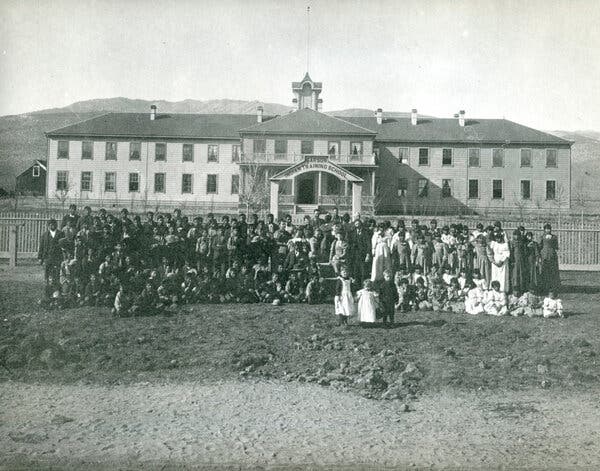
“Brother, do you think we are altogether ignorant of your methods of instruction? Brother, you must learn of the French ministers if you would understand, & know how to treat Indians. They don’t speak roughly, nor do they for every little mistake take up the club & flog them.”
– Onondaga parent speaking to Minister Eleazar Wheelock, boarding school superintendent, Connecticut, 1772
~~~~~~~~~~~~~~~~~~~~~~~~~~~~~~~~~~
“Kill the Indian, save the man…. Transfer the savage-born infant to the surroundings of civilization, and he will grow to possess a civilized language and habit.”
– Captain Richard Pratt, Carlisle Indian Industrial School, Pennsylvania, 1879
~~~~~~~~~~~~~~~~~~~~~~~~~~~~~~~~~~
“When I reached young manhood the warpath for the Lakota was a thing of the past. The hunter had disappeared with the buffalo, the war scout had lost his calling, and the warrior had taken his shield to the mountain-top and given it back to the elements. The victory songs were song only in the memory of the braves. So I could not prove that I was a brave and would fight to protect my home and land. I could only meet the challenge as life’s events came to me. When I went East to Carlisle School, I thought I was going there to die;… I could think of white people wanting little Lakota children for no other reason than to kill them, but I thought here is my chance to prove that I can die bravely. So I went East to show my father and my people that I was brave and willing to die for them.”
– Luther Standing Bear, 1879
~~~~~~~~~~~~~~~~~~~~~~~~~~~~~~~~~~
“The kind of education they are in need of is one that will habituate them to the customs and advantages of a civilized life, … and at the same time cause them to look with feelings of repugnance on their native state.”
– Atlantic Monthly, November 1882
~~~~~~~~~~~~~~~~~~~~~~~~~~~~~~~~~~
“Steady, continuous labor is necessary. Idleness begets restlessness, and results in some breach of discipline. It is the devil’s workshop in an Indian school. A string of text-books piled up in the storehouses high enough to surround a reservation if laid side by side will never educate a being with centuries of laziness instilled in his race. The sound of the “buck saw” or the “noise of the axe” is sweeter to the ear… [The school’s 78 children] farmed 72 acres, cut and hauled 300 posts and fenced 20 acres of pasture, mined and hauled 150 tons of lignite coal, cut 230 cords of wood, stored 150 tons of ice, and cared for 44 cattle, hogs, and horses. Saturdays are dedicated to cleaning and scrubbing the buildings. There is also blacksmithing, shoemaking, carpentry, and sewing. The girls produced 64 dresses, 141 aprons, 25 shirts, 15 pairs of pants, 26 bonnets, 153 towels, 33 chemises, 11 suits, 216 pillow cases, 57 sheets, 46 window curtains, and 94 pairs of mittens.
– George W. Scott, superintendent of the Fort Stevenson Industrial School, Dakota, 1886.
~~~~~~~~~~~~~~~~~~~~~~~~~~~~~~~~~~
“We hope to obtain some story books and pictorial papers for our boys and girls to read. They enjoy them thoroughly, and I am sure that it will broaden their views of life and give them a greater desire to live and be ‘like a white man.'”
– Bessie M. Johnston, Principal Teacher, Indian Industrial School, Genoa, Nebraska, 1886
~~~~~~~~~~~~~~~~~~~~~~~~~~~~~~~~~~
“The health of the scholars was generally as good as could be expected during the year… only 6 died… This school has averaged a fraction over 200 pupils the past year, representing 29 different tribes, scattered along the western coast from California to Alaska.”
– John Lee, Superintendent, Indian Industrial School, Salem, Oregon, 1886
~~~~~~~~~~~~~~~~~~~~~~~~~~~~~~~~~~
“Of the 11 deaths among our [436] students during the year, 8 died from phthsis [tuberculosis], 1 from tubercular epilepsy, 1 from dropsy, as a result of chronic malaria, and 1 suicide.”
– Captain Richard Pratt, Carlisle Indian Industrial School, Pennsylvania, 1886
~~~~~~~~~~~~~~~~~~~~~~~~~~~~~~~~~~
“The health of the school [120 students] has been exceptionally good during the year. Four girls and one boy, the latter an infant, have died here. Christian civilization is the best therapeutic for the Indian.”
– M.M. Waldron, school physician, Hampton Agricultural and Industrial School, Hampton, Virginia, 1886
~~~~~~~~~~~~~~~~~~~~~~~~~~~~~~~~~~
“School wasn’t for me when I was a kid. I tried three of them and they were all bad. The first time was when I was about 8 years old. The soldiers came and rounded up as many of the Blackfeet children as they could. The government had decided we were to get White Man’s education by force.
It was very cold that day when we were loaded into the wagons. None of us wanted to go and our parents didn’t want to let us go. Oh, we cried for this was the first time we were to be separated from our parents. I remember looking back at Na-tah-ki and she was crying too. Nobody waved as the wagons, escorted by the soldiers, took us toward the school at Fort Shaw. Once there our belongings were taken from us, even the little medicine bags our mothers had given us to protect us from harm. Everything was placed in a heap and set afire.
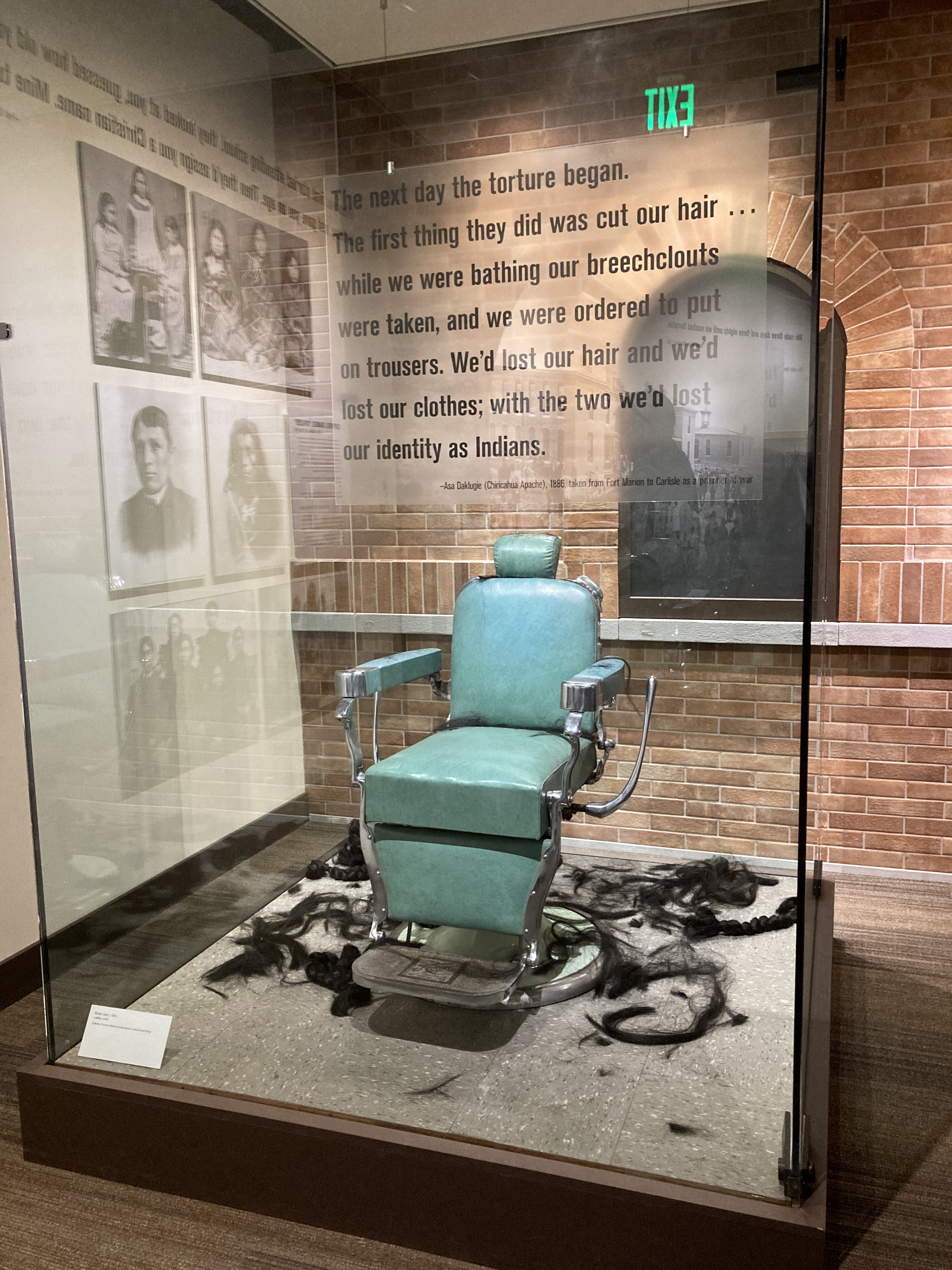
Next was the long hair, the pride of all the Indians. The boys, one by one, would break down and cry when they saw their braids thrown on the floor. All of the buckskin clothes had to go and we had to put on the clothes of the White Man.
If we thought that the days were bad, the nights were much worse. This was the time when real loneliness set in, for it was then that we were all alone. Many boys ran away from the school because the treatment was so bad but most of them were caught and brought back by the police. We were told never to talk Indian and if we were caught, we got a strapping with a leather belt.
I remember one evening when we were all lined up in a room and one of the boys said something in Indian to another boy. The man in charge of us pounced on the boy, caught him by the shirt, and threw him across the room. Later we found out that his collar-bone was broken. The boy’s father, an old warrior, came to the school. He told the instructor that among his people, children were never punished by striking them. That was no way to teach children; kind words and good examples were much better. Then he added, ‘Had I been there when that fellow hit my son, I would have killed him.’ Before the instructor could stop the old warrior he took his boy and left. The family then beat it to Canada and never came back.”
– Lone Wolf, Fort Shaw, Montana, 1894
~~~~~~~~~~~~~~~~~~~~~~~~~~~~~~~~~~
“Practically all of them seem to be tainted with scrofula and consumption—to be liable to break down from seeming good health into utter general debility or quick consumption, almost without premonitory symptoms or apparent cause other than heredity. …
When a pupil begins to have hemorrhages from the lungs her or she knows, and all the rest know, just what they mean, in spite of everything cheerful that can be said or done. And such incidents keep occurring, at intervals, throughout every year. Not many pupils die in school. They prefer not to do so; and the last wishes of themselves and their parents are not disregarded. But they go home and die, and the effect in the school is much the same. Four have done so this year. As many more have gone out who undoubtedly will never be able to return; and others, in still larger numbers, have had hemorrhages from the lungs, or the terrible scrofulous swellings which we know, and they know, practically certify to their fate. Keeping them in school at all sometimes becomes a rather painful task.”
– Frank Avery, Superintendent, Industrial Boarding School, Stephan, South Dakota, 1897
~~~~~~~~~~~~~~~~~~~~~~~~~~~~~~~~~~
“These people cling with an almost deathless tenacity to the traditions and superstitions and legendry of their forefathers…. Their opposition to education and the modes of civilized life being based upon a religious foundation makes it all the more difficult to successfully combat or eradicate from their minds. [Over a quarter of the Sac and Fox refuse to accept their annuity, reducing them to a state of abject poverty] because they believe if they accepted of their annuity the acceptance thereof would give the Government the right to take their children by force and place them in school.”
– US Indian Agent William Malin, Sac and Fox Reservation, Toledo, Iowa, 1899
~~~~~~~~~~~~~~~~~~~~~~~~~~~~~~~~~~
Congressional appropriations for Indian boarding schools and school enrollment:
1877 $20,000 3,598
1900 $2,936,080 21,568
Much of the funding came from diverted treaty annuities and the sale of Native lands.
~~~~~~~~~~~~~~~~~~~~~~~~~~~~~~~~~~
“Indians are wards of the nation in a condition of pupilage or dependency.”
– United States Supreme Court, United States v. Ricketts, 1903
~~~~~~~~~~~~~~~~~~~~~~~~~~~~~~~~~~
“The Commissioner of Indian Affairs, under the direction of the Secretary of the Interior, is authorized and directed to select and designate some one of the schools or other institution herein specifically provided for as an “Indian Reform School”, and to make all needful rules and regulations for its conduct, and the placing of Indian youth therein. … the consent of parents, guardians, or next of kin shall not be required to place Indian youth in said school.”
– 25 U.S.C., Title 25, Chapter 7, §302
~~~~~~~~~~~~~~~~~~~~~~~~~~~~~~~~~~
“They wouldn’t even allow us to be dead in our own way. We had to be buried in the Christian fashion. It was if they wanted to take my mother to a white boarding school way up there… I told the priest, ‘When my time comes, I want to go where my ancestors have gone.’ The priest said, ‘That may be hell.’ I told him that I’d rather be frying with a Sioux grandmother or uncle than sit on a cloud playing harp with a pale-faced stranger. I told him, ‘That Christian name, John, don’t call me that when I’m gone. Call me Tahca Ushte—Lame Deer.’”
– John Fire Lame Deer, Pine Ridge, 1920
~~~~~~~~~~~~~~~~~~~~~~~~~~~~~~~~~~
“The survey staff finds itself obligated to say frankly and unequivocally that the provisions for the care of the Indian children in boarding schools are grossly inadequate. The outstanding deficiency is in the diet furnished the Indian children, many of whom are below normal health. The diet is deficient in quantity, quality, and variety. The prevalence of tuberculosis in the boarding schools is alarming.
Nearly every boarding school visited furnished disquieting illustrations of failure to understand the underlying principles of human behavior. Punishments of the most harmful sort are bestowed in sheer ignorance, often in a sincere attempt to be of help. Routinization is the one method used for everything; though all that we know indicates its weakness as a method in education. If there were any real knowledge of how human beings are developed through their behavior we should not have in the Indian boarding schools the mass movements from dormitory to dining room, from dining room to classroom, from classroom back again, all completely controlled by external authority; we should hardly have children from the smallest to the largest of both sexes lined up in military formation; and we would certainly find a better way of handling boys and girls than to lock the door to the fire-escape of the girls’ dormitory.
The teaching as a whole is not up to the standards set by reasonably progressive white communities.”
– Meriam Report to the Secretary of the Interior, 1928

July 16, 2021.

 Memories of the People
I love the quotes, gives a better understanding of what really happened. Maybe a little bit more about Carlisle industrial Indian boarding school would be the only change I would make.