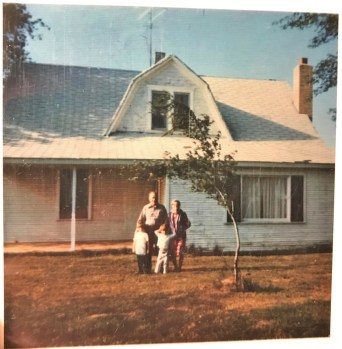
My dad, my grandma Fanny Carr, my brother and me (bottom left) outside of my dad’s childhood home in Grove, Oklahoma.
My father was born on a small farm in Delaware County, Oklahoma in 1925. At the time it was one of the poorest counties in the poorest state in the nation. His parents’ birth certificates say “Indian Territory”. His father, my grandfather, died of a heart attack when my father was seven years old. It was 1932, the height of the Great Depression. My grandmother, left to care for six children, had a nervous breakdown and my father was sent off to an aunt’s house. It was a bleak beginning.
As with most of the people in the county, my father was a poor Okie Cherokee, a few generations removed from the Trail of Tears. But he looked white and had a name that sounded white. That was key. He turned 18 in 1943. The US Army timed the mail so that his draft notice arrived on his birthday. He graduated high school, went to Germany, came home, briefly attended the University of Louisville, and then jumped straight to the law school at the University of Southern California thanks to the GI Bill.
After that, he was set. He became a lawyer, married, bought a house in a nice neighborhood, and then I was set. My mom came from an equally poor background, and was of course subject to all kinds of job discrimination because she was a woman. But that didn’t matter; my dad had a good job. I went to good public schools, an even better private college, and eventually earned a PhD and got a good job and a house in a nice neighborhood. Furthermore, I stand to inherit my parents’ house, which has increased 3,500% in value since I was born. It’s a textbook American dream story.
The X-factor in this story was the GI Bill. Without that, I’d probably be working at a Walmart in Tulsa. The GI Billprovided college tuition, living expenses, low-cost mortgages and low-interest business loans to nearly ten million white veterans. These benefits were largely denied to people of color. Of 67,000 low-cost mortgages, fewer than 100 went to non-whites. Yet there were about a million non-white veterans.
Today, millions of white people can trace their ascent to the higher socio-economic classes back to the GI Bill. If not that, their forefathers may have received an infusion of good fortune from the National Labor Relations Act of 1935, which granted unions the power of collective bargaining, a watershed moment in labor relations that gave white workers power and leverage. That Act, however, allowed unions to exclude people of color, denying them access to better jobs and union protections.
Or perhaps their big break came from the National Housing Act of 1934. This created the Federal Housing Administration, which made home mortgages available to millions of white families. Blacks and others were excluded via redlining, as were Native Americans on reservations. This, more than any other measure, led to the massive racial discrepancy in wealth today. Between 1865 and 1990, African Americans’ share of national wealth grew from 0.5% to 1.0%. This was largely a function of the value of their properties, which have not appreciated like my parents’ house.
The nation’s white grandparents and great grandparents also benefitted from the Social Security Act of 1933. This only applied to half the workers in the economy; farm and domestic labor, both predominately Black, were exempt. At the time, approximately 65% of Blacks were ineligible for Social Security.
Some white people can trace their families’ properties all the way back to the Homestead Act of 1862 (or several later revisions of it), which essentially gave away over 270 million acres of land taken from Native Americans. Nearly all of that went to white settlers. This amounted to about 14% of the Lower 48. Compared to Spanish Latin America, where vast haciendas were granted to a few powerful families, the Homestead Act was remarkably progressive and egalitarian, divvying up the land to 1.6 million white families. Each family received 160 to 640 acres, essentially creating the white middle class.
These laws, some of them considered the bedrock of US public policy, illustrate that the nation was built on the premise that it was created by and for white people. The rest were either second class citizens, support staff, slaves, or not wanted at all. This was not only white privilege, it was welfare, socialism, and affirmative action for whites only.
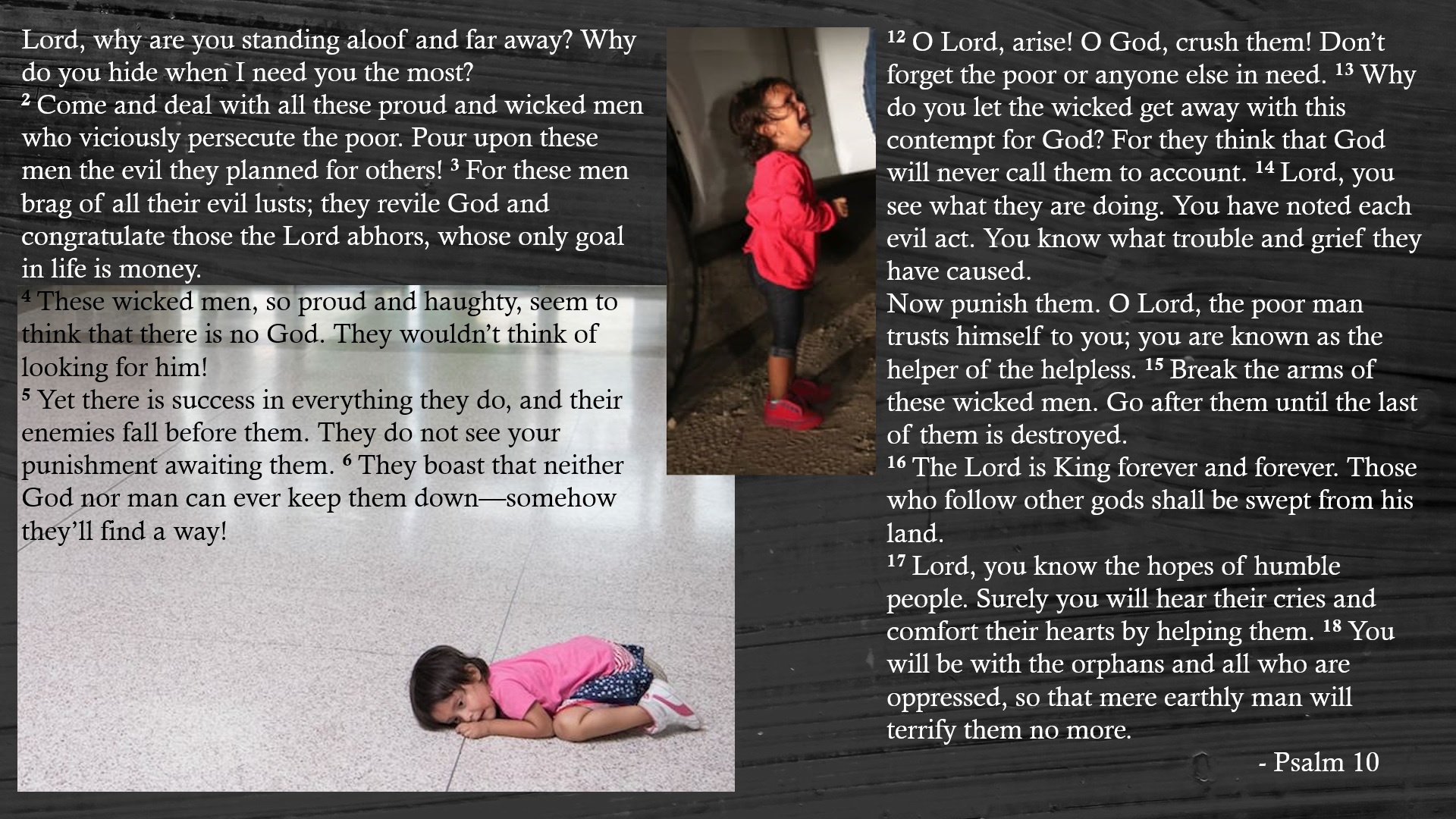
I posted this picture, which is Psalm 10 in its entirety:
CLICK TO ENLARGE
I introduced it as “A prayer for God to kill @realDonaldTrump”, which Psalm 10 very much seems to be (as well as a prayer for God to “destroy” others who oppress the vulnerable). It is hardly a stretch to say that Trump’s policies regarding Guatemalan refugee families would fit the psalmist’s description of the oppressors.
Such prayers, for God to judge the oppressor, are common in the Old Testament. An important part is that it is not a call for people to kill the wicked; it is asking God to intervene and do so. This is a foundational principle of Christian non-violence, that “vengeance belongs to the Lord”; it is not for us to take. My tweet is a description of a prayer, not a prescription for people.
Within hours, Twitter sent me an email saying that my account had been locked for violating their rules. Specifically, they stated, “You may not engage in the targeted harassment of someone, or incite other people to do so. We consider abusive behavior an attempt to harass, intimidate, or silence someone else’s voice.”
I’d love to think I was harassing or intimidating Trump. I doubt it, though. But what would exceed that would be if he thought that Psalm 10 applied to him.
As for Twitter’s rules, attempting “to harass, intimidate, or silence someone else’s voice” pretty much describes hundreds of Trump’s tweets. Did he get notified by Twitter as well?
On June 18, 2019, California Governor Gavin Newsom made headlines with an executive order apologizing for a past “war of extermination”, emphasizing the state’s commitment (via AB 52 and executive order) to tribal consultation (including many non-federally-recognized tribes), and establishing a “Truth and Healing Council”.
The coordinated and deliberate genocide of Native Americans in California, largely during the Gold Rush, is one of the most well-documented genocide in history. The state offered bounties, reimbursed vigilante groups (white death squads), and regulated the enslavement of Native children (where girls sold for twice the price of boys). While there are many books on the topic, largely relying on old newspaper accounts, none are more comprehensive than Benjamin Madley’s An American Genocide.
Here’s one story from 1864, related in Kroeber’s book Ishi.
The Northern and Central Yana are already “brought in”, with most of them working as farmhands and domestic workers on farms and ranches in the Sacramento Valley. (Ishi and the related Yahi remain in the hills.)
Two white women are found killed and the ranchers want revenge.
They convene a meeting at Pentz’s Ranch near Oroville and call themselves “guards”. They steal onto farms and ranches, entering barns and homesteads. They look for “Diggers”, as they call the Northern and Central Yana. Reminiscent of Rwanda, they know exactly who has Yana working for them, which ranches, which farms, and where they sleep. In many instances, they know the names of their victims.
They go door to door, farm to farm, ranch to ranch. On Little Cow Creek they shoot down three Yana men working in a barn, against the protestations of the rancher’s wife. Outside of Redding, they tear a girl from the arms of her white employer and slaughter her in the yard. At a ranch house north of Millville, they seek a young maid.
Eliza, come out. We are going to kill you.
The girl replies, Don’t kill me; when you were here I cooked for you, I washed for you, I was kind to you; I never asked pay of you. Don’t kill me now.
But they pull her out of the house, with her aunt and uncle, and pump them full of bullets. They count eleven bullets in Eliza’s breast, and then bash in her skull for good measure, saying, I don’t think that little squaw is dead yet.
The farms of Cottonwood yield twenty more. The largest haul comes at Oak Run, where three hundred Yana had gathered to celebrate the harvest. No one survives.
In the last two weeks of August, the death squads kill nearly all of the two thousand remaining Yana. As one member explained, We must kill them big and little, nits will be lice. The same comment is made at Sand Creek, Colorado, the same year.
Sometime later the pioneer men discover that the two white women had not been killed by Yana after all.
Today, surviving Yana live at the Redding Rancheria, among other places.
Did Europeans deliberately give smallpox-infected blankets to Native Americans? Absolutely. There is one proven case and many other suspicious ones. But the largest smallpox outbreak, the one that killed possibly hundreds of thousands of Natives, started during the Revolutionary War. While the war naturally brought people – and the virus – together and then re-distributed them, the virus was also spread when the British army, most of whom had already been exposed to the disease, deliberately tried to infect American colonists with smallpox.
Inoculation and Biological Warfare
They didn’t use blankets; they used each other. Enter Onesimus, an African slave of the Puritan minister Cotton Mather, who taught the colonists sixty years earlier how to inoculate people against smallpox. This practice emanated from Africa and was unknown to Europeans. Inoculation, or variolation, is not quite the same as a vaccination. The skin of a healthy person is deliberately slit and infected with a scab from a smallpox victim. The result is a mild form of the illness, usually not fatal, resulting in lifelong immunity. But the infected person is temporarily contagious, able to pass on the full-fledged form of the disease. This made inoculation controversial; it was banned in some colonies and Mather’s house was burned by an angry crowd when he promoted the practice.
During the Revolutionary War, when under siege in Boston in 1775, the British weaponized their prisoners, inoculating and releasing them. This, along with the comings and goings of the war, led to the largest single smallpox outbreak in North America.
Smallpox and war often went together, either thru deliberate or accidental contamination.
At first, American colonists were skeptical that the British would do this to other white people. But General George Washington became suspicious. He wrote to John Hancock, “The information I received that the enemy intended Spreading the Small pox amongst us, I could not Suppose them Capable of – I now must give Some Credit to it, as it has made its appearance in Severall of those who Last Came out of Boston.”
The Great Smallpox Epidemic of 1775-82
This interactive map documents every likely case of smallpox during the 1775-82 epidemic.
The virus spread with the war. It killed 500 American troops outside Quebec, thus preserving Canada as British territory. After that, George Washington secretly inoculated and quarantined his own troops; he viewed this as a critical strategy to win the war. In Virginia, where the British offered freedom to 30,000 escaped African slaves, 90% of the so-called Ethiopian Regiment was wiped out by smallpox. It then spread thru trade and war to the Creek in Pensacola, to the Cherokee on the Holston River, and to the Ojibwe in the Great Lakes.
In August 1779, smallpox appeared in Mexico City, possibly arriving from Spanish-controlled New Orleans. From there, the virus raced up the El Camino Real to Santa Fe, infecting the Pueblo and Hopi. After that, it outpaced European colonists, spreading thru Native trade networks to regions never before exposed to the virus. It passed from the Comanche up the east slope of the Rockies to the Shoshone. On the Great Plains, it especially struck the sedentary farming villages of the Arikara, Mandan, and Osage. Where there were thirty villages before the plague, there were two afterwards. The nomadic Sioux fared better.
A depiction from a Sioux winter count blanket for 1780-81.
From the Shoshone, the virus spread north to the Blackfeet and Cree all the way to Hudson Bay. It also jumped the Continental Divide, struck the Nez Perce, and spread down the Columbia River to the Pacific Northwest. Ten years later, when Captain George Vancouver arrived in Puget Sound, he encountered as many abandoned villages as occupied and described an “apparent depopulation”. Former villages were overrun with weeds; survivors were pockmarked and sometimes blind in one eye.
Most accounts describe an infection rate exceeding 50%, and a mortality rate, for those infected, approaching 90%. This was largely due to poor care for victims. In regions where no one had immunity from prior exposure, care-givers either became sick or fled. Total population loss for the hardest hit areas often exceeded 60%.
Viruses and indigenous peoples
But that wasn’t the only smallpox epidemic; there were many smaller outbreaks—some before, some after. The common refrain that imported viruses wiped out 90% of the indigenous people of the Americas is probably an exaggeration. At the very least, it did not happen all at once. It did happen in isolated instances—such as at Pawtuxet in 1620, allowing the Pilgrims to establish Plymouth. But most epidemics hopped and skipped thru the land at intervals since the 1500s, missing some areas while conferring immunity to survivors. Additionally, sometimes Native populations rebounded between epidemics. Nevertheless, a massive depopulation of North America did occur at the same time that Native tribes in the US lost their British, French, and Spanish allies. Tribes after the Revolutionary War were left alone, short-handed, to face the new and aggressively expanding United States of America.
Smallpox blankets
The only well-documented instance of Europeans deliberately attempting to infect Native Americans with smallpox occurred in 1763 at Fort Pitt, Pennsylvania. English General Jeffrey Amherst recommended it: “Could it not be contrived to send the smallpox among the disaffected tribes of Indians? We must on this occasion use every stratagem in our power to reduce them.” (He now has a town and a prestigious college named after him.)
Colonel Henry Bouquet agreed to implement the plan: “I will try to inoculate the bastards with some blankets that may fall into their hands.”
But, unbeknownst to them, the garrison at Fort Pitt had already done it on their own. A diary written the same day as Amherst’s letter (and well before it would have been received) said: “We gave them two Blankets and an Handkerchief out of the Small Pox Hospital. I hope it will have the desired effect.” Ecuyer later submitted an invoice stating, “taken from people in the Hospital to Convey Smallpox to the Indians viz; 2 Blankets, 1 Silk Handkerchief.” He wanted to be reimbursed.
The fact that both Amherst and the men at Fort Pitt thought of it independently, and that Bouquet quickly agreed to the plan, suggests that it was a practice all were familiar and comfortable with; it was a thing.
In addition to this incident, there are many more stories from tribes who have similar suspicions. By the 1800s, the smallpox vaccination had been created and supplied to many white people in the East. However, Natives were largely unvaccinated and vulnerable.
In 1865, a newspaper in Sacramento discussed the “Indian problem”: “the people are enraged against them, and are ready to knife them, shoot them, or inoculate them with smallpox – all of which have been done.”
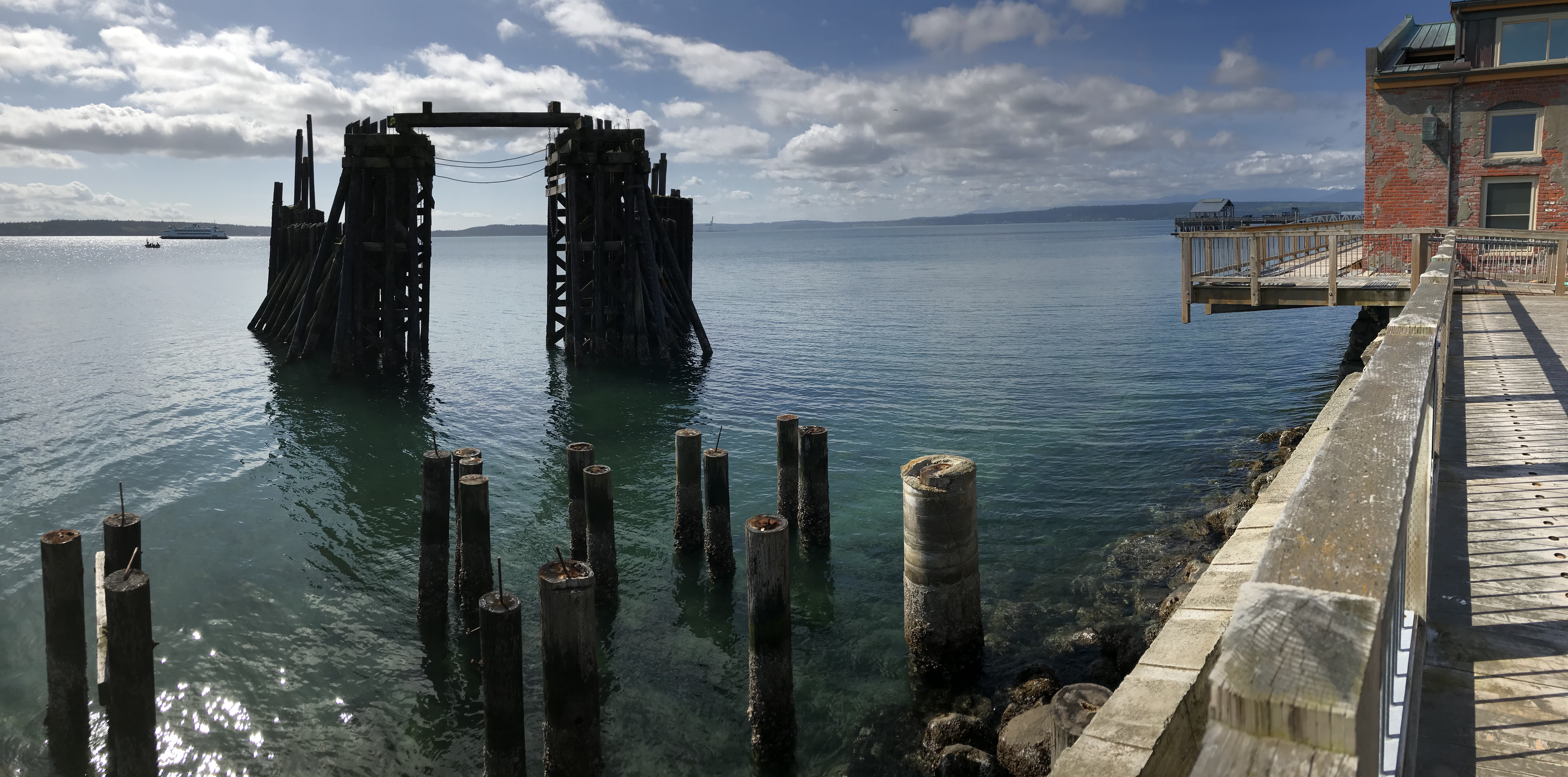
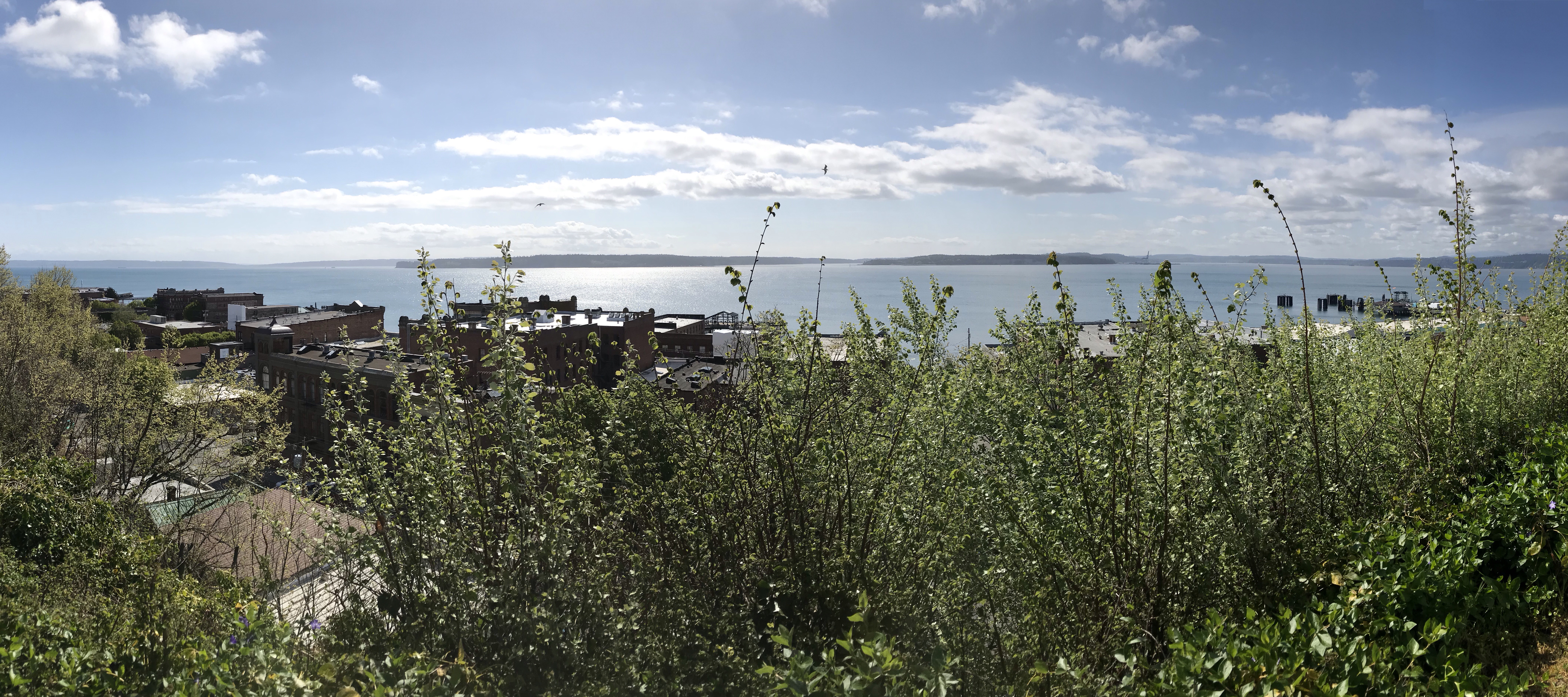
Port Townsend is S’Klallam (or Klallam) land. The town occupies the northeast corner of the Olympic Peninsula, where the Straight of Juan de Fuca meets Puget Sound. The tides, as well as every bird, fish, or orca traveling into or out of Puget Sound, has to pass Port Townsend. The land looks and feels a bit like coastal Alaska, swathed in Sitka spruce and other evergreens, with the jagged purple and white peaks of the Olympics and Cascades showcased between tall firs at every view. But it’s also a part of the Lower 48, a place where the wild meets the urban, where north meets south, where fireweed and California poppies overlap.
The S’Klallam (which means “strong people”) lived here and they still do. They never saw a white man until 1787, when a stream of British, American, and Spanish fur traders began arriving in vessels thru the Straight of Juan de Fuca.
Five years before they ever saw a white man, in 1782, S’Klallam and all the indigenous peoples from Mexico to Alaska saw up to a third of their people die in a smallpox epidemic. The epidemic originated in Boston in 1775.
The Europeans advanced slowly at first. Hudson’s
Bay Company operated in the area, and the S’Klallam traded furs at Fort Langley
(near Vancouver, BC) (established 1827), Fort Nisqually (1833), and Fort
Victoria (1843).
In 1842, mass migration along the Oregon
Trail began. American settlers began to increase exponentially. All of
Washington west of the Columbia River was disputed territory between Britain
and the US until 1846, when the US/Canada border was finalized.
In 1850, the Donation Land Claim Act offered parcels of Native land to white Americans, a kind of affirmative action socialist program for whites only. White immigration surged and the first homesteads were established at Port Townsend the following year. It was the first permanent European settlement on the Olympic Peninsula. The number of white settlers in Puget Sound swelled to 4,000. Two years later, the US created Washington Territory.
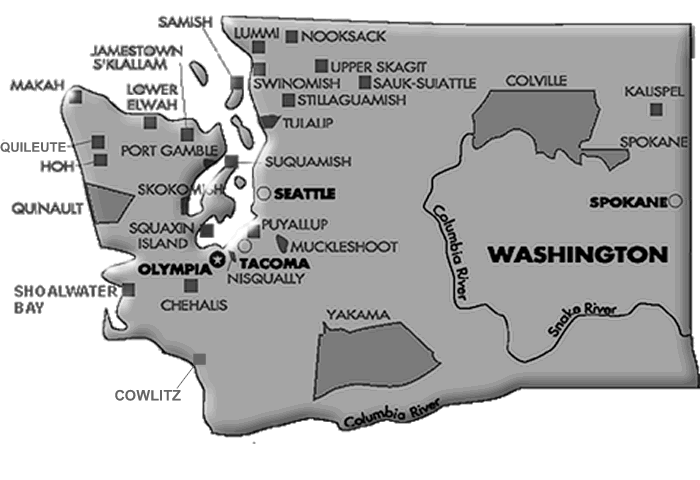
By 1855, the Natives of Washington were outnumbered and under pressure to sign away their land. On January 26, at Point No Point, the S’Klallam signed away 438,000 acres in exchange for less than 4,000 acres near Port Gamble. The deal included $60,000 to be spread out in annuities. The Chemakum and Skokomish were also part of the Treaty of Point No Point.
During the treaty negotiations, most leaders refused to sign. Chief Chetzemoka (číčməhán), a S’Klallam leader from qatáy (Port Townsend), convinced the other leaders to sign. The promise of fishing and hunting rights at “usual and accustomed” places was the centerpiece of his argument.
For those who moved to Port Gamble, life was difficult for the next hundred years. They were denied most of their treaty rights and even forced to move again. The annuities were slow to arrive, and the fishing rights were denied them until pretty much the 1980s, after the Boldt Decision.
Reservations in Washington today.
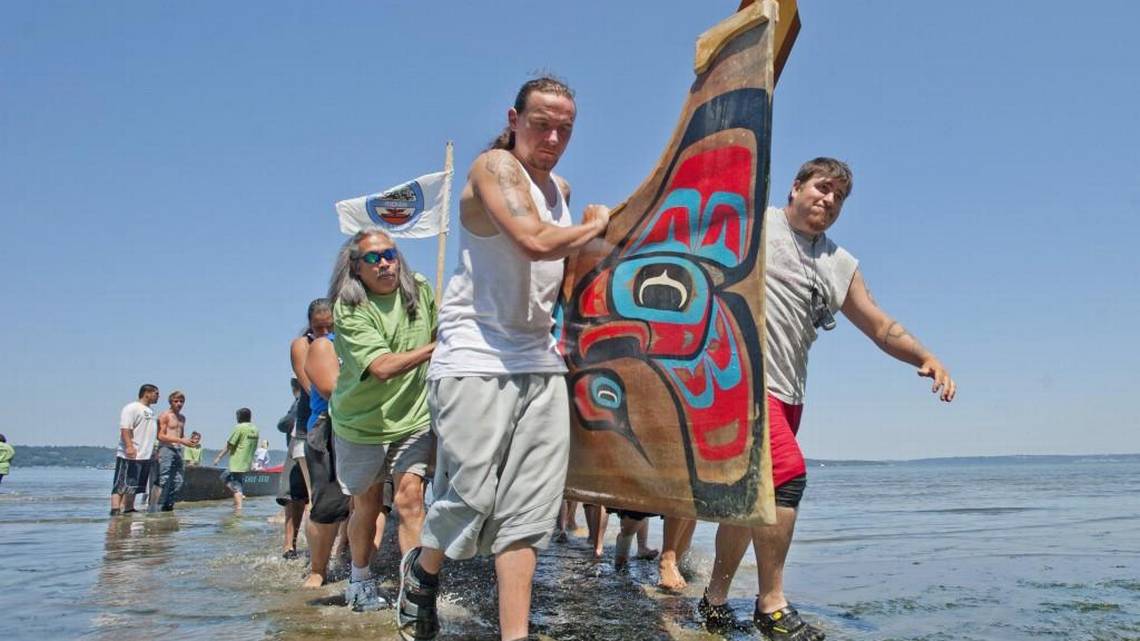
All the while, the S’Klallam persisted. In 1874, a contingent from Dungeness, who had never removed to Port Gamble, pooled their savings and bought land at the base of Sequim Bay, now called Jamestown. Because they did this on their own, outside of a treaty, this group was not federally-recognized until 1981, after decades of battles in court. Another group near the Elwha River Delta gained official recognition in 1968. The damming of the Elwha River in 1913 was devastating to them, destroying the salmon run and submerging their sacred “creation site”. The removal of the Elwha Dam in 2011 was a landmark event in the tribe’s history.
Today, the S’Klallam are split into four
parts: three in the US, each federally recognized as a separate entity, and one
in Canada.
Scia’new First Nation (or Becher Bay Indian Band), near Victoria, BC, includes some S’Klallam as well as members from at least three other ethnic groups.
Today the S’Klallam tribes all self-govern, providing a variety of social and cultural services for their citizens, as well as the Jamestown Family Health Clinic in Sequim, which provides healthcare for both tribal members and the general public. They also engage in habitat restoration and manage fisheries jointly with the state of Washington.
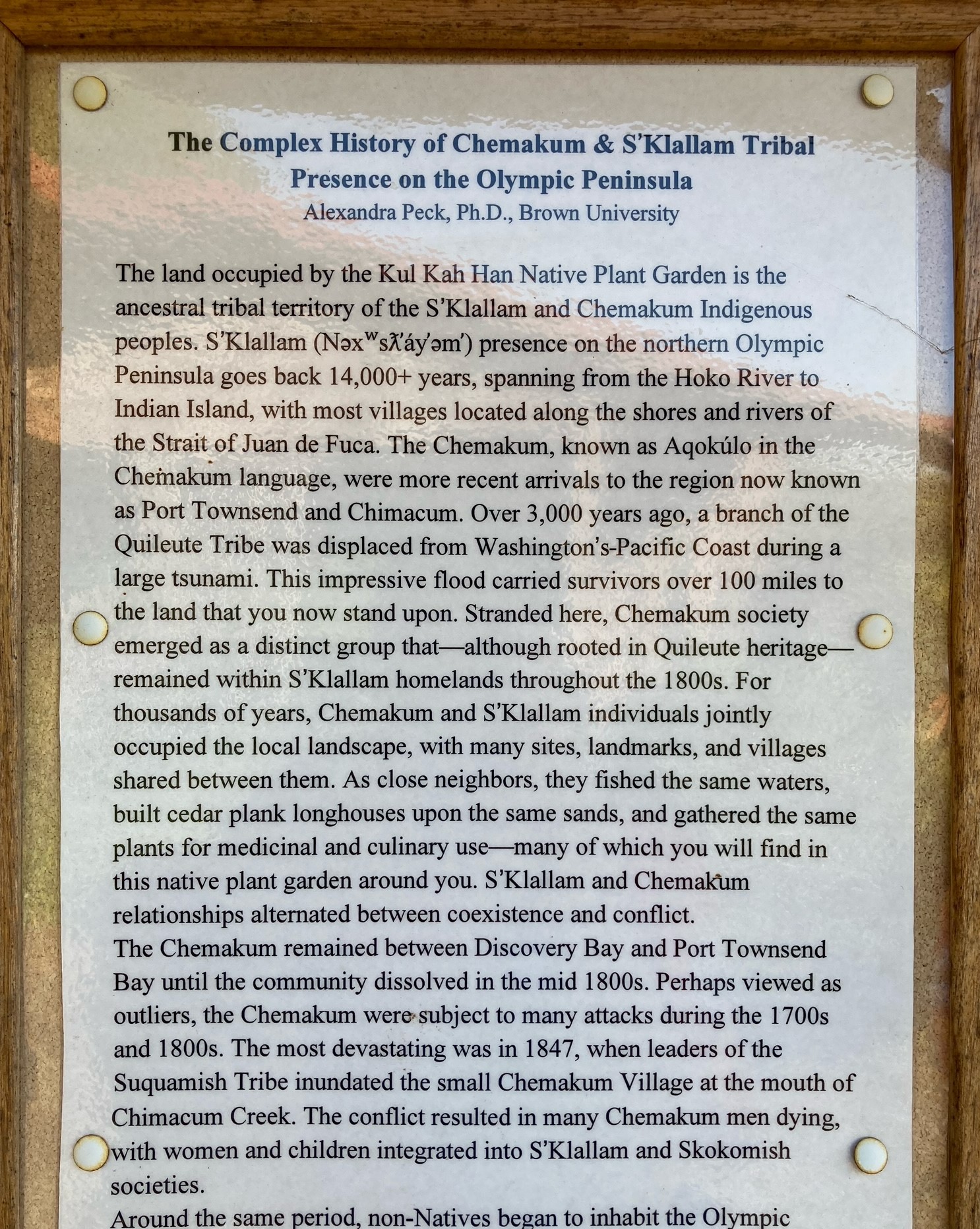
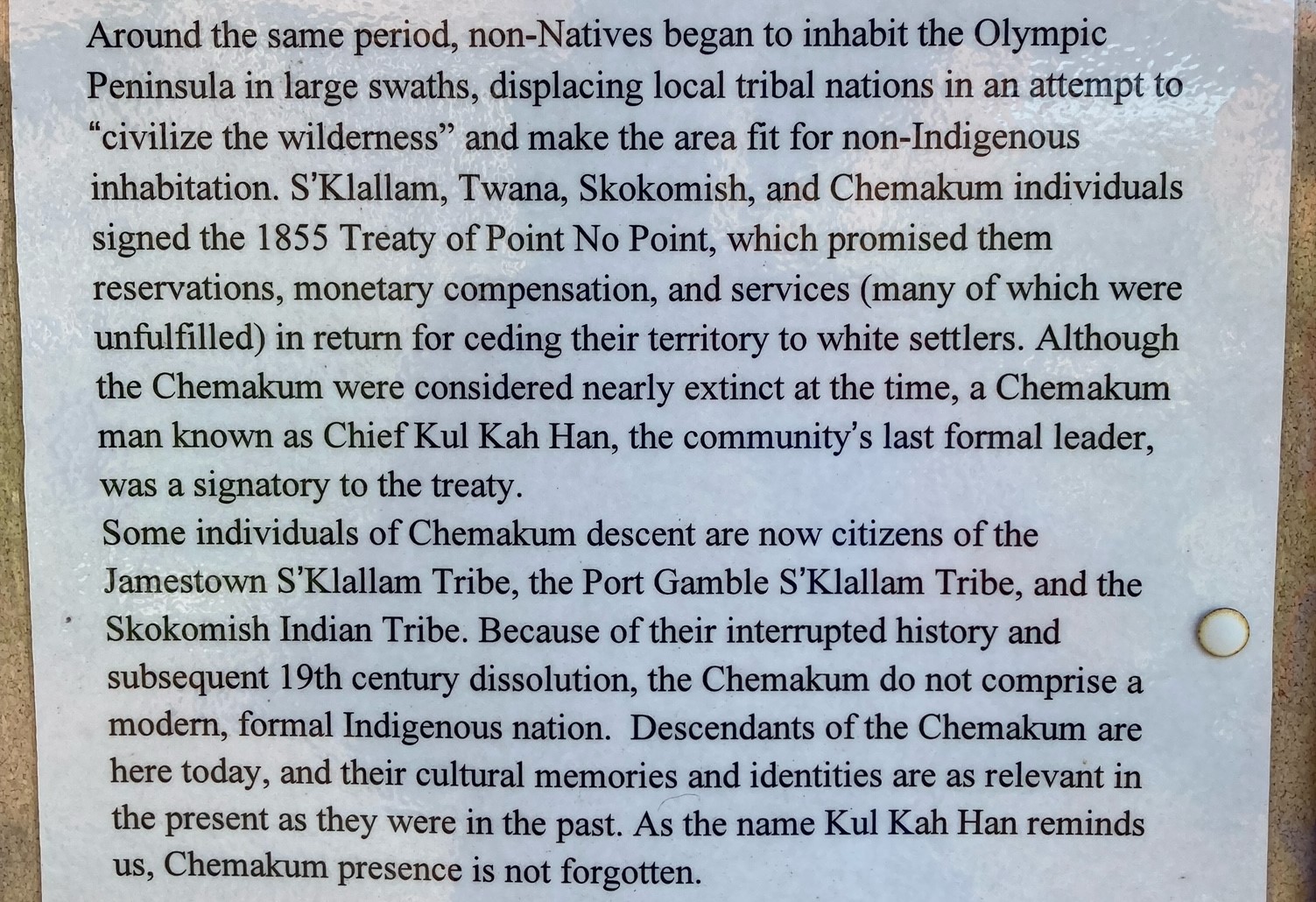
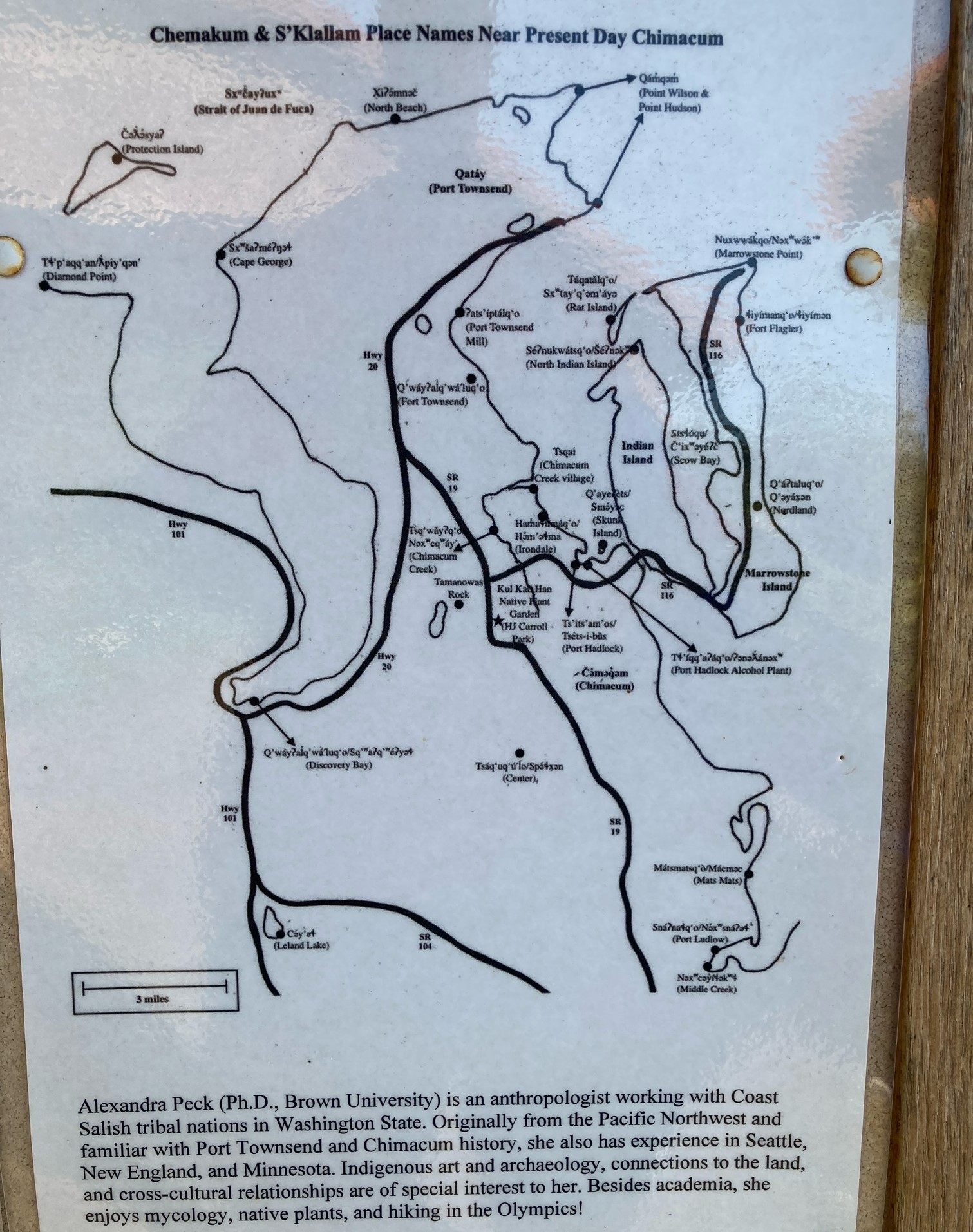
The area was also used by a number of other Coast Salish people, most notably the Chemakum, relatives of the Quileute on the outer coast. Here I post, in three separate photos, a sign from HJ Carroll Park in Chimacum, which provides some of their history. Click on each to enlarge.
For a reverse land acknowledgment of Port Townsend, examining who and what is currently honored, who Townsend was, and Rainier, and Wilson and others, see this post.
Capitalism exists. For as long as there have been two neighbors willing to trade fish for bread, furs for leather, or obsidian for feathers, there has been capitalism. For as long as there has been money and people looking for the cheapest pair of shoes, there has been capitalism. It happens everywhere: in prisons, using cigarettes as the monetary unit; in strict communist countries, where black markets spring up; in school yards, where kids trade items from their lunch boxes. Capitalism is like air; it is and it will always happen.
But
is it a good thing? Does it work? That depends. When economists and politicians
say “the free market works”, they are presumably assuming it is a
well-functioning free market. In economic theory, this assumes that there is
“perfect competition” and “perfect information”. No business is getting a
subsidy or facing tariffs that aren’t common to all. Every business has access
to the same labor market, other inputs, and access to credit so they can borrow
money to invest in new equipment. There are no monopolies. All consumers know
exactly what they are paying for. There is no deceit and the playing field is
level. That is a well-functioning free market. That almost never exists.
It
almost never exists for a number of reasons. First, political power is used to
intervene, often to benefit specific business interests in order to protect
them from competition. Developing countries are restricted in how much sugar
they can export to the US in order to protect a few influential families in
Louisiana and Florida. US cotton farmers receive large subsidies, enabling them
to out-compete cotton farmers in Africa. National borders restrict the flow of
labor, resulting in drastically different wages from one country to the next.
These are all deliberate manipulations to avoid perfect competition.
There
is a second reason why perfect markets rarely exist. Rather than government
manipulation of markets, the second reason stems from a lack of government
regulations to keep the market functioning as it’s supposed to. For example,
without rules, a company might attempt to save on costs by watering down their
drinks, or using tap water but saying it is spring water, or other forms of
deliberate deception. In the extreme, they could engage in labor abuse, such as
child labor or slavery. If one company gains an advantage (perhaps thru
nefarious means) they could use their power to drive out the competition,
perhaps by temporarily selling at a loss. Left to its own devices, capitalism
will destroy itself. Without rules and regulations that ensure fair play,
abuses will occur and monopolies will arise. A competitive market will cease to
exist. This is the inevitable end of laissez-faire capitalism; capitalism
without rules.
The most recent example was the near-collapse of the world’s financial markets stemming from selling of sub-prime loans to US home-buyers. Here, the core assumption of “perfect information” was violated. Many of the home-buyers did not understand the terms of the loans. These loans were then packaged and re-sold to investment banks, but the true contents were deceptively hidden. From the home-buyers to the banks, no one understood what they purchased and could not evaluate the risk. The banks’ exploitation of poor home-buyers trickled up, spreading defaults from Main Street to Wall Street. Government regulations that required full disclosure, or appropriate insurance, or forbade adjustable-rate mortgages for low-income home-buyers, could have prevented the problem. The problem was not the free market; it was a poorly functioning market that violated key economic principles.
Like a river with no banks, capitalism without regulations disintegrates into exploitation and monopolies. It kills itself.
Capitalism
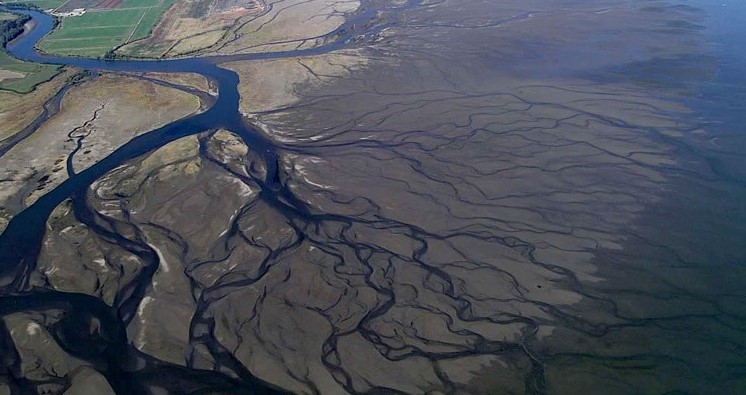
is like a river that functions when it is flowing within its riverbed. Imagine
a river that comes out of the mountains and flows across a flat low country to
the sea. As a company looks for profits and a consumer looks for good deals,
the river follows one rule: it flows downhill. As it leaves the mountains, it
carries with it sediment, little bits of dirt suspended in the turbulent water.
As the river comes into the lowlands, the water slows. The sediment sinks to
the bottom. In this way, the riverbed slowly builds up. Left to its own devices,
the bottom of the river will eventually build up enough that the river
overflows a bank and takes a different route. It will split and braid, jumping
banks and switching courses, fanning out into a delta, essentially destroying
itself as a single river channel. This has important ecological and geological
functions, but for our metaphor, the river has destroyed itself. As Bruce
Springsteen says, “Like a river that don’t know where it’s flowing, it
takes a wrong turn and it just keeps going.”
Capitalism
is like this river. It needs good government regulations like levees to contain
it and keep it on course—to prevent deceit, exploitation, and monopolies.
It is curious to note that many of those who call for capitalism are actually calling for an end to some of these good regulations that keep the market fair. Perhaps they are benefiting from a meandering side-stream; they want to manipulate the rules so they can manipulate the market. On the other side, many who criticize capitalism are actually asking for the level playing field that should be provided by a well-functioning market with perfect competition and perfect information. While people may toss out labels like “capitalism” and “socialism”, most political debates are over the levees and how high they should be.
Back
to my original questions: is capitalism a good thing and does it work? As
described above, it only works with government regulations to keep the market
functioning with fair competition for all business and accurate information for
all consumers. With that, it will work as a way to enable people to buy and
sell.
There
are some things, however, that capitalism is not designed to do and cannot be
expected to do. It generally does a poor job at providing “public goods”,
things like street lights, education, police and fire departments, sewage
treatment, and the like. For more complicated reasons, it will not provide
flood insurance or health care for many people. It does not protect the
“commons”, free-access resources like fish in the ocean, from unsustainable use
and exploitation. It does not prevent negative environmental externalities like
pollution or global warming from economic activities. And it does not concern
itself with distribution of wealth or social support systems. For all of these
things, one needs government intervention to make rules or alter incentives.
This may sound like a lot of restrictions, which some will call
“socialism”, but there is still plenty of room for capitalism to
thrive within these confines.
Reparations for on-going injustices against Native and African Americans are entirely feasible. Historic government programs for white people serve as a model.
The giant Monopoly game
Imagine the US economy thru history as a giant Monopoly game. In the beginning, Native Americans owned every parcel on the board. Several hundred years ago development was minimal, but most ethnic groups, from the Pueblo of the Southwest to the Iroquois in the Northeast, had permanent settlements and agriculture. In Monopoly terms, the game was young; perhaps a single house on most properties.
Acoma Pueblo, New Mexico, the oldest continuously inhabited community in the United States.
The Europeans arrived slowly. By 1600, over a hundred years after Columbus’s first voyage, the Spaniards had only toeholds in New Mexico and Florida. In 1607, Powhatan granted a small parcel of land to English colonists to build Jamestown as a vassal town. In 1619, an epidemic wiped out most of the inhabitants of Patuxet. The Pilgrims occupied the abandoned town, moved the unburied skeletons out of the way, and re-named it Plymouth. All told, the European settlers had the equivalent of Mediterranean and Baltic Avenues, the two cheap properties just after passing Go.
While Native Americans once had the entire board, today’s reservations are analogous to these cheap properties along the first row of the Monopoly board.
After that, European immigration exploded. Every time the whites passed Go, they got a new player—or several. Using force, the threat of force, and overwhelming numbers, they quickly bought up most of the Monopoly board. I say “bought” because there is a paper trail, a treaty, for almost every square inch of land in the US, where Natives, albeit under duress and often trickery, ceded their land. In return, they got to keep a small parcel, today’s reservations. Some Native groups also got some treaty rights, which they continue to fight for in court to this day. In Monopoly terms, Native Americans were left with that strip of cheap light blue properties along the first row: Oriental, Vermont, and Connecticut Avenues.
The game went on and here we are in 2019. The whites, using slave labor from Africa, developed most of the properties, making it prohibitively expensive for Native Americans or African Americans (post-slavery) to move around the board. It’s hard to join a Monopoly game after it’s underway and all the properties are owned. They became one of those players only safe on their own property (if they had one) or in jail.
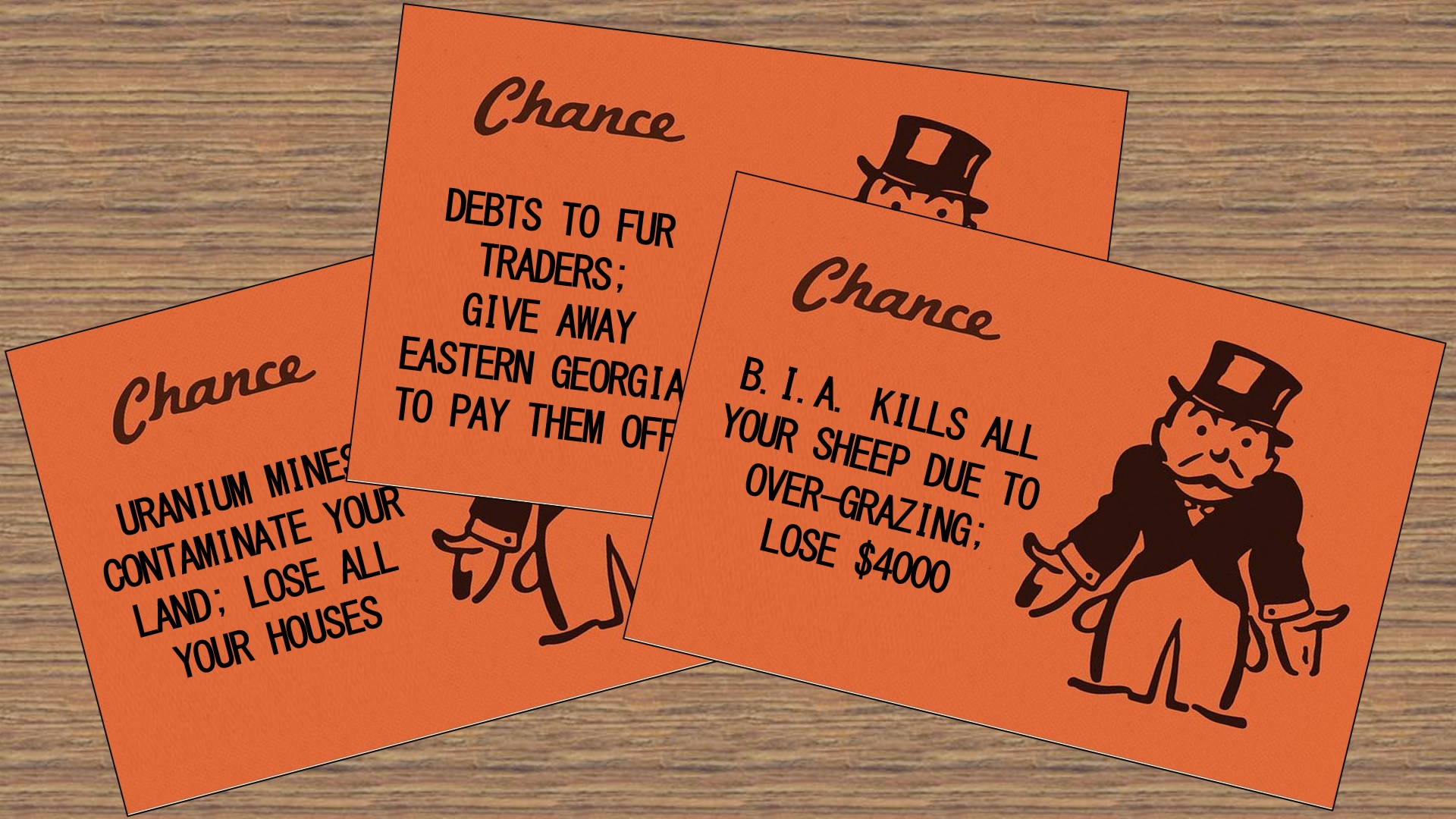
While Chance and Community Chest were sometimes a gold mine for whites (literally), they never went well for Native Americans. In the early 1800s, they gave up much of the eastern United States to pay off debts to white fur traders. They were ethnically cleansed via various “trails of tears” from many areas east of the Mississippi. This pattern replicated itself in the West in the late 1800s, and was followed by the massive deportation of children to boarding schools and high rates of forced sterilization and child removal through the 1970s. Major court battles over child removal continue today.
Where we are today
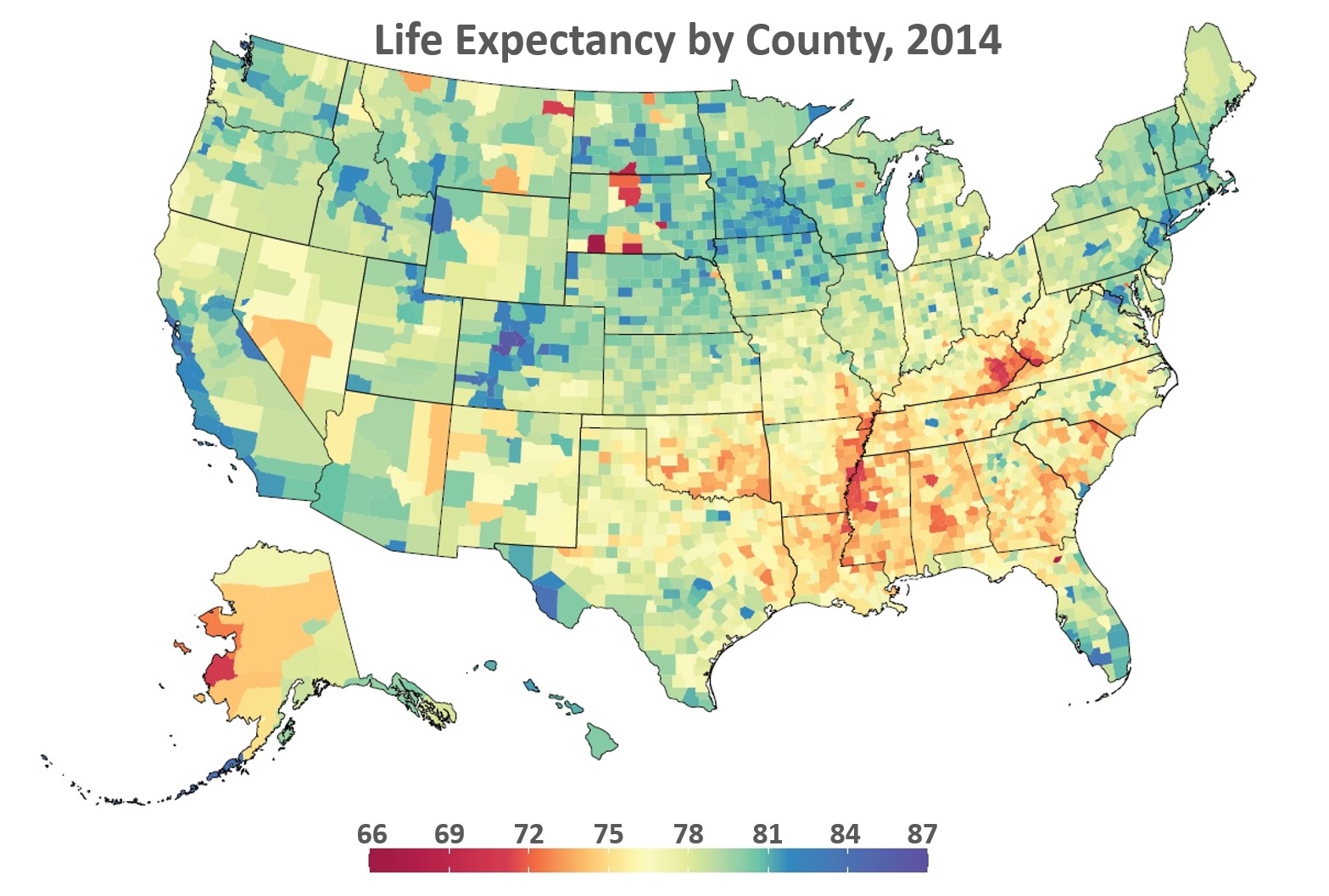
Today the inequalities created by joining the game late remain. There are massive differences in education, health, wealth, and a wide variety of socio-economic indicators. Only 19% of Native Americans attend college, compared to 42% for whites. High schools in solid Native or Black areas often don’t offer a single AP class. Native American reservations, particularly those in the Dakotas and Montana, have the lowest life expectancies of anywhere in the US, a full 20 years less than the highest places. In 2007, life expectancy for males at Pine Ridge was 48, less than that of Haiti and among the lowest in the world. The average African American household has a net worth (made up mostly of the value of your home and vehicles) of $17,600, compared to $171,000 for white households. The gap is widening. Graduating college raises Black wealth to an average of $68,000; it raises white wealth to almost $400,000. One can search on-line for “ethnicity” and anything from suicide to diabetes to unemployment to the odds of getting shot by the police and find wide racial disparities.
The Native reservations in the northern Plains, Southwest, and even Wisconsin stand out here. Also evident are the African American regions in the South, as well as the recent impacts of the opioid epidemic in Appalachia. This report in the Journal of the American Medical Association (JAMA) stated that “inequalities in life expectancy are large and increasing.”
Affirmative action for whites
I’ve left some things out. Early in this giant Monopoly game the European settlers changed the rules. They got loans to buy land when they didn’t have enough money. They got their debts forgiven. They got land given to them for dirt cheap, even when they tried to steal it—especially when they tried to steal it. They got free college education. For them, it was like playing Monopoly when your grandpa is the banker and he’s doing all he can to help you win.
Here are some examples.
The Naturalization Act of 1790 specified that only “free white persons” could become US citizens. This philosophy continued, with few exceptions, until 1965. In many states, non-whites could not own land until 1952. Today, a preference for white immigrants has been resurrected by the writings of Ann Coulter and the policies of Donald Trump, who oppose immigrants from “hellhole” (Coulter) or “shithole” (Trump) countries.
The Preemption Acts of 1830 and 1841 gave illegal squatters (white “pioneers”) the right to buy public land “to which the Indian title had been… extinguished” if they simply lived on it. Up to 160 acres, for $1.25/acre. Basically, so many whites were breaking the law that the government decided to let them keep the land they were stealing. This led to a flood of pioneers west across the Mississippi River, staking claims to Native land in Montana, the Dakotas, Wyoming, Colorado, Nebraska, and Kansas. The Act specified that you didn’t even have to be a US citizen; you only had to be white. This led to calls for “opening the land” and “manifest destiny”, euphemisms for ethnic cleansing. If the Natives stole a few pioneer horses, the US Army would wipe out a village. As Natives were forced to relinquish title, the nation’s Monopoly board shifted from predominately Native to mostly white ownership. Today, Ted Bundy and his followers claim “preemption rights”.
The Homestead Act of 1862 (and several later revisions of it) gave away over 270 million acres of public land taken from Native Americans. Nearly all of that went to white settlers. This amounted to about 14% of the Lower 48. Limited efforts were made to extend the program to freed slaves in the South. Compared to Spanish Latin America, where vast haciendas were granted to a few powerful families, the Homestead Act was remarkably progressive and egalitarian, divvying up the land to 1.6 million white families. Each family received 160 to 640 acres, essentially creating the white middle class. In Monopoly terms, properties were passed out to the white players for free.
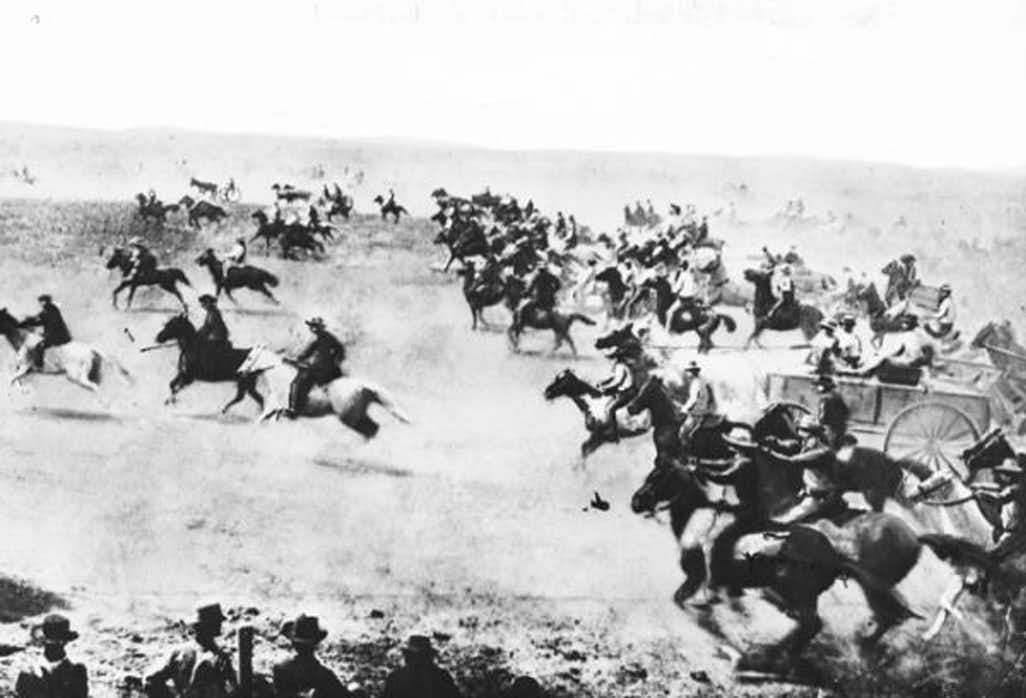
At the sound of a cannon at noon on April 22, 1889, a large section of Oklahoma was opened to white settlers. Fifty thousand of them raced to stake claims on land recently freed of Native title. Most of the Natives, already removed once and sent to Oklahoma, watched in dismay as white pioneers occupied their land and stole their horses and cattle.
The Mining Law of 1872 allowed prospectors, nearly all white, to stake a claim to mineral rights on public land at a cost of $5/acre (a price which remains unchanged today). This led white gold miners to demand that the US take back the Black Hills, already defined by the Treaty of 1868 as part of the Great Sioux Nation. More on this below.
The National Housing Act of 1935 created the Federal Housing Administration, which made home mortgages available to millions of white families. Black and others were excluded via redlining, as were Native Americans on reservations. This, more than any other measures, led to the massive racial discrepancy in wealth today. Between 1865 and 1990, African Americans’ share of national wealth grew from 0.5% to 1.0%.
The National Labor Relations Act of 1935 granted unions the power of collective bargaining, a watershed moment in labor relations that gave white workers power and leverage. The Act, however, allowed unions to exclude people of color, denying them access to better jobs and union protections.
After World War II, the GI Bill provided college tuition, living expenses, low-cost mortgages and low-interest business loans to nearly ten million white veterans. These benefits were largely denied to Blacks. Native Americans on reservations were denied home loans. Navajo code-talkers still did not have the right to vote. (Acknowledgment: My father, a Cherokee Nation citizen who looked white and graduated high school, did go to college on the GI Bill. This largely explains my socio-economic status today.)
Most of the racial discrimination in these laws or in the implementation of these programs were challenged in court, and most were upheld by the US Supreme Court. These laws, some of them considered the bedrock of US history, illustrate that the nation was built on the premise of white supremacy—the notion that the nation was primarily created by and for white people. The rest were either second class citizens, support staff, slaves, or not wanted at all. This was not only white privilege, it was welfare, socialism, and affirmative action for whites only. These programs form the basis of white middle class wealth to this day.
For nearly 200 years, the Supreme Court said affirmative action for whites was okay. Now they say it’s not okay for anyone else; now it’s time to put racism behind us and be “color blind”. Conservatives use slogans such as “all lives matter” and the “the only race is the human race” to sweep cries for justice under the rug. Now that whites have helped themselves to nearly all the properties on the Monopoly board, the Supreme Court looks at people of color and says shut up and roll the dice; we’re playing fair now.
Ideas for reparations today
Unwinding a Monopoly game already well underway, regardless of the injustices and ill-gotten gains, is a very difficult task. Its only analogies in history are a few dramatic – and violent—revolutions: France 1792, Mexico 1917, Russia 1917, and China 1949. Only these effectively cleared the game board and started over; only these completely re-ordered society. The end of apartheid in South Africa in 1994 offers an intriguing model of restorative justice thru its Truth and Reconciliation Commission process, although the peaceful revolution fell short with regard to meaningful economic change.
Another interesting model is the Year of Jubilee, prescribed in the Old Testament for the Israelites and announced by Jesus (“the Year of the Lord’s Favor”) at the start of his ministry (Luke 4:18-19). It was supposed be implemented every 50 years: massive land reform where all properties reverted back to their previous owners, the release of all slaves, and forgiveness of all debts. It was a remarkably progressive economic policy, designed 2,400 years before Karl Marx, but there is no evidence it was ever implemented.
More practical and feasible, however, is looking to the US’s own history for ideas for reparations. The programs described above, the various forms of affirmative action for white settlers, provide a recipe of policies that could be used today to restore Blacks and Native Americans to the great game, to be fully functioning members of the economy, with equal access to its opportunities. That is what reparations are about.
Using the examples above, here are some modern equivalents.
The Homestead Act = Land Restoration
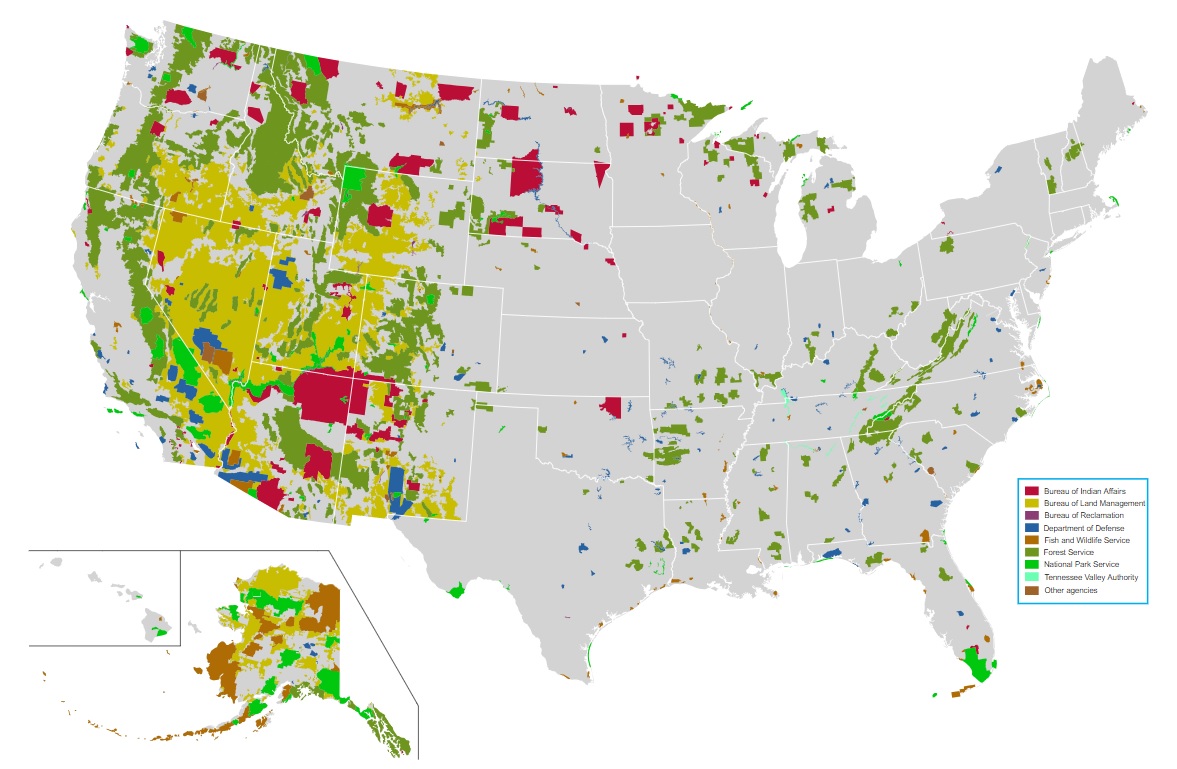
It is difficult to take land away from someone and give it to another. However, over a quarter of the United States is still in federal government hands. It was all taken from Native Americans at one point, and a lot of it was never given to white settlers. A case in point are the Black Hills. In 1980, the Supreme Court ruled it rightfully belonged to the Sioux. Since 10% of the world’s gold came from the Homestake Gold Mine created there in the aftermath of the land theft, the Sioux could arguably make a much larger claim. Most of the Black Hills are a federally-owned national forest, which could easily be turned over to them. They would also be owed, at a minimum, Thunder Basin National Grassland, where buffalo could be restored. In fact, buffalo could and should be restored to a number of Native-managed lands.
Many other lands illegally taken, such as the Powder River country or parts of the last Cherokee “cession”, are privately-held but sparsely populated today, perhaps even less populated than three hundred years ago. They could be bought back and returned to the appropriate tribal governments.
FEDERAL LANDS Nearly 27% of the United States, including 21% of the Lower 48 and 46% of the West, is in federal government hands. While this includes national parks (bright green), military bases (blue), and even Native reservations (red) held in trust by the Bureau of Indian Affairs, the vast majority of federal lands, 88%, is split nearly evenly between the US Forest Service (olive green) and the Bureau of Land Management (yellow).
The GI Bill = Education Equality
Education is supposed to be the “great equalizer”. America is supposed to be great because anyone, even the poor kid, can go to school, work hard, and become president someday. But the odds are against them. Across the nation, education funding and outcomes are closely correlated with the socio-economic status of the local school district. The inequalities are so glaring that they drive property values. Every class, every program, every extracurricular opportunity available to a rich kid should be available to a poor kid.
Social Security = Health Care
While access to the Indian Health Service is a treaty right, it has been a disgrace. Native health indicators lag far behind those for whites. Moreover, the Indian Health Service has been responsible for systematic involuntary sterilization of Native women as recently as the 1970s. Full access to health care, including access to services on remote reservations, is required. If Paul Farmer can bring First World health care to rural Haiti, the US can bring it to Pine Ridge and Navajo Nation.
The Mining Law = Small Business Grants and Loans
Today’s Indian reservations are yesterday’s concentration camps, most of them remote and disconnected from the rest of the economy. They need an infusion of funds and support to jump start economic activity and create jobs. Grants and low-interest loans are required. The same is true for predominately African-American neighborhoods, many of which evolved as a result of redlining by the Federal Housing Administration.
Reparations and healing
To date, the only reparations ever paid by the US government was for $300 per slave, but this was to the slaveholders, to compensate them for their losses. A plan to divide up Southern plantations and give each freed slave 40 acres and a mule never came to fruition. It is too late for past generations, but current generations continue to suffer.
Reparations are about recognizing current inequalities that are linked to past injustices and addressing them. They are about leveling the playing field in the present and repairing a relationship. They also serve as a major step, symbolic and/or practical, in bridging a divide and healing a broken relationship.
As described above, reparations thru programs and policies, rather than cash distributions to individuals, offer a chance for the nation to clean house, to address many of society’s problems, and simultaneously acknowledge and address its racist past.
In recent days, Donald Trump has
threatened domestic violence against “the left”. In an interview with
Breitbart, he said, “I can tell you I have the support of the police, the
support of the military, the support of the Bikers for Trump – I have the tough
people, but they don’t play it tough — until they go to a certain point, and
then it would be very bad, very bad.”
Iowa Republican Senator Steve King posted a
Facebook meme that said, “Folks keep talking about another civil war. One side has about
8 trillion bullets, while the other side doesn’t know which bathroom to use.”
King added a winking emoji and the line, “Wonder who would win….” Congress
recently stripped him of committee assignments over his statements on white
supremacy.
These statements come on the heels of the New
Zealand mosque massacre, the Pittsburg synagogue massacre, and the Charleston
church massacre, targeting Muslims, Jews, and African Americans respectively.
It would seem that any surge in violence as described by Trump and King will
follow this pattern: attack soft targets. This means people of color or other
marginalized groups, in their churches, schools, and social meeting places.
It’s a strategy that targets people where they live, kills non-combatants (the
definition of “terrorism”), and minimizes the risk to the attacker.
Native Americans are familiar with this. Most of
the famous “battles” associated with the ethnic cleansing of Native
Americans were attacks by white Euro-Americans on peaceful villages, targeting
women and children and male leaders who had just previously declared their
peaceful status and cooperation with the whites.
Per instructions from the US Army, Black Kettle was flying an American flag and a white flag of surrender when he was attacked. This image comes from modern remembrance of the victims near the massacre site. Most of the Sand Creek site is now a privately-owned ranch.
One of the most well-known examples of this is Sand
Creek, 1864, where Colonel John Chivington, a
Methodist pastor, led a group of Colorado volunteers against the Cheyenne and
Arapaho camps of Black Kettle, White Antelope, and Left Hand. Under orders of
the US government, those Native bands had just reported to Fort Lyon and set up
camp. Chivington found them to be much easier targets than the combatant
Cheyenne Dog Soldiers he was supposed to be looking for. More than killing
combatants, Chivington wanted to make a statement for himself, so he attacked the
peaceful villages. He also wanted to target children because, in his words,
“nits make lice.” He and his men killed hundreds of women and
children and then paraded their scalps, testicles, vaginas, breasts, and fetuses
on the streets of Denver to cheering crowds. One man, Captain Silas Soule,
refused to participate. He later gave testimony against Chivington and was then
gunned down on those same Denver streets.
But the massacre of innocents at Sand Creek was
not an isolated incident; it was the norm.
It applies to many, if not most, of the so-called
“battles” of the “Indian Wars”. Here’s a few more:
Washita
River Massacre, 1868. Liutenent Colonel George Custer, using General
Sheridan’s “winter campaign” strategy to attack villages of mostly
women and children hunkered down for the winter in deep snow, attacked Black
Kettle’s band of Southern Cheyenne (the same group from Sand Creek). Black
Kettle was seeking peace and had just returned the previous day from Fort Cobb,
where he had said, “We all want peace, and I would be glad to move
all my people down this way; I could then keep them all quietly near camp. My
camp is now on the Washita, forty miles east of the Antelope
Hills, and I have there about one hundred eighty
lodges.” Custer attacked at dawn, killing many women and children, as well
as Black Kettle and his wife. Fifty-three women and children were captured and
used as human shields and hostages.
Marias Massacre, 1870. Seeking to avenge the murder of a white fur trader, Major
Eugene M. Baker and his troops surrounded a band of Piegan families in their
winter camp in deep snow. When informed by scout Joe Kipp that this was a
peaceful group under protection of the US Army, Baker deliberately ignored the
information, threatened to shoot Kipp, and said “That
makes no difference, one band or another of them; they are all Piegans and we
will attack them.” Kipp shouted to warn the Piegan, but the men under Baker
opened fire and killed over two hundred. Only fifteen were men. Fifty were
children under the age of twelve.
Camp
Grant Massacre, 1871. The Tucson Committee for Public Safety, a
local white militia with support from Mexican Americans and a rival tribe,
attacked a peaceful band of Pinal and Aravaipa Apache who were living near a US
Army fort. One hundred forty-four Apache were killed and mutilated, of which
only eight were men. Twenty-nine children were sold into slavery. In response,
President Grant condemned the attacks and brought the perpetrators to trail.
The jury found them not guilty after nineteen minutes of deliberation.
Looking
Glass’s Camp, 1877. While Chief Joseph had resolved to fight
for the Wallowa Valley (which was only included in the demands of the white
settlers because of a poorly drawn map) Looking Glass resigned to move to the
new reservation. But the US Army, under General Howard, decided to be sure and
preemptively arrest Looking Glass. In the process, they opened fire on his
camp, killing an elder, while a woman and child drowned in the Clearwater River
trying to escape. In a result all too common with attacks on peaceful villages,
the rest of Looking Glass’s band abandoned their non-violent strategy and
joined Chief Joseph in the fight for their land.
Wounded
Knee Massacre, 1890. The Sioux had already been confined to
concentration camps (“reservations”) for a dozen years when the Ghost
Dance revival swept through, a religious re-awakening of Native culture. Afraid
of the movement, the US Army called Spotted Elk’s band of 350 back to Pine
Ridge. They were en route returning when they were attacked by the US Army 7th
Cavalry. In the dead of winter, they massacred 300 Lakota, mostly women and
children, buried them in mass graves, and bragged that they had avenged
Custer’s defeat at the Greasy Grass (Little Bighorn) fourteen years earlier.
I’m leaving out the Bear River Massacre of 1863,
as well as countless smaller examples, such as an attack on a small group of
surrendering Lakota near the Black Hills in the 1870s. This kind of thing
happened a lot. The white flag of peace was an easy target. So were women and
children. In nearly all the battles between Natives and the US Army, the
Natives had their families with them. The US Army didn’t and came to consider
this the Natives’ greatest handicap. In addition to “winter campaigns”
where entire villages were holed up in snow, they knew that Natives would
quickly surrender if the risk to their women and children was unacceptable. When
the US Army came upon Chief Joseph’s peaceful band fleeing to Canada, they
surrounded their tipis in the night and gave the order to “aim low”.
If history, both past and recent, is any guide,
the lessons from these experiences are sobering. The road of peace and
surrender is a dangerous one. When race is involved, when the motivation is ethnic
cleansing or genocide, women and children are targets, possibly even more than
men.
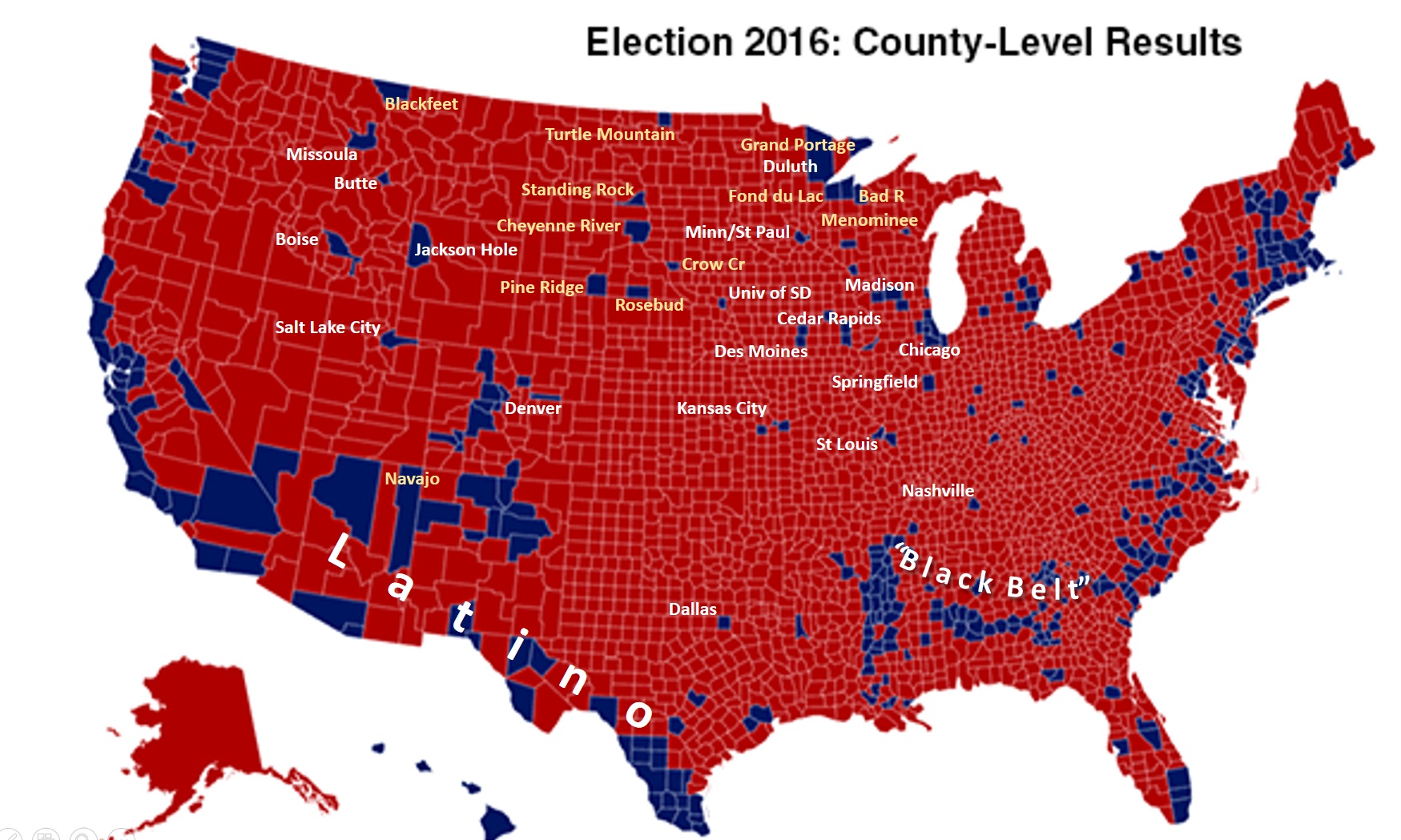
2016 presidential election results by county. While Hilary Clinton won the urban islands, Black, Latino, and Native vote, Trump won the rural areas, vast tracts of formerly-Native land now controlled by angry white supremacists. In this context, the Native reservations appear to be the most isolated and vulnerable of all.
In 1886, when Geronimo went “off the reservation” for the
third time, the US military’s only hope of finding him was to use friendly
Apache scouts. For most of the year, the US military, with 5,000 white soldiers
and dozens of Apache trackers, chased Geronimo’s small band of 38 men, women,
and children through the rugged mountains of Mexico.
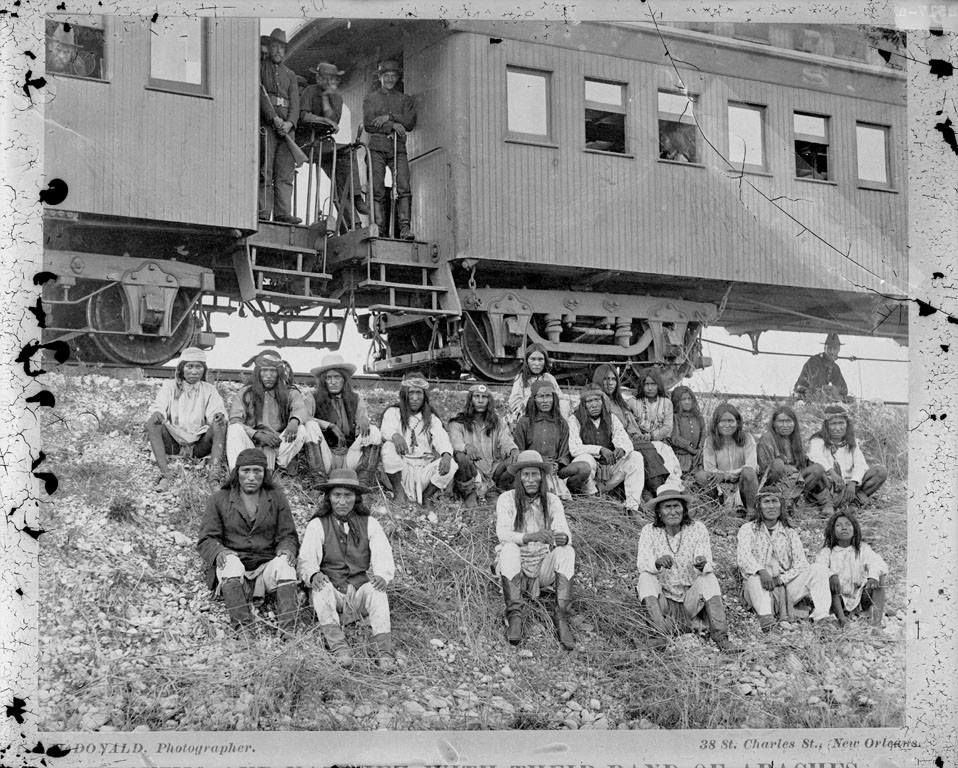
When Geronimo finally surrendered, he and his band were all packed on a train and sent to a prison in Florida. The children were sent to the Carlisle Indian Industrial School in Pennsylvania, where a third of them died of tuberculosis. They were considered future terrorists. As Miles said, “the boys of today will become the Geronimos of a few years hence.” The Apache scouts were rewarded with the same fate— fourteen of them were also shipped off to prison in Florida. Also sent to Florida were hundreds of other Chiricahua Apache that never even left the reservation.
A photo showing most of Geronimo’s band en route to a Fort Marion in Florida. Also sent to prison were the Apache scouts who helped capture him, as well as about 400 other Chiricahua Apache that never even left the reservation.
In 2011, when Osama bin Laden was hiding in similarly remote country, the US military gave him the code name Geronimo, used Apache helicopters, and eventually found and killed him after ten years of searching.
There are deeper parallels. Essential to the US military effort in Afghanistan were —and still are— thousands of Afghan translators, engineers, and other professionals assisting US troops on a daily basis. Like the Apache scouts, most of them face the same risks on the job as American soldiers. Some have been killed in combat or by roadside bombs. More significantly, in a land where the Taliban controls most of the countryside, all their neighbors know who they are working for. They and their families are constantly at risk because they work for the Americans. In this way, they are sacrificing more, and putting more at risk, than US troops.
Recognizing this, in 2008 the US government created the Special Immigrant Visa (SIV) program, offering these Afghan allies the chance to immigrate to the US with a permanent green card and work permit. That may sound like a golden opportunity for them, but they are only escaping their country because they have to. In most cases, they are leaving behind parents and other relatives, with little hope of ever returning. They are only allowed to bring their own children. When they get here, the US doesn’t actually do a whole lot for them. They get a one time stipend of about $900 per family member, most of which quickly goes to first and last months’ rent and a cleaning deposit for an over-crowded apartment. Imagine a family of eight in a small two-bedroom apartment where the a/c and furnace don’t work. I know. I’ve spent the past nine months befriending one such family. They get food stamps for six months, and enrolled in Medicare. They are on their own for transportation and a job and everything else. I was shocked to learn they are also obligated to pay back the US government the cost of their airfare from Afghanistan, which can total over $10,000 for a family. Most significantly, their engineering degrees and professional certifications aren’t valid in the US. So men that supervised the construction of military bases for US troops in Kabul are now driving Uber in Sacramento.
They are the lucky ones. The SIV application process, with
includes extensive background checks because they may be future terrorists, is
so bogged down that there are now over 20,000 waiting to be
processed in Afghanistan. They are in line for just 4,000 visas; only about
half actually get processed in a given year. The wait takes years. Every few
months, Afghan refugee social media channels in the US are filled
with the news of another colleague assassinated on the
streets of Kabul or Ghazni. Since the election of Trump, the number of SIVs
processed has slowed dramatically. In 2016, resettlement organizations in
Sacramento, one of the top destinations for SIV refugees, worked with multiple
new families arriving each week. Last year, new arrivals slowed to less than
one a month.
One-hundred thirty years after the Apache scouts were sent to
prison, helping the US military fight your own people is still a thankless
task. The only “thank you for your service” that Afghans get is to be sent
thousands of miles from their home with little support, just like the Apache
scouts.
I recently found myself staying in San Diego. It was a work trip related to oil spill response– one of the things we gotta do in the modern industrialized world: prepare for oil spills. Keeping with my new year’s resolution, here’s my land acknowledgement.
San Diego Bay may have changed over time, but the sky is probably much the same as always.
This was Kumeyaay country. Still is– only, like most Natives in southern California, they were moved off the expensive shoreline real estate to deserts and mountains inland. That’s still Kumeyaay country; for thousands of years, they occupied the San Diego area from the coast all the way to the Colorado River.
The Spanish arrived in the late 1700s. That’s pretty late by European conquest standards, especially since they had already been in Mexico for 250 years. California was hard to get to. Like an island, it was protected on the inland side by harsh deserts. On the ocean, Spanish vessels coming up from Mexico struggled against northwest headwinds. They finally made it in 1769. But who made it was a lunatic fringe, Father Junipero Serra. He set up a tyrannical mission system that was considered out of control by European visitors, Mexican authorities, and Catholic authorities in Rome. The Mexican authorities shut them down 57 years later.
The missions were devastating to the Natives. I could write books on conditions inside them– and many have. I’ll limit it to this: In 1790 the missionaries reported to Mexico City that there were 13,308 Indians living in the missions. They reported 4,780 had died so far that year. That’s 26%. There were still six more weeks left in the year.
The Mission San Diego de Alcalá was built in 1769. But the Kumeyaay did not accept enslavement easily. Six years later, over six hundred of them sacked the mission, burned it to the ground, and bludgeoned three Spaniards to death, including a priest.
Today the Kumeyaay live on 13 different reservations, as well as off reservations, and are associated with 11 different federally-recognized tribes. There are also five Kumeyaay communities in Baja California.

 The coordinated and deliberate genocide of Native Americans in California, largely during the Gold Rush, is one of the most well-documented genocide in history. The state offered bounties, reimbursed vigilante groups (white death squads), and regulated the enslavement of Native children (where girls sold for twice the price of boys). While there are many books on the topic, largely relying on old newspaper accounts, none are more comprehensive than








 Memories of the People